

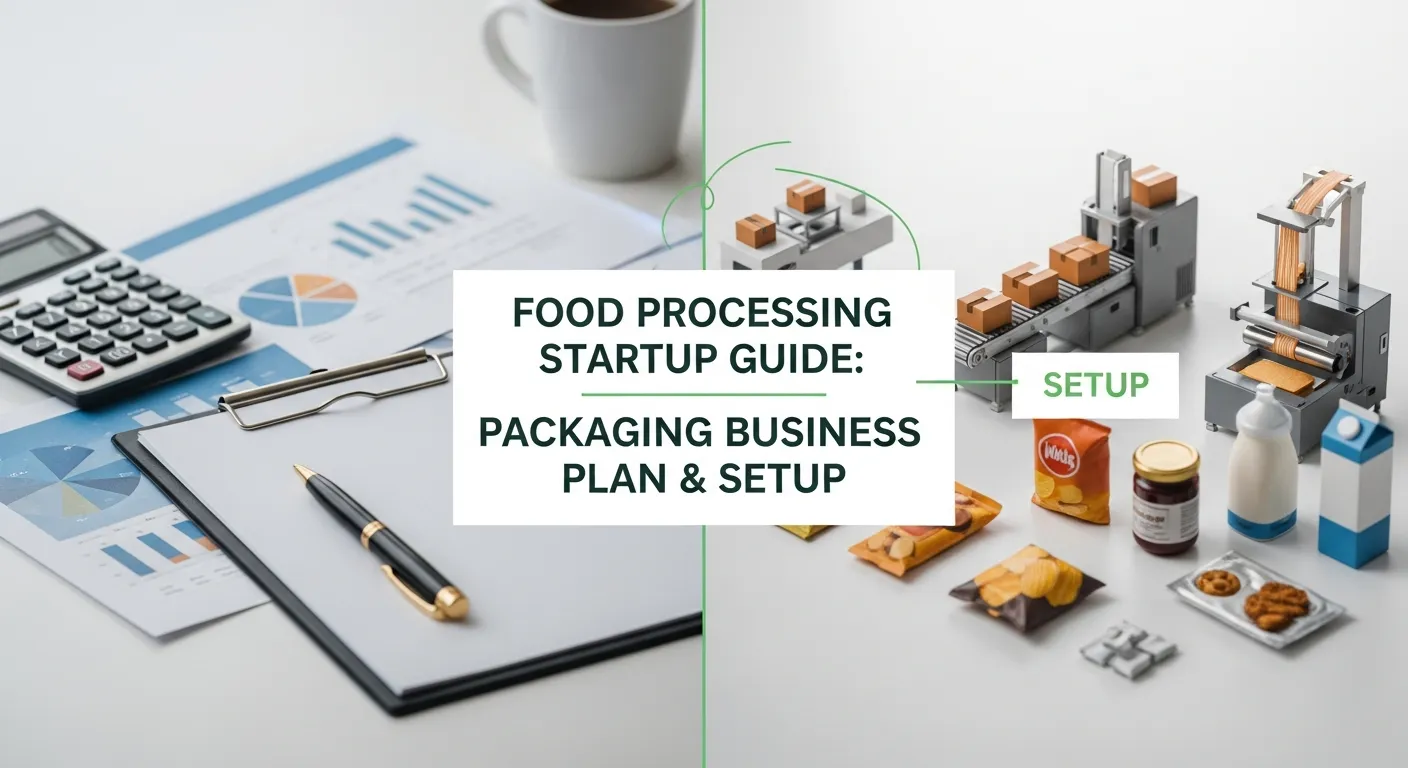
Processing & Packaging Ventures: India harvests an abundant quantity of cereals, pulses, fruits, vegetables, milk and spices annually, yet largely underutilized are large portions of harvest and many regions also lack adequate storage, packaging and processing facilities.
In 2023-24, India exported food products worth 46.43 billion dollars and imported food products worth 31.7 billion dollars. Therefore, Indian can capitalize with extensive food processing within the country.
This creates valuable potential for new business ventures which can take a raw agricultural product and sell it in a value added form. This document aims to provide sufficient information for an entrepreneurial venture to capitalize(Processing & Packaging Ventures).
1. An Agricultural Surplus in India: A Way Forward-Processing & Packaging Ventures
In India, a lot of crops are lost to waste. About 315 million tonnes of cereals and pulses are produced in the country every year. A lot of the pulses are wasted, while India is the largest producer. More than 330 million tonnes of fruits and vegetables are produced every year and after harvest, 20-25% of these perish.
With 230 million tonnes of milk produced, India is the world leader in milk production. As a dominant country in the production of spices, India also exports 4.7 billion dollars worth of spices. Surplus vegetables, particularly, can be converted into powders, fruit pulps, freeze-dried fruits, powders of dairy, protein from pulses, extracts from spices, and more(Processing & Packaging Ventures).
2. Benefits of Exporting Surplus as Processed Products
Everyone benefits from the surplus being turned into processed products. Start-ups are able to make higher profits from selling processed food as opposed to selling unprocessed food. Healthy organic foods from plants are in high demand from customers all over the world. Additionally, there are more employment opportunities created in food diversion as well as in rural areas.
3. Start up Processing and Packaging Ventures that Have Great Potential
3.1 Dehydrated Vegetable Powders
In India, there are surplus on certain vegetables. Start-ups can establish dehydration units at food parks to produce and sell highly demanded powders of onion, garlic, tomato, beetroot, and ginger in the Middle East and Africa(Processing & Packaging Ventures).
3.2 Flours & Protein From Pulses
Despite having a surplus of pulses, India is still bringing in protein isolates. Startups, however, can focus on producing protein from pulses, and on pea protein and pulse-based flours which is in huge demand in the USA and Europe due to the 20-billion-dollar vegan and plant-based diet.
3.3 Freeze-Dried Foods, Juices & Concentrates-Processing & Packaging Ventures
Cold-chain inadequacies lead to the wastage of almost a quarter of the fruits. Startups can transform fruits by pulping, juicing, and freeze-drying them, along with making powders. These are of high demand in global baby food, snacks, and beverages. The PMKSY cold chain schemes provide these ventures with subsidy-based support(Processing & Packaging Ventures).

3.4 Value-Added Dairy Milk Products & Powders
When milk supply is excessive, farmers face the dire consequence of having to lower their prices. Milk can be converted into various products that are in demand in the Middle East, Africa, and the global fitness market, which includes whey protein, milk powder, ghee, and lactose-free milk.
3.5 Spices and Oleoresins
Producing a lot of spices and with the spice extract opportunity being signficant, there can be small spice oil and oleoresin extraction facilities for the food, pharma, and cosmetics industries. With the ODOP schemes, this can be done with spice clusters in Kerala, Gujarat, and Rajasthan.
3.6 Packaged Foods and Ready-to-Eat Meals
There are Indian ready food products that are in demand, as Startups can make frozen meals, packaged curries, or retort pouches. This has demand in the USA, Europe, and with NRIs. PLISFPI is able to support companies that produce ready to eat meals.
Read Our Book: Click Here
4. Import–Export Gaps That Show Startup Opportunities
There is a $15 billion trade deficit on edible oils(Processing & Packaging Ventures).
That on cacao products, there is a $513 million trade deficit meaning there is engagement opportunities on cacao processing and chocolate making.\\
There is a $1.5 billion trade deficit on alcoholic beverages and vinegar, thus, there is opportunity in using waste fruits to make craft vinegar and fruit wines.
5. Government Support Schemes-Processing & Packaging Ventures
PMKSY: This includes food parks, cold chains, and processing units.
PMFME: Within the framework of the One District One Product approach, the initiative offers a 35% subsidy for micro food processing units.
PLISFPI: The initiative offers benefits to businesses for higher sales of processed food.
Nivesh Bandhu Portal: The portal provides data on clusters of raw materials, prospective investments and market data.
6. MSME Success Stories to Learn From
With a global reputation, Daawat rice had branched out to other rice brands and rice traders, before shifting to branding and marketing. The Everest and MDH spices were and still are famous globally for their quality and presentation.
From the contemporary beverage brand Paperboat, one can find traditional Indian drinks which are their oldest. This serves as a good example of fast branding and processing, backed by considerable government support for developing brands.
Read Our Project Report: Click Here
7. How NPCS Can Help You
The NPCS assists you as an entrepreneur by drafting a detailed market study, an exhaustive feasibility and project report, all financial forecasts and future predictions, and by providing a schematic design of the factory that determines the needed machines, the estimated cost of the raw materials, etc. with all of the appropriate parameters.
We handle issues related to government schemes and subsidies, necessary certifications, project planning, and documentation. We handle your investor documentation so that you can start your processing business with vision and peace.
Read More: Startup Guide to Building Global Food Processing Business
8. Easiest Startup Roadmap-Processing & Packaging Ventures
- Find out what crops are in surplus in your area.
- Select a processing technology – dehydration, freeze-drying, extraction, and just packaging.
- Acquire a subsidy of your choice, PMKSY, PMFME, or PLISFPI.
- Use modern packaging.
- Certify with FSSAI, HACCP, ISO.
- Keep it simple and with a strong brand. Most importantly, it has to reflect Indian heritage and origin.
- Include exports to the USA, Europe, Africa, and the Middle East.
- Complete a DPR and business plan with NPCS.
Find the Best Idea for Yourself With our Startup Selector Tool
In Conclusion: Surplus to Success
Does India have agricultural surplus? Certainly, not. It is also one of our strengths. The demand globally is for the surplus agricultural products. India has a great opportunity to export the value-added products from the surplus of fruits, vegetables, spices, pulses, and milk(Processing & Packaging Ventures).
There is a high demand for the surplus of the agricultural products. Also, there is a great opportunity with Government support, modern processing , and tech for start up the surplus agriculural products.
The start-ups are reducing waste, earning big, and positioning India as a possible future forerunner in the processed foods industry. With NPCS, surplus crops are potential front-end products. Surplus = Strength; Value Addition = Success-Processing & Packaging Ventures.
FAQs-Processing & Packaging Ventures
1. Is it possible for a person with no background to establish a food processing business?
A. Yes; if enough training and assistance are attained, it is possible to establish a food processing unit with little experience.
2. What products have the highest margins?
A. Some products have some of the highest margins; these include powders, concentrates, ready-to-eat foods, and protein isolates.
3. Is starting a business a big investment?
A. Not particularly, because government support covers a significant portion of start-up expenses.
4. Can I export if my unit is small?
A. Yes, a small-scale industry is eligible to export once all the necessary certifications are obtained(Processing & Packaging Ventures).
5. Is there any risk in food processing?
A. Not particularly. It is mainly a matter of conducting thorough market research, proper packaging, and following clean standards.


