






Home Business Ideas
They assume that starting a business would require them to rent space, buy equipment, hire people, and spend years before they see a return on their investments. Such an assumption has cost more aspiring entrepreneurs their dreams than any shortage of ideas ever has.
Reality has been very different. There are hundreds of thousands of people across the country who run profitable businesses out of their homes, spare rooms, kitchen tables, and phones, which required little more than a few thousand rupees and a willingness to commit to the task at hand. The idea of a side-hustle economy is no longer a foreign concept. It is thriving in tier-2 cities in middle-class apartments, in rural households where women are building cottage units alongside managing their families.
The question is not whether you can start a business from home. The question is which one — and how.
The Home-Based Business Economy Is Growing Fast
India’s MSME sector is one of the largest in the world in terms of numbers of enterprises as well as their contributions to the GDP. A significant and growing proportion of these enterprises operate from home in various capacities, including service providers, food processing, handicrafts, digital services, and local retail sales. This number has been on a steady rise, and the trend is set to continue.
The shift in work culture that has happened as a result of the pandemic has played a significant role in normalizing the notion that a professional set-up at home is not just possible but, in some cases, more efficient than a formal set-up.
This has created an opening for an entirely new wave of self-employment, especially among people who were already working from home and realized that they had the time and the capacity to add a side business to their routine.
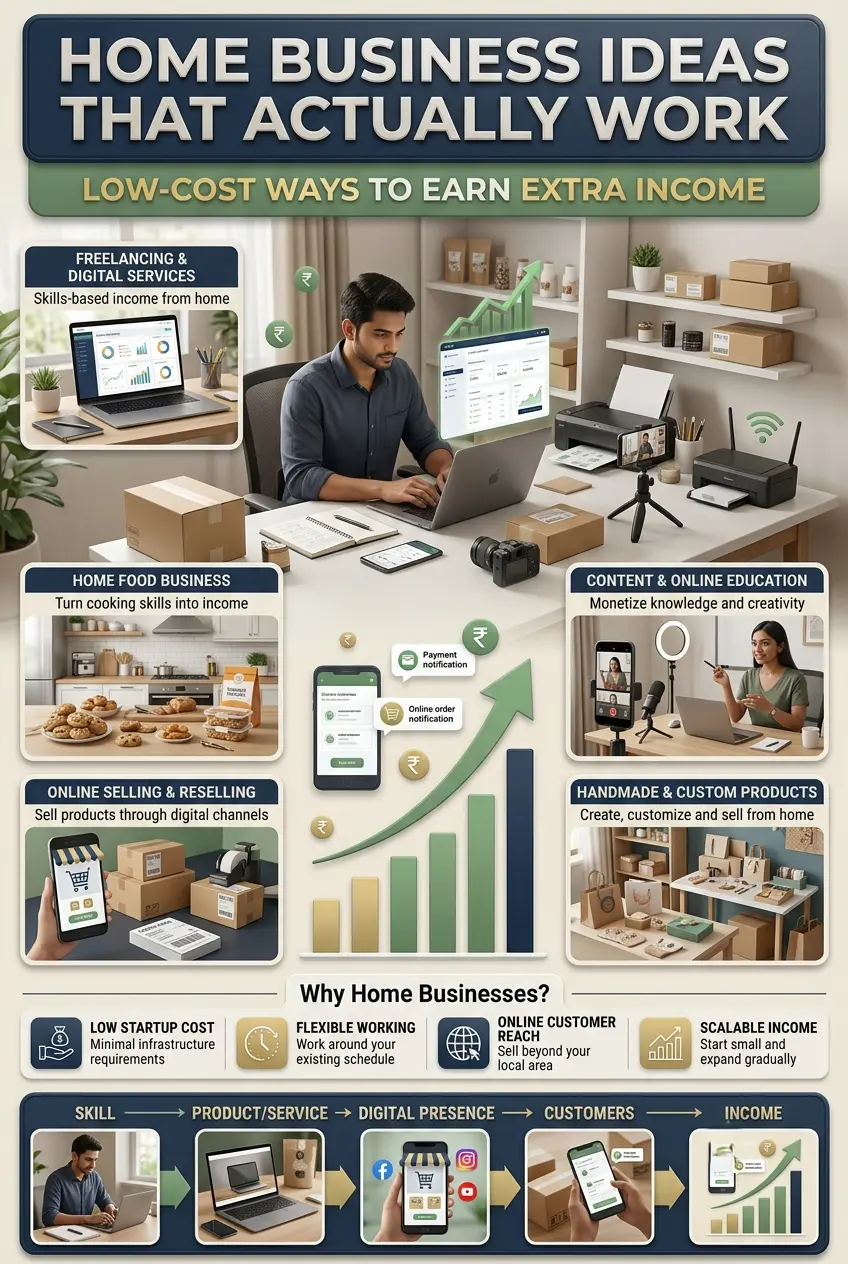
The gig economy layer that is sitting above the traditional home-based work has matured rapidly as well. Various platforms for freelancing, digital marketing, tutoring, content creation, e-commerce selling, and service delivery has significantly lowered the barriers to entry. What used to require an office address, a telephone line and a formal storefront can now be launched from a laptop in a spare bedroom, sometimes within days.
Who Is Starting Home Businesses — and Why
The profile of the home-based entrepreneur in India has changed significantly over the last decade. It is no longer just homemakers running a tiffin service or retired professionals offering tuitions. Home businesses are being started by a much wider cross-section of people:
- Salaried professionals who want to have a secondary income stream without quitting their jobs
- Young graduates who want to test a business idea before committing to it full-time
- Women entrepreneurs who want to achieve financial independence with flexible working hours
- Retired individuals who want to be productive and supplement their savings
- Students in their final years of college who want to build something on the side
- Small-scale operators who want to add a home-based unit to reduce overhead
Each of these groups has the same fundamental challenge with respect to starting a home-based enterprise — they need ideas, and they need enough business sense to evaluate what fits their skills, time, and budget. Generic advice such as “follow your passion” or “identify a market gap” does not help when you have ₹10,000 and three free hours a day, and you’re trying to figure out where to start.
The Opportunity Is Bigger Than Most People Realize
India’s home-based business ecosystem has been progressively formalized through GST registration, Udyam registration for MSMEs and the rapid spread of digital payment infrastructure which has given home-based entrepreneurs more market legitimacy and reach than any previous generation has had. Even a small food business run from a home kitchen can now serve customers across the city through delivery apps. A handicraft maker in a small town can reach buyers in metros or abroad.
The sectors with the most home-business potential are broader than most people imagine. Beyond the obvious categories of stitching, cooking, and tutoring, there are real opportunities in food product manufacturing, specialty services, content and copywriting, handicrafts for export, repair and maintenance, agriculture-linked processing, beauty and wellness services, and dozens of digital service categories which can be started small and scaled up methodically as demand grows.
What most aspirants lack is a reliable, consolidated reference that tell them what kinds of businesses can be realistically built from home, what each one requires to get going, and what the market actually looks like. A good home-business handbook answers these questions before you spend money and make mistakes, which is exactly the kind of resource that pays for itself many times over.
What Holds Most People Back — And What Fixes It
Ask someone why they have not started the home business they have been thinking about for two years, and the answers are always the same: ‘I don’t know which idea to pick.’ ‘I don’t know how much it will cost.’ ‘I don’t know how to start.’ ‘I don’t know if it will work.’
These are not excuses — they are genuine information gaps. Most people have the willingness and the energy. What they lack is a reliable, India-specific reference that lays out options clearly and gives them enough practical information to make an informed decision. A good home-business handbook does exactly that. It shortens the research phase and helps people avoid false starts and gives first-time entrepreneurs a realistic picture of what they are getting into before they commit resources.
The value of structured knowledge before starting a business is well established. Entrepreneurs who start with clear, relevant information make better decisions, invest their limited capital more efficiently and build businesses that survive longer. A book that delivers that kind of knowledge — in plain language, with practical detail, and grounded in Indian market reality — is not a luxury for a home-business aspirant. It is a foundational tool.
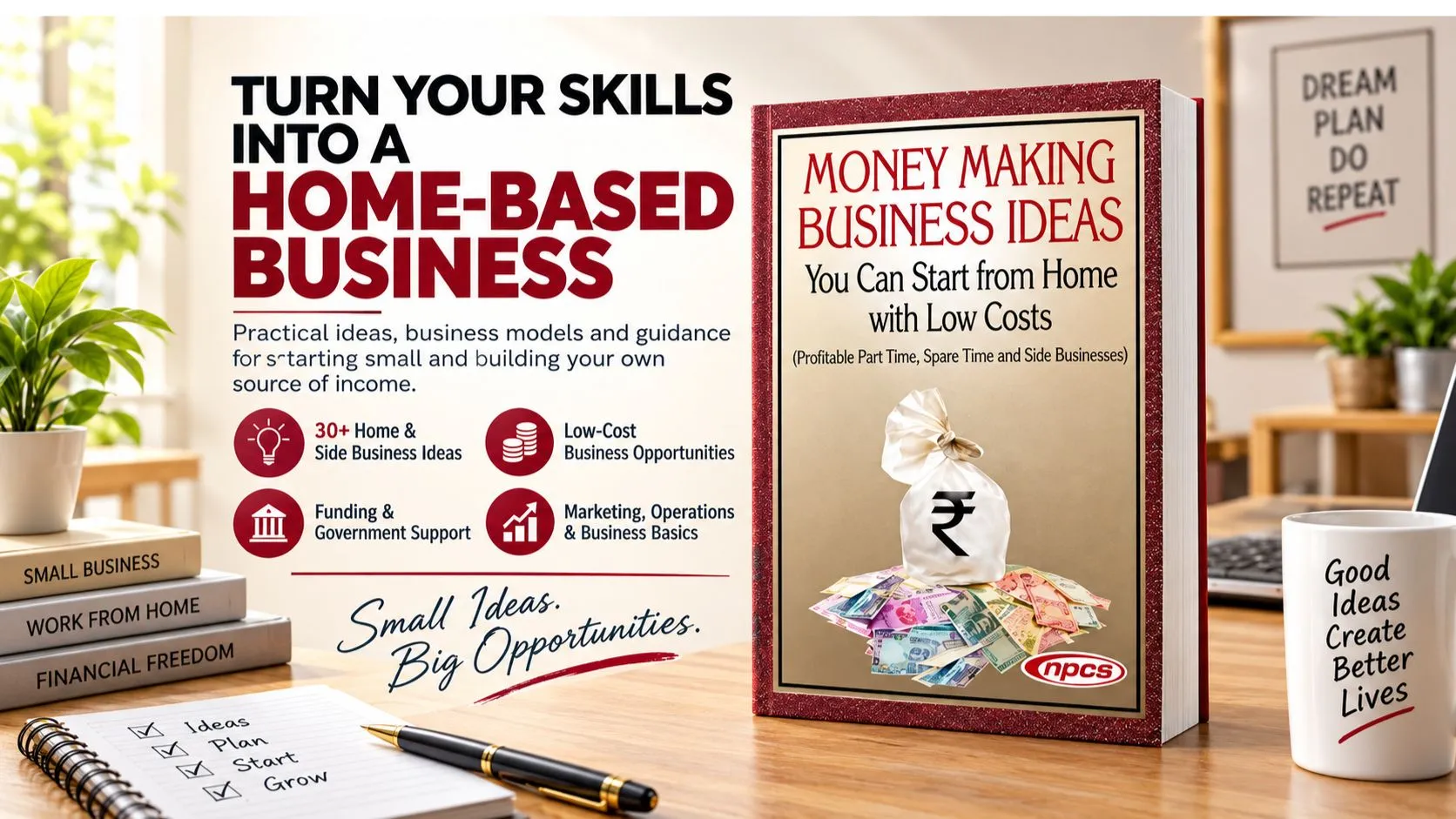
Introducing: Money Making Business Ideas You Can Start From Home With Low Costs
Author / Compiler: NPCS Board of Consultants & Engineers | Publisher: NIIR Project Consultancy Services | Edition: 2nd Revised Edition | ISBN: 9788195075577
This handbook by NIIR Project Consultancy Services — one of India’s most respected industrial consultancies with over 30 years of experience and more than 150,000 project reports delivered across 85 countries is exactly the kind of practical, consolidated resource that home-business aspirants have been looking for.
The 2nd Revised Edition has been updated to reflect current market conditions, technology access and the evolving landscape of home-based enterprise in India. Unlike generic motivational books on entrepreneurship, this handbook takes a direct, practical approach to the subject, presenting a wide range of money-making business ideas that can realistically be started from home with low capital, in spare time, part-time, or as a side venture alongside existing employment or family responsibilities.
The coverage is deliberately broad. The book spans ideas across food processing and home cooking, crafts and handmade goods, skills-based services, digital and content-related businesses, repair and maintenance services, beauty and personal care, agricultural processing, and cottage-scale manufacturing businesses. For each category of business, readers get a practical understanding of what the opportunity involves, what it requires to get started, and what kind of demand exists for it.
What makes this book particularly valuable for Indian readers is the contextual relevance. The ideas are not lifted from foreign markets and transplanted without adaptation. They are grounded in Indian consumer demand, Indian supply chain realities, and the practical constraints that home-based entrepreneurs in India actually face — limited capital, limited space, limited working hours, and the need to balance the business with family responsibilities.
The book is organized to serve readers at different stages. Someone who has not yet decided which business to pursue will find the breadth of ideas invaluable for shortlisting options that match their skills and situation. Someone who has already settled on a direction will find the specific coverage gives them a sharper picture of what they are getting into before they invest money.
For readers evaluating a home business for the first time, the revised edition also provides grounding in how to assess an idea before acting on it — considerations around local demand, competition, startup costs, and what meaningful differentiation might look like in a home-based context. This kind of structured thinking saves money and avoids false starts which is where most first-time entrepreneurs lose their confidence along with their initial investment.
The book does not promise overnight results or push unrealistic projections. What it does — and does well — is put a wide range of credible, practical, low-investment business possibilities in front of readers and give them the information to make an informed choice about which direction makes sense for their specific situation. That is a considerably more valuable thing than motivation alone.
For women entrepreneurs in particular, this book deserves attention. Home-based business is one of the most viable pathways to financial independence for women who need flexible hours and cannot commit to a fixed-office setup. The range of ideas covered includes multiple categories that have proven particularly well-suited for women-led home enterprises — from food products and beauty services to handmade goods and digital work. The information is presented without assumptions about prior business experience, making it genuinely accessible to first-timers.
For salaried professionals testing the waters before making a full commitment, the part-time and spare-time framing of the book is especially relevant. Many of the business ideas covered are structured around the reality that the reader has a limited number of free hours each day and cannot afford to lose their primary income while building something new. That is a realistic starting point — and the book meets readers exactly there.
At its core, this is a book about options and decisions. It functions as a structured reference that expands what readers consider possible, narrows it down to what is realistic for their situation, and gives them enough grounding to take the first step with confidence. For entrepreneurs in India who are serious about building something from home — whether as a primary livelihood or as a supplementary income stream — this is a reference that earns its place on the desk.
Purchase / Call-to-Action
Get Your Copy — Money Making Business Ideas You Can Start From Home
| Title | Money Making Business Ideas You Can Start From Home With Low Costs — Profitable Part-Time, Spare-Time & Side Businesses |
| Author / Compiler | NPCS Board of Consultants & Engineers |
| Publisher | NIIR Project Consultancy Services |
| Edition | 2nd Revised Edition |
| ISBN | 9788195075577 |
If you have been thinking about starting a home business but have not yet found the right idea — or if you have too many ideas and need clarity on which one to pursue — this book gives you the structured guidance to move from thinking to doing. It is a practical, India-specific reference that pays for itself the moment it helps you avoid one wrong decision or points you toward one right one.
Order Now
Official Publisher (Niir.org): Click Here to Buy
Amazon India: Click Here to Buy
Flipkart: Click Here to Buy
Your Investment Deserves the Right Opportunity
Every serious investment begins with choosing the right sector and the right business model. With hundreds of industrial opportunities available across India’s manufacturing and clean-energy landscape, making the most informed choice is critical. NPCS Startup Selector tool helps entrepreneurs, MSMEs, and investors identify the most suitable business opportunities based on their investment capacity, location, and interests — so your capital is directed toward a venture with the strongest fit and potential.


