



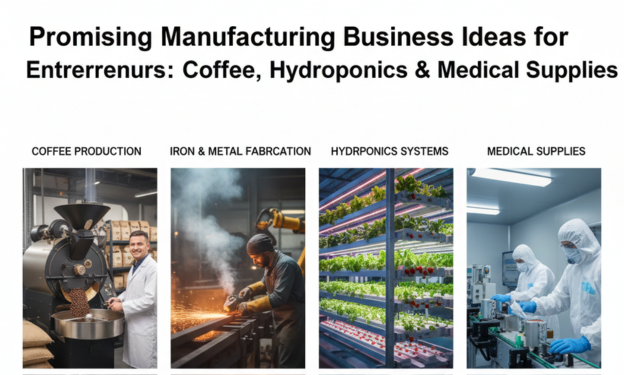
Manufacturing Business Ideas for Entrepreneurs: When initiating a new industrial business venture, one will need an understanding of the market trends, market demand and necessary practical steps to set up the business. In the changing economy today, entrepreneurs are offered various opportunities in various fields. This paper examines the four promising manufacturing and industrial business concepts that are on the rise:
- Curing and Powder, Coffee plantation.- Construction of a coffee processing business farm to finished powder.
- Sponge Iron- Making sponge iron (direct reduced iron) to be used in steel.
- Hydroponic Greenhouse Farming-State of the art, soil-free agricultural production to ensure constant crop production.
- Urine Collection Bag Production – The production of important medical disposable bags in health sector.
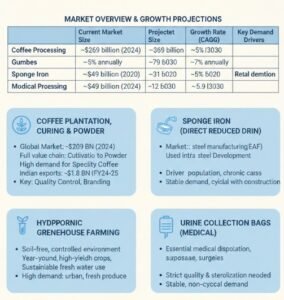
All these opportunities are solutions to an expanding demand in the market, whether it is in the ever-present need of coffee and steel or in the sustainable use of the land and the medical demands. We will take a closer look at each of the businesses, such as market projections, growth predictions, and critical considerations to startups. Firstly, the table below gives an overview of the market size and growth outlook of every sector:
| Business Idea | Current Market Size | Projected Market Size | Growth Rate (CAGR) | Key Demand Drivers |
| Coffee Processing (Plantation & Powder) | ~$269 billion (2024) | ~$369 billion (2030) | ~5% annually | Rising global coffee consumption; specialty coffee culture; emerging market demand |
| Sponge Iron (Direct Reduced Iron) | ~$49 billion (2025) | ~$69 billion (2030) | ~7% annually | Infrastructure development fueling steel demand; shift to cleaner steel production (EAF) |
| Hydroponic Farming (Greenhouse) | ~$16 billion (2025) | ~$31 billion (2030) | ~12–13% annually | Year-round crop production; sustainable farming needs; high yield from limited land |
| Urine Collection Bags (Medical Device) | ~$2.0 billion (2022) | ~$2.9 billion (2030) | ~5% annually | Aging population and homecare; increased surgical and chronic care needs |
Coffee Plantation, Curing and Powder
Becoming a coffee business owner is a very rewarding venture to people who are enthusiastic about this internationally popular drink. This opportunity consists of the entire chain, such as the growing of coffee-related plants (plantation), drying and roasting of the beans, to making coffee powder (roast and ground coffee, or even instant coffee). Coffee is the beverage that is one of the most significant used globally and the demand is steadily increasing. A shift in lifestyles and a strong cafe culture has seen coffee become a necessity in the daily life of many people not only in the established markets but also in areas that are growing at a high rate.
Market Outlook and Demand Growth
The coffee market in the world is monumental and continues to grow. By 2024, the market is estimated at approximately $269 billion and will grow to approximately 369 billion in 2030, which is approximately a 5 percent yearly growth. This is driven by rising consumption in the emerging economies (such as coffee consumption in Asia Pacific has been increasing over the last few years) and the world tendency towards specialty coffee and high quality coffee. The consumers are increasingly willing to pay quality beans as well as distinct coffee flavors. As an example, demand in single origin coffee and sustainably sourced beans is increasing, and it is building niches that have potential opportunities to be taken by new entrants.
Entrepreneurs must remember that the coffee demand is not only on the global market, but also the local market is lively. In India, by way of instance, the coffee industry is on the upswing: Indian coffee exports have reached an all-time high of $1.8 billion in FY 202425 (still up by more than 40 percent compared to the prior year) and the domestic market is expanding as a result of the urban youth developing a coffee habit. This implies that there are high opportunities in export-oriented coffee companies and brands that are targeting the local consumers. Altogether, the demand perspective of coffee powder and its products is strong due to the young population developing the coffee habit and the elderly population sustaining their daily brew.
Production Process and Key Requirements
Starting a coffee plantation and processing business involves several stages:
- Cultivation- Coffee plants need the right agro- climatic conditions (typically elevated areas with suitable temperatures and proper rainfall). Entrepreneurs may begin working with their own plantation (given the geographical conditions) or obtain raw green coffee beans with such growers.
- Processing (Curing) – Coffee beans should be processed (cured) once they are picked. The process of curing includes such activities as pulping, fermenting, washing, and drying the beans in order to acquire green coffee beans. It is one of the most serious phases which influence the quality of the beans. You need to have a curing plant or enter into a contract with one in case you deal with raw cherries.
- Roasting It is then roasted in order to extract aroma and flavor on green coffee beans. Roasting machines come in sizes between small-scale roasters (to make batches) and bigger industrial roasters to produce in bulk. Knowledge of the roast profiles (light, medium, dark roast) or the employment of experienced roastmasters can be used to distinguish your product.
- Grinding and Packaging -Roasted beans are ground to coffee powder (unless you will sell whole beans directly). It is important that it must be packaged in a way that it maintains freshness- coffee is usually packed in multilayered air-tight packaging with one-way valves. The product can be marketed with the help of attractive branded packaging.
- Quality Control and Certification -This is important in maintaining the quality. Tasting of the coffee in terms of taste, smell, and defects of the beans should be a norm. Also, it may be certified as organic, on fair trade or on Rainforest Alliance in case of a target market that considers sustainability.
Key considerations: Coffee processing business may be initiated at a small scale level (such as purchasing beans at the farm, roasting and grinding in a small plant) or at an integrated large level (owning plantations and having a full-fledged processing plant). New entrepreneurs may start with a small roasting plant and reverse-integrate to the sourcing of beans or even to farming. One needs to study coffee varietals, logistics of supply chain and the customer preferences. The coffee powder segment is highly influenced by branding and marketing – success might be achieved through the provision of a flavour profile or story (single-estate sourced or using eco-friendly methods).
Tips in market entry: Find a niche or differentiator of your coffee product. For example:
- Specialize in high-end coffee targeting the high-end customer group.
- Instant coffee powder brand development to the convenience of mass markets.
- Export markets should be targeted when the cost of production is competitive in local markets (deficit countries use imports).
With proper quality and marketing, a coffee processing business has the potential of entering a huge and expanding market of coffee lovers both in the country and internationally.
Sponge Iron
Direct Reduced Iron (DRI) or sponge iron is one of the important raw materials of steel production. It is made by simply not melting the iron ore, but directly reducing it to a porous and solid structure (like a sponge) without melting, in contrast with the traditional blast furnace processes. Sponge iron is applicable in the electric arc and induction furnace to produce steel, thus it is a very valuable material in the steel recycling and mini-mill industry. Sponge iron production is an opportunity to the entrepreneurs who have interest in the industrial and metallurgical sector to help in the infrastructure and manufacturing foundation of the economy.
Market Outlook and Industry Growth
The sponge iron market is closely related to the development of the steel industry which is strong. Due to the investments made by the countries in infrastructure, construction, automobiles, and other steel-intensive sectors, the demand of the steel and consequently of the sponge iron is high. The sponge iron/DRI market in the world was estimated at approximately over $49 billion in 2025, and is estimated to reach about 69 billion in 2030. This means a healthy CAGR of approximately 6 7 per annum. Growth drivers include:
- Infrastructure and Urbanization: New economies (India, China, Southeast Asia) are also constructing bridges, buildings and highways at a high rate, which is creating a demand in steel. These regions are usually the ones that steelmakers use sponge iron to meet their steel-making requirements.
- Environmental Considerations: Sponge iron production, particularly gas based DRI with the use of natural gas or hydrogen as opposed to coke based blast furnaces may have a reduced emission of carbon dioxide. As the world focuses on green steel and the reduction of carbon footprint, sponge iron has become a focus of cleaner steelmaking.
It is worth noting that India is the largest sponge iron producer in the world and this is an indication of strong demand by its domestic industry and government push. The size of this sector can be illuminated by the fact that in 2023, the Indian DRI output has hit an all-time high of about 49 million tons. This pattern points to the fact that it can be a good business idea to establish a sponge iron plant in areas where the steel demand increases (and raw materials are available).
Key considerations: When entrepreneurs enter sponge iron industry, they should be ready to invest a lot in land, plant and machinery and environmental regulation (pollution control equipment to control dust and gas emission is needed). Location is significant also, being close to iron ore, or to steel mills who will purchase the product, to reduce the cost of logistics. It also is essential in power supply (to operate electric drives, air blowers, etc.), therefore, consistent electricity or captive power generation may be required.
Opportunity highlights: Although entry is not very easy, manufacturing sponge iron can be profitable. The steel industry is expanding and DRI is in constant domestic and international demand. Adopting new technologies (as with gas-based DRI or possibly pilot-hydrogen-based DRI in the future) you will be able to achieve an efficiency advantage and sustainability which is the direction the industry will be taking. Value-addition in the mining industry is also being promoted by the governments – rather than exporting raw iron ore, it can be encouraged to convert it into sponge iron in the country. This may take the form of tax subsidies or simplified authorizations in part of the world on sponge iron projects.
Hydroponic Greenhouse Farming
Hydroponic agriculture is a recent method of agriculture, in which plants are cultivated without soil, in the presence of nutrient-enriched water solutions in a regulated environment (usually greenhouses or vertical plant farms located inside). This method of agriculture is becoming exceedingly popular because it brings about intense and high density crop production with an efficient utilization of resources. Establishing a hydroponic green house business can be an exhilarating and futuristic undertaking to an entrepreneur who loves agri-tech or sustainable farming.
Market Potential and Growth
Hydroponics is one of the agricultural industries that has been expanding rapidly. The market of hydroponic farming systems and produce is at the double-digit pace globally. According to industry reports, the market value is projected to increase by approximately 12-13 percent a year by 2025 and it will reach over $30 billion in 2030, equivalent to the growth rates of the other sectors in this paper. It is estimated that the market size will even grow to more than 50 billion by 2035, as it will be adopted faster.
What’s driving this rapid growth? Several converging trends:
- Demand for Fresh & Local Produce: Fresh and local produce, particularly in cities are in demand among the consumers. The farms would be in the form of hydroponic farms surrounding urban areas and as such, produce would reach the market immediately after harvest and therefore the produce will be high in taste and nutritional value. This farm to table trend encourages use of higher prices of herbs and greens that are produced in green houses.
- Year-Round Production: Traditional agriculture is seasonal and dependent on climate. Hydroponic greenhouses give an opportunity to grow throughout the year because it is possible to regulate temperature, humidity, light, and nutrients. Regular supply needs grocery chains and restaurants that guarantee the constant supply of various crops (such as lettuce, basil, strawberries) all year round.
- Resource Efficiency and Sustainability: Hydroponics requires a much less amount of water than traditional soil-based agriculture – usually by up to 90 percent. It also consumes less land as plants may be stacked up the wall or may be planted in tight patterns. This is a significant benefit in a world where people are short of land, and the amount of water is limited. Further, the closed-loop systems will also be able to curb fertilizer runoff and reduce the use of pesticides (as the environment is regulated), which makes it environment-friendly and in line with the increasing popularity of organic and pesticide-free foods.
- Technological Advancement: New technology in climatic control system, LED grow lights, automation, and nutrient formulation has made hydroponic systems more productive and easier to operate. The fact that sensors and IoT have been integrated to monitor the health of plants and automatically administer doses of nutrients allows relatively new farmers to ensure that the growing conditions are most optimal. The cost of these technologies is also becoming less expensive and this reduces the entry cost.
Venture capital and government grants are being used to support hydroponic startups and projects around the world in a move to achieve food security and sustainable agriculture. Indicatively, North America, Europe, and some of Asia (Japan, Singapore, UAE) have witnessed the increased number of large hydroponic and vertical farming plants. Hydroponic farming is also becoming established in and near metro cities, and is aimed at the high-end retail and hospitality markets with high-end products.
Setting Up a Hydroponic Farming Business
Scalability of hydroponic farming is one of its features that are appealing to me: you can begin small (even a few hundred square meter greenhouse or a warehouse indoors where you can put up an indoor farm) and expand once the demand increases. Some of the important parts and processes to consider:
- Greenhouse/Indoor Space:Determine the size and nature of construction. Hydroponics are normally performed in green houses (polyhouse or glasshouse) that have climate control. In cities, there are those entrepreneurs who utilize the rooftop or warehouses, which are under the complete control of the environment (usually referred to as vertical farming when they have multi-level racks). Make sure that the location is covered by good electricity and water.
- Hydroponic System: Select type of growing system depending on the type of crops you would like to grow. Most frequently used hydroponic systems are:
- Nutrients and Growing Medium: Although there is no soil, plants can require a growing medium to support roots (such as coco peat, perlite, Rockwool cubes, etc.). Various plant stages have specific recipes that are prepared with nutrient concentrates (with nitrogen, phosphorus, potassium, and micronutrients) and water. Entrepreneurs must possess in-house agronomy experience or obtain nutrient plans by experts.
- Seeds/Plant Varieties: It is important to choose appropriate crop varieties that would grow under hydroponic environment. Hydroponics is popular with leafy greens (lettuce, spinach, kale), herbs (basil, mint) and some fruiting crops (tomatoes, cucumbers, strawberries). Begin with simple, quick-to-grow produce, such as lettuce to master your system, and then mix it up.
- Climate Control and Lighting: Having ventilation, cooling (such as exhaust fans, evaporative coolers) or heating (in cold climates) helps put the temperature under control. The indoor farms will also require LED grow lights to mimic the sun, particularly the crops that grow fruiting which demand high levels of light. These factors can be controlled by the use of automation systems alongside humidity.
- Operations: Compared to traditional farming of the same magnitude, Hydroponic farming is less labor intensive, although it would demand technical surveillance. It is necessary to monitor pH and nutrient concentration (EC) of the water, pay attention to the growth of pests or algae, and take care of the equipment (pumps, filters). It is essential to train personnel or train oneself in the best practices of hydroponics.
Advantages for startups:
- Hydroponics may be very productive – it is possible to have 4 to 6 crop cycles of lettuce in a year (hydroponic) which is far more productive than open-field farming.
- It creates opportunities in niche markets: like increasing exotic salad greens or herbs which are normally imported and thereby cater to the local high-end consumers and decrease imports.
- The environmentally-friendly approach to the business will be able to appeal to the customers who are environmentally friendly and even the government. Grant may be offered or incentives on sustainable agricultural projects to entrepreneurs.
- Modular development: to develop it, it is possible to begin with a pilot to gauge market demand and then add additional greenhouses or vertical farm modules.
Challenges to note: Equipment makes the initial cost per square foot more expensive than normal farming. It should also be ensured that there is a market of the produce, usually produce grown through hydroponic technique sells at a higher price thus the target customers (such as high-end supermarkets, hotels or direct online sales to health conscious consumers) need to be located. When the economies of scale are achieved, the operational costs are reduced, and the predictability of output would also guarantee a constant revenue..
All in all, the horticultural opportunity of hydroponic greenhouse farming is a high growth prospect that is in tandem with the future developments in the production of food. It provides an attractive way to the entrepreneur to help in providing food sustainably and at the same time make a profit through the operation of an agribusiness.
Urine Collection Bag Manufacturing
One such niche in the medical supplies industry is to make urine collection bags (urinary drainage bags). Healthcare Urine bags are specified medical items used to collect urine when the patient has a urinary catheter, which is usually the case with immobile and post-operative patients and with medical issues. They are widely used at the hospitals, nursing homes and homes. Being a disposable medical item, urine collection bags exhibit a steady demand and cannot be less than the standards of healthcare quality. To an entrepreneur, entering this field will imply that he is in the greater healthcare market which is generally resilient and steadily expanding.
Market Overview and Demand
The urine collection bag market is under the medical devices industry and has been enjoying gradual growth. The market worth of the urinary drainage bag in the world amounts to approximately $2.0 billion in 2022 and is forecasted to be about 2.9 billion by the year 2030. This is indicative of a steady though stable growth of 4-5 per cent per annum. The major motivation factors are:
- Aging Population: With the growing number of elderly people across the globe, there is a growing rate of age related conditions which may lead to catheterization (enlarged prostate issues in men, urinary incontinence or post-surgery care). The old people tend to require the urine bags either temporarily or on a long-term basis and this increases the demand.
- Healthcare Growth: There is growing healthcare access in most countries and hospitals/ clinics are growing. Increased usage of urinary catheters and drainage bags in the post-operative care and critical care units is associated with more surgeries and medical procedures. Improvement in the healthcare infrastructure of emerging markets also increases procuring medical disposables such as urine bags.
- Home Healthcare & Chronic Illness Care: Home management of chronic illnesses (with the assistance of home nursing) is on the increase. Urine collection bags may be used by the patients with mobility difficulties in the long run, a spinal injury, and chronic kidney issues outside the hospital. This has established a retail and distribution market of such medical supplies, not only the procurement of hospitals.
- Infection Control Practices: The current medical practice focuses on single use disposable equipment to minimize chances of infections. High quality disposables that are hygienic are substituting reusable urine bags to a great extent. This change will ensure a steady demand because every patient will require many bags throughout the years (bags are typically changed regularly to avoid infections).
The stable development and the necessity of this product suggest the stable business opportunity. Although it is not as large a market as coffee or steel, it is a niche market that new manufacturers can take over the local market or the region, particularly when they provide good products at competitive prices.


