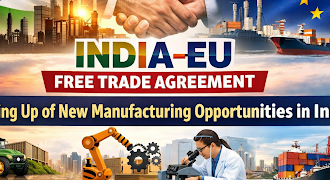






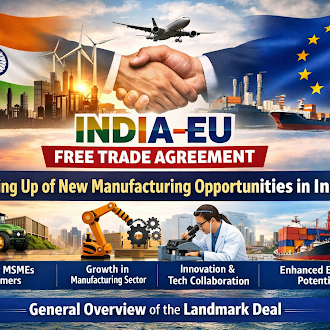
India-EU Free trade Agreement (FTA) is one of the historic milestones in the international relations of India. The Prime Minister stated that the deal, which was finalized with the leaders of European Council and European Commission is the biggest free-trade deal that India had ever signed. These comments by the Prime Minister highlighted the fact that the accord will not only intensify the economic relations, but will also create job opportunities and give the India-Europe alliance a strong base to manage to have a prosperous future. The FTA is being praised as a new template to a joint prosperity since it:
- Provides more access to Indian farmers and small-scale industries to European markets.
- Gives new chances to manufacturing through special treatment and lowered tariffs.
- Enhances collaboration between the services segments of India and Europe.
- Improves the mobility of the youths, professionals, students, and researchers, thus enhancing innovations.
- Enhanced global supply chains through linking the second and fourth largest economies of the world.
Table -1 – The Key Highlights of the India European Free Trade Agreement.

1. Aspect On the part of the statement of the Prime Minister.
- This is the biggest free-trade agreement ever between the second and the fourth largest economies of the world with India benefiting its 1.4bn population.
- | Benefits to farmers and MSMEs Ford and Dagger, 2016.
- Opportunities in manufacturing Tariff exemptions and easier market entry open up industrial prospects in a variety of industries.
- Improved Information technology, financial, logistics, research and development and professional services India has strong talent endowments which are enhanced through further cooperation in service sector.
- human employment and mobility| The deal includes good jobs, or mobility to youth and professionals in the two regions, along with opportunities to students and researchers in the two regions.
- By, having access to big developed economy, India will be able to reach the advanced supply chains, Technology transfer and innovation ecosystems.
This focus of FTA on manufacturing is central to the growth aspiration of India. To advantage start ups and first generation entrepreneurs, it offers an opportunity in a generation to grow globally. We shall look at how this can be utilized by the investors into the industrial project and MSME business planners.
Opportunities in manufacturing: Areas of Boundless Potential.
Manufacturing of Electronics and High Technology.
EU is a large customer of semiconductors, electronics and telecommunications equipment. The incentive plans by India based on production in combination with the concession of tariffs by the FTA provide favourable conditions to the electronics manufacturing industry. In the case of startups; it becomes feasible to assemble and manufacture smartphones, tablets and networking equipment due to:
- Increased component taxes on imports into the EU, decreasing the input expenses by Indian assemblers.
- Special treatment with respect to the finished goods produced in India and entry into the EU market, assuming that they do not violate the quality standards used there, thus motivating the local value addition, and the development of the export-oriented units.
- Opportunities in the area of industrial automation, robotics and Internet-of-Things (IoT) equipment, to where European companies are seeking partners to have cost-effective manufacturing. Indian start ups are able to license technology, design to meet local demands and then send back to Europe.
The electronics are also scalable due to the large domestic market demand, the cross-border design process, and modular production processes. The problem of risk management involves a high level of following the regulations imposed on the product by EU and quality control investment. The entrepreneurs are advised to put funds in the training of skilled labour force and management of intellectual property in order to achieve long-term competitiveness.
Electric Mobility Components and Automotive.
There is an opportunity of automobiles and auto parts. The manufacturers in the EU want to explore other supply chain patterns, which are non-traditional hubs and India wants to become a global automotive manufacturing center. The FTA can unlock:
- 0 or low tariff on Indian component like gearboxes, braking system and electronics to the EU market, hence increasing revenue of exports.
- Electric vehicles (EV) and battery technology cooperation. European companies have modern EV arenas and battery technology, whereas India has affordable production and a booming national EV sector. Battery pack assembly, power electronics recycling and recycling can be localised through joint ventures.
- The possibility of MSMEs to provide tier-II and tier-III cities with precision-machined parts, castings, forgings and injection-moulded parts to larger assemblers is increased. FA means that the business environment will be more predictable and will promote either long-term contracts or automatization as an investment.
Read Project Details: Sheet Metal Components for Automobiles
However, businesspeople should think over tooling that is capital-intensive and quality certification (e.g., ISO/TS and CE marks). Design houses and research institutes would help in compliance to EU standards at a cost effective margin.
Life Sciences and Pharmaceuticals.
The manufacturing of pharmaceuticals is one of the strength of India, the country was already a major source of generics to the EU. The simplified regulatory cooperation by the FTA only enhances growth in:
- Active pharma constituents (APIs) and compaddions. Lower tariffs and recognition of the good manufacturing practices (GMP) make Indian companies to enter the EU markets more easily.
- MoBiologics and biosimilars, and in this case, the Indian companies can use cost-effective biomanufacturing to provide cheap therapeutic products to the healthcare industry in Europe.
- Diagnostics and medical equipment. Startups have the potential to create inexpensive diagnostic test kits, wearables and medical imaging devices that meet the health requirements of Indians at the standard of EU quality. It is credible working with European design houses.
High profitability is due to high margins in specialty generics and biologics. Scalability needs a constant investment in R&D, quality assurance and compliance with regulations. These risk factors are strict pharmacovigilance standards and changing EU data protection and clinical trials regulations. The entry barrier to the market would be neutralized by collaborating with the existing distributors in Europe.
Food Processing and Agri -Based Industries.
Proper access to European markets was specifically emphasized by the Prime Minister towards the farmers and small industries. The removal of tariffs and an upsurge in consumer demand in Europe in exotic, natural and sustainable products can be used in agri-processing ventures. Opportunities include:
- Organic and processed foods e.g., spice mixes, ready foods and frozen fruit/vegetable. Elements such as traceability and sustainability are appreciated by European consumers; eco-certifications as well as regional narratives can be used by Indian startups as a means of differentiation.
- Tea, coffee and nutraceutical specialties. The varied agro-climatic regions in India are capable of producing high quality teas and other extracts of medicinal herbs that are likely to attract health conscious customers in Europe.
- Stock exchanges dairy and vegan. The conventional dairy products such as the ghee and paneer and the plant-based milks of the oats and millets can be offered to the niche markets when packaged in unique ways.
The ease of compliance will be increased by the decrease in the sanitary and phytosanitary barriers by the FTA. However, entrepreneurs have to invest in cold-chain, laboratory quality-controlling as well as EU-conformant labeling. The profitability depends on volumes and positioning of the brands; it is necessary to have distribution partnerships in Europe.
Chemicals, Clean-Technologies and Renewables.
The ambitious carbonisation aims of the European Union boost the demand in green chemicals, renewable-energy apparatus, and solutions of waste-management. The Indian industrial clusters have been located to generate products of a competitive price like:
- Niche chemical products- dyes, pigments, agrochemicals and sophisticated polymers. The free-trade agreement will lower taxes levied on raw material imported in Europe like catalysts and intermediate thus reducing the cost of production in Indian chemical plants. On their part, EU buyers have a stable supply of chemicals at affordable prices.
- Solar photovoltaic units, wind turbine engines, and energy-storage units. European utilities and developers are in need of cost effective hardware European manufacturers can provide modules, inverters, and control systems Indian manufacturers are able to offer cost effective hardware. The partnerships will be focused on the recycling techniques and the circular-economy designs.
- Solutions to recycling and waste-management. EU policies regarding circular economics promote recycling technologies. Indian start-ups will be able to come up with waste-to-energy plants, plastic recycling, and waste-treatment solutions of waste water to domestic and international demands.
These sectors have good profitability opportunities due to high value addition and strong market in the world. The risk factors are fluctuating prices of raw materials and severe environmental policies. It will require sustainable manufacturing processes and research and development in order to be successful over the long term.
Import-Export Driven Opportunity Analysis.
The trade in the EU has a large percentage of the Indian exports. The free-trade agreement does not only reduce tariff barriers but removes the many non-tariff barriers by mutual recognition of standards and simplified customs. This translates into:
- Increased exports in labour-intensive industries like the textiles and leather and handicraft where duty-free access improves the price competitiveness. Examples of sustainable fabrics, vegan leather, and personalized crafts that can be part of European consumer values can be considered by start-ups.
- Availability of more sophisticated capital goods such as CNC machines, laboratory equipment and clean-technologies in Europe at lower prices that will allow Indian manufacturers to modernize production technology. Lower importation taxation rates make it cost effective to micro-, small and medium-enterprises modernise their plants which enhances product quality and throughput.
- The services services like IT outsourcing, engineering consultancy, legal services, and education. Improved mobility conditions will enable the Indians professionals and students to spend longer durations in Europe, creating knowledge transfer.
Table 2 Strategic Advantages of Indian Business People.
| Benefit | Implication for startups and MSMEs |
|---|---|
| Reduced tariffs on inputs | Lowered costs for machinery, components and raw materials imported from Europe, encouraging modernisation and capacity expansion. |
| Duty-free export access | Competitive advantage for Indian products in EU markets; supports scaling of export-oriented units across textiles, pharmaceuticals, food and engineering goods. |
| Innovation and technology transfer | Collaboration with European firms accelerates adoption of advanced manufacturing techniques, automation and Industry 4.0 solutions. |
| Quality and compliance | Mutual recognition of standards simplifies certification, though companies must adhere to stringent EU requirements – a catalyst for raising overall product quality. |
| Integrated supply chains | India’s integration into European supply networks offers resilience against disruptions and creates opportunities in logistics, warehousing and packaging. |
| Human capital mobility | Movement of skilled professionals, students and researchers fosters cross-pollination of ideas and reduces talent shortages in emerging sectors. |
Quality and Compliance
It makes certification easier since there is a mutual acceptance of standards yet the companies are subjected to high EU requirements an impetus towards the overall enhancement of product quality.
Integrated Supply chains
The interconnectivity of Indian countries with the European supply networks, provides stability to such disruptions and new logistical, warehousing and packaging opportunities.
Human capital mobility
The mobility of the skilled personnel, students and researchers will lead to cross-pollination of ideas and serve to mitigate shortages of talents in new sectors.
Lessons of Indian Industrial Leaders.
Tata Group Long-term Vision and Diversification.
The Tata Group, which is being advanced by the Tata family, shows how an Indian conglomerate developed as a trading nation and turned into one of the world manufacturers. Its success rests on:
- Diversification in terms of strategy with steel, automobiles, information technology and consumer goods, which enables balancing of risks due to business cycles.
- The compliance with moral standards and quality which have earned the trust in the international markets and allow acquiring iconic brands in Europe and other parts of the world.
- Investment in research and development e.g. setting up of R&D centres which work with the universities and international technology partners.The lesson to new entrepreneurs is simple; build a diversified but synonymous portfolio, invest in technology and be ethical when doing business in the global arena.
Reliance Industries Scale and Vertical Integration.
The scale and vertical integration is manifested through Reliance Industries, the family business of the Ambani family. The company started its operations under the textile and petrochemical sectors and established the biggest refining complex in the world before diversifying into telecommunication and retail sectors. Key takeaways include:
- The value chain is controlled to gain control of margins at every stage; starting with the raw materials to finished products.
- The aggressive investments in world-size facilities, which allowed acquiring a cost leadership and bargaining power.
- Using financial markets to finance capital intensive projects at a very tight cost control.
When coming into the manufacturing industry, entrepreneurs need to put in mind the ideal of vertical integration where a trade-off is made in the long term between expenses of an initial investment and the long-term profitability.
Amul- Cooperative Model and Brand Building.
The collective ownership and the brand building is exhibited by the milk cooperative revolution pioneered by Amul and led by Dr. Verghese Kurien. Aggregating milk and processing it to value added products and selling it under a single brand, Amul generated a dairy brand that was globally recognised. Lessons include:
- The primary producers can be empowered by forming cooperatives or producer firms to provide equitable wealth distribution to enable a steady supply.
- In the value addition instead of selling raw commodities, it is better to process milk into butter, cheese, and ice cream because it is a better deal.
- Constant branding and adherence quality creates customer loyalty and a high price in the local and export market.
Biocon Innovation in Biopharmaceuticals.
Biocon, an enzyme manufacturing company that is marketed by Kiran Mazumdar Shaw, is one that started as a small company and ended up being one of the major biopharmaceutical firms. Its journey underscores:
- Making a substantial investment in intellectual property and research and development to come up with proprietary biotechnologies instead of just depending on generic products only.
- Establish strategic relationships with international drug companies to develop and gain entry into the market.
- Operating within the most complicated regulatory frameworks through the development of world-class quality regimes and becoming active players in dialogue with regulators.
The early venture in life sciences can replicate Biocon model by concentrating in niche technologies, cooperating with the academia as well as meet international standards of quality.
MRF Tyres Niche Leadership Focus on Quality.
MRF is a small balloon company that was promoted by the family of K. M. Mammen and grew to be one of the biggest tyre manufacturing companies in India. Such critical success factors are:
- Specialisation in one of the main product lines (tyres) and constant investment in technology to enhance performance and life cycle.
- Excellent distribution channels both in the rural and the urban markets with a high availability and trusts in the brand.
- Export orientation having international standards of certification, which allows it to penetrate more than a hundred countries.
In the case of new manufacturing enterprises, the experience of MRF shows the power of concentration, gradual innovation, and quality adherence.
The Project Ideas to future entrepreneurs.
High-tech Battery Production and Recycling.
The area of electric mobility and energy storage is also developing at a very high pace due to the EU, which drives decarbonisation. An opportunity to set up a lithium-ion battery will be a profitable venture to develop a plant to assemble and recycle batteries. Startups have the ability to get both cathode and anode materials by local suppliers, make battery packs and sell it to EV manufacturers. Any recycling plant and recovery of valuable metals saves the reliance on imports and promotes the circular economy. The issue of profitability depends on the ability to enter into long-term supply contracts, upholding safety standards, and using government incentives on clean energy projects.
Smart Agro-Processing Units
Most part of the Indi workforce is in agriculture although value addition is low. The agro-processing plants of fruits, spices and cereals can be set up by entrepreneurs in small-scale, export-oriented units. The combination of sorting, grading, drying and packaging processes with the process of digital monitoring of quality will provide them with the ability to provide the same products in accordance with the EU sanitary norms. Contract farming or cooperatives provide links between the farmers that would assure the supply of raw materials. The removal of both tariff and non-tariff barriers by the FTA increases profitability in exports and domestic sales will be used to cushion against price volatility.
Precision Tooling inventories and engineering.
Precision components are in increasing demand in aerospace, medical equipment and industrial equipment. Establishing a plant with CNC machines, additive manufacturing lab, metrology lab can be used to produce extremely accurate parts to customers in Europe. Entrepreneurs would be able to begin with supplying domestic OEMs and later export when they have acquired certifications. Partnership with technical institutes would enable retraining of workers. This market has a large initial investment but has good margins and sustained supplier partnership.
Specialty Textile Manufacturing.
The duty-free accessibility of the EU regards its sustainable textile presence together with technical textiles and functional cloths creates a chance in organic cotton textile. Investors are able to establish units that use contemporary looms, dyeing technology and environmental friendly processes. There has to be adherence to EU regulations concerning chemicals and labour practices. It means that by introducing design and providing cooperation with European fashion houses, Indian manufacturers will be able to set higher prices and create labels that are known all over the world.
Sustainable Building Materials.
Both the EU and India focus on sustainable infrastructure. Startups can explore production of environmentally friendly construction materials like fly-ash bricks, recycled plastics panels and factory-processed modules. Using the EU experience in construction technologies assists in coming up with the products that comply with the strict environmental standards. These products are in demand in local low cost residential housing projects, the products can be exported to European markets, where the buildings are in need of low-carbon solutions.
One-stop Consultancy Services to Entrepreneurs.
The success of an entrepreneurship takes more than an idea, besides that it entails a systematic appraisal and planning. Niir Project Consultancy Services (NPCS) is a professional consulting firm that offers consultant services to prepare market survey-cum-detailed techno-economic feasibility reports. Our reports provide detailed market study, process engineering, process mapping, a list of equipment, need of raw materials and financial estimates which is projected with profitability. Through NPCS, entrepreneurs are made to come out with objective data on factoring feasibility, profitability and long term scaling, thereby minimizing risks in investment and making informed decisions.

FAQ -Entrepreneurial Concerns.
Which areas can be looked at by a new entrepreneur in India-EU FTA?
Another opportunity involves focusing on areas in which there is a match between EU demand and the strength of India; electronics, automotive components, pharmaceuticals, agro-processing, renewable energy equipment and specialty textiles. Such sectors enjoy tariff concessions, accessibility and possibilities of collaboration.
What can startups do to make profit exporting to the EU?
Value addition and scale result in profitability. Startups are supposed to base their products on high point bearing products which they should invest in the technology to increase the efficiency and they are supposed to sign long term contracts. It is important to know the EU consumer preferences and create a strong brand.
Which are the primary compliance requirements of export to EU?
Export to the EU has to be of high quality, safety and sustainability. Business people are supposed to use effective quality control measures, acquire related certifications (GMP, CE, ISO), trace inputs and adhere to labour and environmental laws.
Does it have funds to finance manufacturing projects that are aimed at the EU market?
Government programmes in financial institutions of India provide schemes to promote the export-oriented manufacturing. Capital costs can be lowered through the subsidies, credit guarantees and production-linked encouragesments. This can be done by meeting with the banks at an early stage of planning in order to ensure that the funding is done correctly.
What can NPCS do to help in planning the project to the EU market?
NPCS focuses on the preparation of feasibility reports depending on the industry. We study the trends in the market, competitive environment, process technology, capital and operating cost and revenue potential. This holistic strategy assists entrepreneurs in making feasible projects, obtaining capital and going through regulatory license.
Conclusion
The new opportunity of Indian manufacturing is the India-EU Free Trade Agreement. The deal is bound to change the business environment by connecting the second and fourth largest economies in the world and offering advantage to 1.4 billion Indians. Those entrepreneurs who are innovative, invest in quality and engage in strategic alliances would enjoy the advantages of gaining markets, reducing expenses and improving technological cooperation. Carefully planned, the standards followed by both the world and the help of professional consultants such as NPCS, the new generation of industrialists of India can use this ancient agreement to establish the businesses that are globally competitive.


