




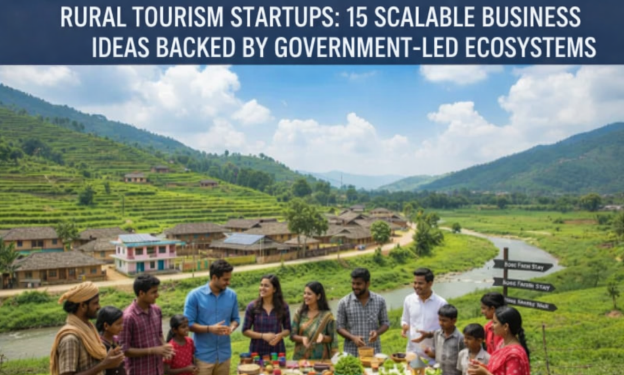
The Rural tourism in India has changed the concept of postcard romance to project feasibility. To every person who has ever undertaken work on the district-level consulting or ground-sourcing of MSME clients, the indicators are obvious: tourism projects do not merely transport people as they shift products, services, capital, and entrepreneurial spirit. The rural tourism framework of the government, particularly the organised programme such as Swadesh Darshan 2.0, PRASHAD and Vibrant Villages Programme, has formed thick layers of organised demand on which startups can tap into existing footfall as opposed to building demand on a mass-zero basis. This structural shift is precisely why rural tourism startups are gaining long-term feasibility momentum rather than operating as seasonal ventures.
The tourism sector in India earns a foreign exchange amounting to 30.3billion USD and provides 46.3 million people with employment opportunities, with domestic tourism levels amounting to 2,736 crore. These numbers have the significance to the founders not in their size but in their downstream implication: where footfall is concentrated consumption is concentrated.
Clusters have a quicker conversion rate, sell more predictably, and achieve profitability sooner as compared to scattered retail. Livelihood diversification, formalisation of micro-commerce, and increased incisivity in spending are present in the rural markets, which previously relied virtually 100 percent on farm earnings. When roads, utilities, digital infrastructure, and destination branding are built by the state, the first-generation entrepreneur gains a rare advantage—market proximity without market monopoly pressure, a key advantage for rural tourism startups.
The available distribution of registered homestays on state basis. These are formal hospitality micro-nodes, and they explain why institutional B2B demand is the fastest path to scale of local product startups:
| State | Registered Homestays |
|---|---|
| Himachal Pradesh | 68 |
| Uttarakhand | 93 |
| Maharashtra | 43 |
| Karnataka | 6 |
| Goa | 4 |
| Odisha | 14 |
| West Bengal |
The strategic implication is direct: the more concentrated registered homestays it becomes the easier it is to start up with a supply of standardised utility products, hygiene kits, decor merchandise, packaged foods, aromatics, basic therapy products, or regional souvenir product lines. A state with 500+ registered hospitality touchpoints is not a craft market—it is a contract manufacturing launchpad for travel-linked SKUs, especially for rural tourism startups looking for predictable institutional buyers.
Read Also: Top 20 Herbal Products Manufacturing Business Ideas
Why Rural Tourism Ecosystems Matter for Startup Selection Logic
Rural MSMEs prompted by tourism also have a triple-compounding effect, as was documented in feasibility studies:
- Predictable seasonal demand spikes – Tourism circuits create a clumped month of peak demand. The founders are able to schedule the production, inventory, and working capital cycles around known peak window instead of having to do the same through guesswork. This predictability has a direct positive effect on the utilisation of capacity and minimises the risk of idle machinery, one of the largest profitability killers in small plants.
- District-level brand amplification – Tourism infrastructure constructed by government has the effect of being a brand accelerant. It is not only the large manufacturers that have their product story catapulted into the national limelight courtesy of destination marketing. Stickiness and invisibility are mutually disadvantageous. That is why the businesses that are scalable are those ones that transform regional identity into homogenous product formats repeatable dimensions, closed packaging, and quality control at the batch level, and reliability in supplies.
- Supply-chain shortening –Rural tourism clusters enable manufacturers to compete against organised brands in terms of cost reduction in logistics and warehousing pressure as well as lead times. When you have to buy your product locally and refresh it regularly, you do not have to create a national budget to create your business nationwide. You must have a national SKU discipline. This operating model defines the scalability logic of rural tourism startups.
Read Our Books: Modern Technology Of Perfumes, Flavours And Essential Oils
Learning from India’s Rural-Focused Industrial Success Models
1. Reliance Industries / Reliance Retail
Promoter: Dhirubhai Ambani
The rural penetration of Reliance was not established on the basis of niche products, it was established on the basis of category adjacency and route ownership. The brutality of the logic behind the decision was as follows: when you own procurement, warehousing, and last-mile retail rails, product categories become natural extensions. What would be taught to novice entrepreneurs is practical; do not begin rural production by picking the strangest item. Make a selection of the most replenishable product first, and then add some neighbor categories that would share the same distribution channel.
2. Dabur India Ltd.
Promoter: Dr. S.K. Burman
Dabur boosted rural trust using heritage positioning that is supported by consistency at a batch. One product hero was never their product logic. It was trust architecture and repeat purchase categories. The lesson of the founder is critical to the feasibility: when your batches are different, your margins will die sooner or later. Standardise early.
3. Haldiram’s – Snacks with National Taste Discipline
Founder: Ganga Bhishen Agarwal
The scale logic that is most applicable to rural founders, demonstrated by Haldiram, is when local taste becomes national business, where process becomes repeatable, and SKU becomes portable. It is not the boundary, but the hook that is local.
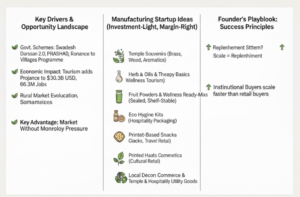
15 Scalable Rural Tourism Startup Ideas (Investment-Light, Margin-Right, Scale-Ready)
1. Temple Souvenir Manufacturing
The PRASHAD scheme has created infrastructure temples that boost footfall across religious tourism belts. Its production opportunity is not that of idols, but of souvenir format engineering; of brass and wood-finish utility decor, printed spiritual merchandise, boxed carry kits, aromatics, and identity based souvenirs which tourists purchase in travel formats. The fact that there is predictability, repeatability and incessant retail density is what scales does not sentiment make.
2. Herbal Oils & Therapy Basics
Massage oils, hair oils, pain balms, herbal ointaments and aromatics are products that are consumed at a high frequency in health tourism hubs. Logic of profitability: smaller packs stimulate trial, refill packs stimulate retention and gift packs stimulate season spikes, particularly during spiritual tourism and wellness circuits.
3. Coir and Jute Utility Products
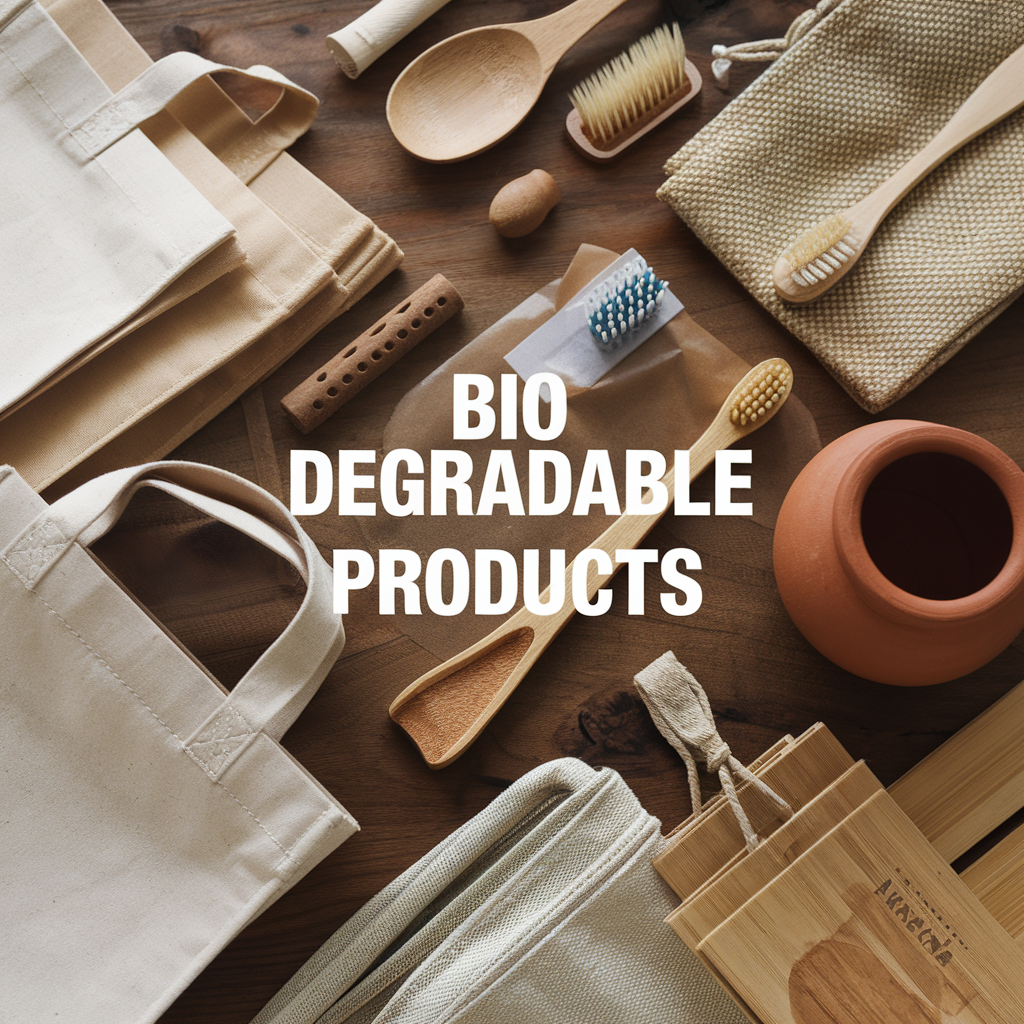
The stories of eco-tourism are aggressively growing the demand of coir mats, jute bags, biodegradable packaging kits, printed identity bags, and standardised natural-finish carry products. Logic of feasibility: the margin is in printing, material discipline and in contract replenishment, rather than in the price of raw commodities.
4. Bamboo Bottles & Utility Packaging
In case of bamboo utility products, they can be scaled into standard product sizes such as bottles, storage trays, lamps, planters, decores, and hospitality utility objects. It is business-to-business rather than craft-only retail business logic.
5. Fruit Powders & Wellness Ready-Mixes
Tourists do not purchase loose powders. They purchase powdered ones, which are sealed and labeled and easy to carry. The segments to be scaled consist of fruit powders, sattu blends, spice-based beverages blend, millet-based wellness beverages, and foodstuffs with longer shelf life. The rule of manufacturing feasibility is easy: as long as you are able to retain 6-9 months of shelf-life with moisture control and intact sealed packaging, the same SKU will scale across the city retail and export markets by way of diaspora demand.
6. Handloom Merchandise for Tourism Retail
The tourist routes increase demand of printed cloth products, identity shawls, linen packages, regional printed merchandise, tourism decor products, and handloom gift packages. This is scaled in the event that supply is standardised.
7. Eco Hygiene Kits for Rural Hospitality Buyers
Rural resorts and homestays require hygiene SKUs that are portable, complete and compliant and thus have to be replenished. Local production of eco hygiene kits would guarantee discipline of the margin and recurring B2B orders.
8. Herbal Cosmetic Consumer Goods
Herbal soaps, balms, oils, and aromatics will be on demand to boost the economy, which is fast growing due to rural wellness tourism. The pack architecture and replenishment of the margin are not rare, but the pack architecture.
9. Agarbatti & Aromatics (Portable Tourism SKU Discipline)
Rural consumption curve indicates that aromatics are better sold in a gift and travel package as compared to loose commodity package.
10. Millet-Based Snacks for Travel Retail
The tourist destinations become snack consumption areas. The logic behind the founder is to produce evergreen SKUs and grow during peak months.
11. Rural Haats Commerce Packaging
The tourism belts promoted by the government boost the amount of visitors flowing in the rural haats, which enhances the demand of the locals in the packaged products, decoration kits, and hygienic products.
12. Printed Local Merchandise for Tourism Circuits
These comprise identity kits, cloth bags, jute-packs and cultural carry formats.
13. Regional Drink Concentrates & Wellness Mixes
Export logic works at scale where the products are sealed, stable and tested in batches.
14. Temple & Festival Kits Manufacturing
Seasonal calendar demand + evergreen SKU = right scale path of feasibility.
15. Local Décor & Hospitality Utility Goods
Algorithms lose to standardisation. Local storytelling cuts budgets of adverts. But there is nothing like supply reliability compared to the scale of story telling.
Profitability Pattern Awareness for Founders
Lens | Implication
Tourism clusters demand faster than retail scatter | Scale comes from replenishment SKUs
Packaging costs kill margins, not material costs alone | Engineer pack economics early
Institutional buyers scale faster than retail buyers | Circuits, homestays, temples, resorts
QC variation kills scale | Standardise batch traceability early
Local identity scales when SKU is portable | Gift, carry, sealed formats
FAQ (Founder-Ready, Practical, Decision-Useful)
Q1. How do rural tourism startups secure early buyers for manufactured goods?
It has by addressing organised demand nodes, (homestays) temple circuits, rural hotels, haats, and wellness resorts, which make their purchases in repeat rather than single purchases. This institutional approach significantly strengthens early cash flows for rural tourism startups.
Q2. Which kinds of product formats are best scaled by rural MSMEs based on tourism?
SKUs that are portable, moisture controlled and sealed, repeatable sizes, regional identity and well defined performance, particularly food powders, oils, balm and eco packaging.
Q3. Is it a realistic possibility to introduce rural goods associated with tourism to the export markets?
Essentially- products such as spices, condiments, fruit powders, millet blends, aromatics, and biodegradable packaging are experiencing high cross-border pull rates when lots are trackable and product conformity is baked-in at the outset.
Q4. What are the unknown cost items usually overlooked by the founders of tourism-based rural manufacturing?
Packaging, distributor, margins, seasonal working capital cycles, moisture control infrastructure, batch testing and lead times. Most founders price including factory margin and forget market margin.
Q5. What are the ways of small rural brands competing with the national FMCG and organised product companies?
By owning the route: local dealer penetration local dealer penetration, institutional replenishment cycles, smaller trial packs, retail, larger refill packs, hospitality, and bundled product mix, rather than a single hero SKU. This route-ownership discipline defines the long-term winners among rural tourism startups.
Rural tourism provides you with the rail. The manufacturing provides you with the margin. The founders that grow nationally through villages are not the most vocal they are the most refillable, conforming, batch-matching, and distribution-disciplined. That’s not a slogan. That’s feasibility.


