






Maize Processing Business in India processing industry is a high potential manufacturing segment with high demand from the industrial sector, and ample availability of raw materials. Traditionally maize processing in India was confined to feed consumption and low-value starch production. However, the rapid growth in the pharmaceuticals, food processing, textiles and the personal care industries has enhanced the demand for maize-based derivatives like starch, liquid glucose, dextrose monohydrate and sorbitol.
If the investor is considering this sector from their point of view, the structural gap between the production of maize and its processing capacity can be considered the most attractive feature. India produces maize in high quantities, but only a small amount is used to produce high-value industrial products. This gap gives an opportunity for long-term MSMEs and first generation entrepreneurs.(Maize Processing Business in India)
India Maize Production and Processing Scenario
According to the Ministry of Agriculture & Farmers Welfare, India produces over 36 million metric tonnes of maize every year. Despite this, there is still a limited amount of industrial processing.
Currently, maize utilization is broadly based on the following pattern in India:
- Around 55-60% is consumed by poultry and animal feed industry
- Nearly 10-15% is used in direct consumption of food
- Only 20-25% is converted into starch and value-added derivatives
This imbalance is the reason why, while India is exporting native starch, it is still importing refined products such as modified starches and pharmaceutical grade sorbitol.(Maize Processing Business in India)
Industrial Demand For Derivatives Of Maize
Maize starch has become a valuable raw material for a number of industries. Textile manufacturers use starch for warp sizing, and the paper and packaging industry uses starch-based adhesives to a great extent in corrugated boxes. Pharmaceutical companies have modified starch as a binder and excipient so that it has a steady demand throughout the year.
Liquid glucose and dextrose derivatives have enjoyed high growth because of their extensive use in food and pharmaceuticals. Key demand drivers include:
- Confectionery and bakery products that require texture stability
- Ice cream and dairy products where controlled sweetness is required
- Oral pharmaceutical syrups and IV fluids preparations
Policy support and growth in pharmaceutical manufacturing, promoted by the Department of Pharmaceuticals, has further boosted the domestic demand for high purity glucose derivatives.(Maize Processing Business in India)
Sorbitol: High Growth Import Substitution Opportunity
Sorbitol is one of the most attractive products of the maize processing value chain. It is produced by the hydrogenation of glucose syrup and is used extensively in the dental, oral care, cosmetic and nutraceutical sectors.
At present, India relies heavily on imports of pharmaceutical grade sorbitol because of its low refining capacity. The existing situation provides manufacturers with new business opportunities which they can pursue through their manufacturing operations at sites near pharmaceutical and FMCG distribution centres.
The domestic production of sorbitol in India delivers major benefits which include:
- Reduced procurement and logistic expenses for buyers
- Reduced reliance on imported material
- Improved supply chain reliability
Trade Pattern Reveals Gap in Value Addition
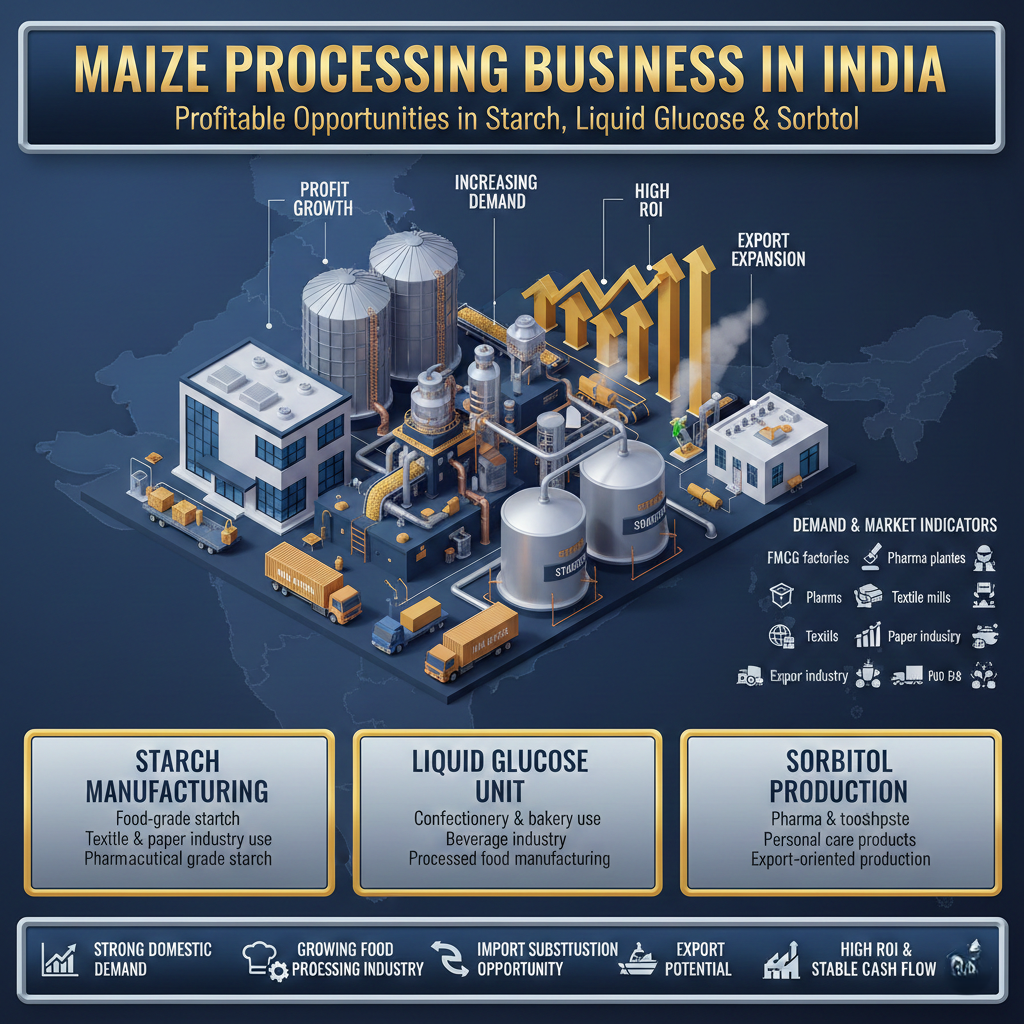
The maize derivative business in India shows a critical disparity between available raw materials and the capacity to produce value-added goods. The country exports native starch but it needs to import other starch products:
- Modified and speciality starches
- Hydrogenated glucose products.
- Pharmaceutical-grade sorbitol
Pharmaceutical centres in Gujarat, Telangana and Himachal Pradesh often depend on imported inputs so local processing facilities are viable in a commercial sense.(Maize Processing Business in India)
Learning from Existing Indian Businesses
The success of maize processing in India is already well established commercially. Riddhi Siddhi Gluco Biols Ltd. moved from the basic starch to sorbitol and specialty derivatives, facilitating entry into the pharmaceutical and FMCG supply chains.
Similarly, Gujarat Ambuja Exports Ltd. took advantage of the availability of maize in India and moved from trading in maize to wet milling and starch derivatives manufacturing.
These companies show that forward integration and value addition are important to long-term profitability.(Maize Processing Business in India)
Project Opportunities in Entrepreneurship for MSME
Maize processing provides several types of scalable projects based on the size of investment and technical capacity. Some of the most viable are:
- Native, modified maize starch production for textiles and packaging
- Liquid glucose production, confectionary and bakery industries
- Dextrose monohydrate manufacturing for pharmaceutical applications.
- Sorbitol Production for Manufacturers of Oral Care and Personal Care Products
These projects can be implemented separately or integrated in one maize wet milling unit to improve capacity utilization.(Maize Processing Business in India)
Integrated Wet Milling & Profitability Structure
An integrated maize wet milling plant enables producers to attract revenue from several products instead of depending on a single product. This diversification helps in improving the financial stability and project returns.
Some common revenue streams are:
- Native and modified starch
- Liquid glucose and dextrose
- Sorbitol
- By-products, such as maize germ oil and gluten feed
The integrated method increases both project internal rate of return and the ability to grow operations in the future.(Maize Processing Business in India)
Feasibility and Project Planning Support
Niir Project Consultancy Services(NPCS) helps entrepreneurs in preparing Market Survey cum Detailed Techno-Economic Feasibility Reports (DPRs) for maize processing projects. These reports include market analysis, manufacturing processes, machinery selection, sourcing of raw material, product mix planning and detailed financial projections.(Maize Processing Business in India)
Such professional evaluation helps investors to assess feasibility, profitability and risk before committing capital.(Maize Processing Business in India)
Final Conclusion
India’s maize processing industry are a rare scenario of availability of plentiful supply of raw material and a lack of industrial demand. Entrepreneurs that invest in value-added starch and glucose derivatives can build scalable, resilient and profitable manufacturing businesses.(Maize Processing Business in India)
For MSMEs and investors seeking to branch out from trading in commodities and start in industrial processing, maize-based manufacturing is a great and sustainable growth opportunity.(Maize Processing Business in India)
Frequently Asked Questions (FAQ)
Is maize processing good for MSME and first generation entrepreneurs?
Yes. With sufficient feasibility analysis and professional advice, maize processing is ideal for new entrepreneurs, because of guaranteed availability of raw material.
Which maize derivative has more profitability?
Value-added derivatives like sorbitol and pharmaceutical-grade dextrose are generally higher margin products than native starch.
Can MSME-scale units survive in competition with large manufacturers?
Yes. MSME units often get advantages of low logistics cost and faster supply, if they are serving regional industrial clusters.
Is import substitution an option in this sector?
Yes. India is still importing sorbitol and specialty glucose syrups in spite of the surplus maize production.
How important is the location of plants?
Plant location is a very important factor. Proximity to pharmaceutical, FMCG or textile clusters enhances commercial viability to a major extent.


