





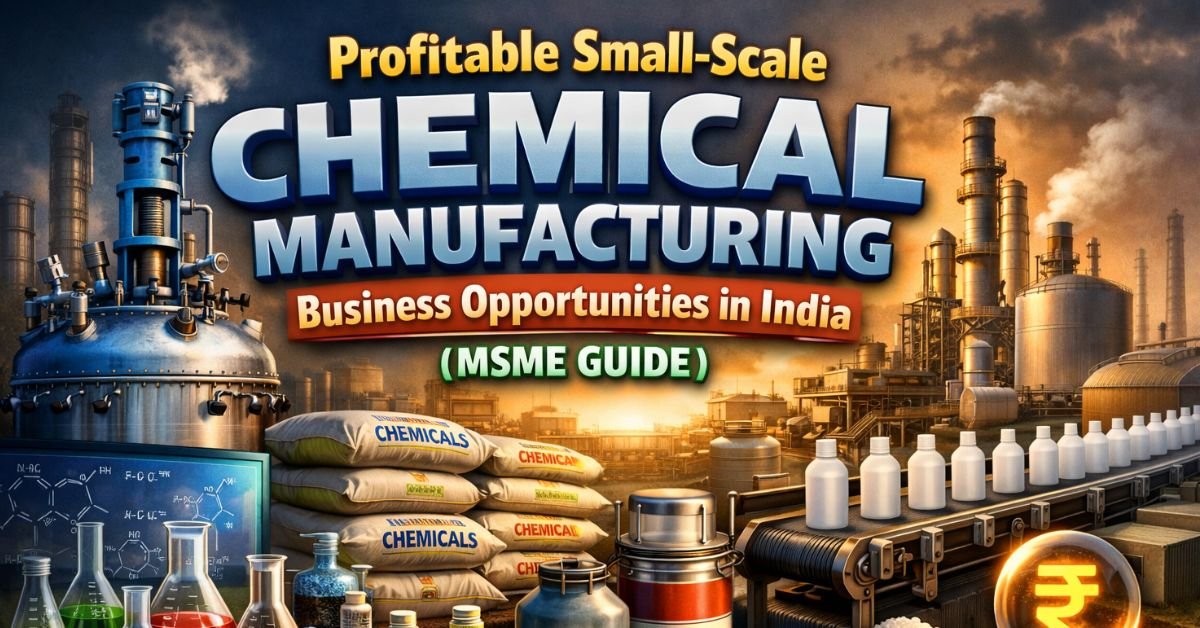
Chemical Manufacturing India sector, India is seen as an industry dominated by large corporations, capital-intensive petrochemical complexes and multinational players. While this perception is partly accurate in the case of bulk chemicals and petrochemicals, there is an important and rapidly growing reality that is ignored. Beneath large refineries and fertilizer plants is a thriving ecosystem of small and medium enterprises (MSMEs) producing organic and inorganic chemical intermediates that are critical to almost every industrial sector in the country.
According to industry estimates and according to the government publications, more than 80,000 commercial chemical products are manufactured in India, covering the organic, inorganic, specialty and petrochemical segments. While it is true that alkali chemicals dominate in terms of overall volumes, the organic and inorganic chemicals are the backbone of industrial inputs used in agriculture, construction, healthcare, textiles, packaging, water treatment and pharmaceuticals.
For first-generation entrepreneurs, startups and MSMEs, this structure is a pragmatic and scale-up possibility. Instead of competing in the bulk chemical production of capital-intensive manufacturing, new manufacturers can strategically position themselves in the intermediate chemical value chain – where investment needs are not excessive and demand is deeply embedded in the industrial process.(Chemical Manufacturing India)
Table of Contents
ToggleRead More: Handbook On Chemical Industries (Alcohol Based)
Understanding Industrial Demand for Organic and Inorganic Chemicals
Industrial demand for chemicals is essentially process rather than discretionary. Unlike consumer goods, chemicals are needed on a continuous basis in order to keep industrial operations running. Water treatment plants need chemicals on a daily basis for purification, coagulation and pH control. Textile units rely on the use of bleaching agents, dye intermediates and finishing chemicals. Paint and coating companies use inorganic pigments, fillers, and stabilizers and agrochemical firms use organic intermediates for formulation and mixing.(Chemical Manufacturing India)
Industry data broadly classifies chemical production as alkali chemicals, organic chemicals, inorganic chemicals, dyes, and pesticides. Although the volume of organic and inorganic chemicals is lower compared to alkalis, the strategic importance of these chemicals is their cross sectoral usage. A single chemical product can be consumed at the same time by different industries such as textile, water treatment, construction chemical manufacturers and pharmaceutical companies.
This multi-industry dependency results in regular demand cycles and protects the small-scale manufacturers against extreme market volatility. Even during economic slowdowns, the compliance-driven sectors such as water treatment, sanitation and healthcare are consuming chemical inputs.(Chemical Manufacturing India)
Why Small Scale Chemical Manufacturing Is Ideal For MSME's
From the point of view of techno-economic feasibility, organic and inorganic chemical manufacturing has a number of structural advantages that make it suitable for MSMEs and Startups. Unlike petrochemical plants, which have continuous processes, large land banks and long gestation periods, most organic and inorganic chemical units have batch or semi-batch plants.
Key advantages include:
- Relatively lower capital investment as compared to large chemical complexes
- Batch-based production systems with flexible capacity utilization
- Strong local demand by existing industrial clusters
- Faster onboarding of customers when quality consistency is achieved
- Predictable repeat order after supplier approval
Once an MSME has established the quality of the product, regulatory compliance, and reliability of delivery, buyers tend to place recurring orders. This results in predictable cash flows and long-term supplier relationships – which is crucial to business sustainability.(Chemical Manufacturing India)
Read More: Modern Technology of Industrial Chemicals
High Potential Small Scale Manufacturing Opportunities
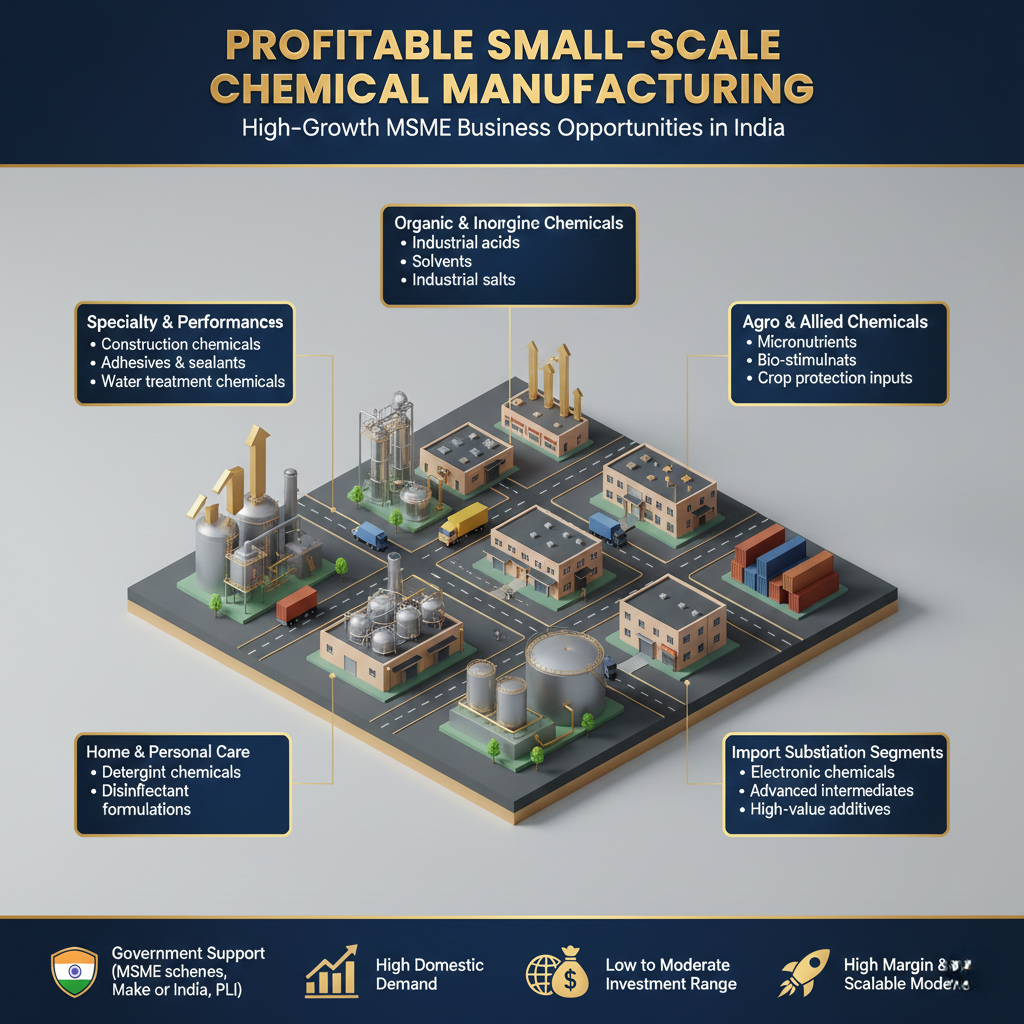
Water Treatment Chemicals and Effluent Treatment Chemicals
Rapid urbanization, industrial growth in growth, and increased environmental regulations continue to drive demand for water and effluent treatment chemicals throughout India. Municipal corporations, industrial estates, refineries, power plants and manufacturing units need uninterrupted supplies of treatment chemicals as per discharge norms.(Chemical Manufacturing India)
Small-scale units producing goods like alum, ferric chloride, polyaluminum chloride, and customized coagulant blends can meet the demand of the public and private sectors. These chemicals are compliance driven, so demand is fairly stable, even during economic downturns.
This segment is very attractive because capacity expansion can be accomplished incrementally with the addition of reactors or blending systems without major changes in infrastructure.(Chemical Manufacturing India)
Organic Solvent Blends for Industrial Purposes
Organic solvents are important in the pharmaceuticals, paints, coatings, inks, adhesives and specialty formulations. While bulk solvents are manufactured by large enterprises bulk solvents, many final-users have process-specific requirements for solvent blends.(Chemical Manufacturing India)
This provides a perfect scope for MSMEs as:
- Production is formulation-driven & batch-based
- Customization – it increases customer stickiness
- Moderate Technology Requirements – “Technology requirements are moderate”
- Capital intensity is relatively low
With good formulation discipline, quality control, and cost efficiency, the small scale solvent blending units can develop stable customer portfolios and scale gradually.
Inorganic Salts and Compounds: Specialty
Specialty inorganic salts like sodium sulphate, magnesium sulphate, calcium chloride and potassium salts are extensively used in detergents, construction chemicals, pharmaceutical and food processing, and agriculture industries.
These products are an essential input into the processing process rather than being end consumer products, so the demand for these products is consistent. Taking the feasibility into consideration, it is generally agreed that such projects entail moderate investment, scalable capacity and diversified end-use industries.
Success in this segment is very dependent on the maintenance of purity standards, moisture control, storage stability and professional packaging, which are areas in which disciplined MSMEs have a comparative edge over unorganized suppliers.(Chemical Manufacturing India)
Read More: Project Reports & Profiles
Dye Intermediate's, Textile Processing Chemicals
India’s textile centres have high consumption of dye intermediates as well as organic textile processing chemicals. Small-scale manufacturers producing intermediates for dye synthesis, pretreatment chemicals and finishing auxiliaries, are able to blend well into local supply chains.(Chemical Manufacturing India)
Over the course of time, manufacturers can progress from commodity products to specialized intermediates in order to improve the margins and the export potential. This value addition through gradual processing strategy has been a proven growth path in the chemical industry of India.
Industrial Cleaning and Sanitation Chemicals
Demand for industrial cleaning and industrial sanitation chemicals has risen substantially in hospitals, factories, warehouse, food processing units and logistic facilities. These products typically are delivered under contract-based arrangements, and therefore have predictable consumption patterns.
Operationally this segment is attractive because capacity expansion may be achieved by adding blending and packaging lines and not by making heavy capital investments. Product portfolios can also be easily diversified on the basis of customer requirements.(Chemical Manufacturing India)
Export Opportunities for Chemical Manufacturers (MSMEs)
India’s chemical exports continue to steadily grow because of cost competitiveness, skilled manpower and established industrial clusters. MSMEs for organic intermediate, specialty salts and treatment chemicals can have access to world markets through standard specifications and relevant quality certifications.
Export oriented products benefit from economies of scale, foreign exchange earnings and less dependence on domestic demand cycles. Many small manufacturers successfully start with domestic sales, and move slowly into exports when processes are stabilized.(Chemical Manufacturing India)
Importance of Techno-Economic Feasibility Analysis
Before investing in any kind of small scale chemical manufacturing project, entrepreneurs must do a detailed techno-economic analysis. Critical areas of evaluation are:
- Manufacturing process / batch yield efficiency
- It includes the following: – Energy and utility consumption
- Effluent treatment and waste disposal requirements
- Working capital cycle, Receivables management
- Volatility and risks associated with sourcing raw materials
- Regulatory approvals & compliance costs
A well-prepared feasibility report can help investors understand the viability of the project, expected returns, risk factors, and scalability options. It is also an important part of getting bank finance and institutional funding.(Chemical Manufacturing India)
Final Perspective
Small scale production of organic and inorganic chemicals is one of the most realistic ways to get into India’s industrial economy. With stable downstream demand, scalable batch technologies and moderate capital requirements, MSMEs can construct profitable and sustainable operations without having to compete directly with petrochemical giants.(Chemical Manufacturing India)
Entrepreneurs with a focus on feasibility-focussed project selection, regulatory preparedness, quality consistency and long-term scalability are the best positioned to succeed in India’s changing chemical manufacturing setting.(Chemical Manufacturing India)
Frequently Asked Questions
Are organic chemical manufacturing units for first time entrepreneurs?
Yes. Batch based organic chemical units with standardized formulations are suitable for new entrants with proper technical guidance.
What is the range of investment for small-scale chemical projects?
Most of the projects involve an investment of INR 1 crore to INR 8 crore depending upon product type, capacity and level of automation.
Is there export demand for Inorganic chemicals?
Yes. Industrial salts, treatment chemicals and specialty compounds are aggressively exported from India.
What are the major risks in this business?
The price volatility of raw materials and the cost of regulatory compliance are the main risks.
Is there easy production capacity growth?
Yes. Batch-processing plants offer the potential for incremental growth on the plant with additional reactors or blending systems.


