






India’s Chemical Manufacturing Business is one of the fastest growing sectors in the country with a contribution of over ₹15 trillion to the economy, growing at a good CAGR across bulk chemicals, specialty chemicals and petrochemicals. Despite strong domestic production, India is import dependent in a number of high-value chemical segments.
For entrepreneurs, MSMEs and mid-scale investors, this demand-supply gap represents huge opportunities – particularly in domains pertaining to import substitution, sustainability and downstream integration.
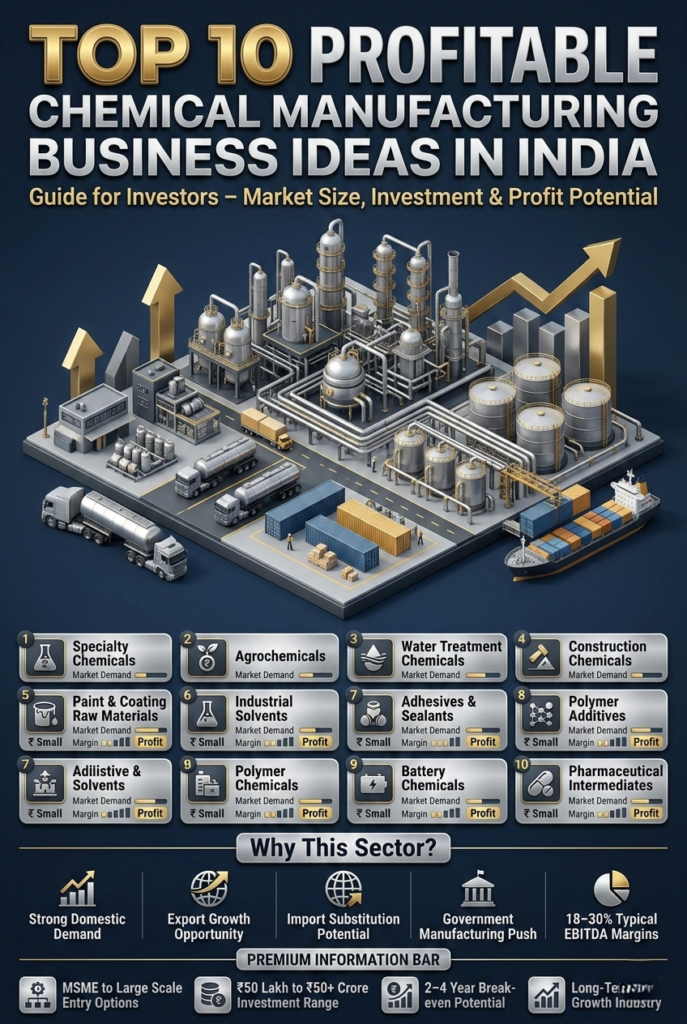
The guide presents ten chemical production opportunities in India which show high potential for development during 2026 together with investment information and growth factors and critical factors to consider.(Chemical Manufacturing Business)
Table of Contents
ToggleRead More: Modern Technology of Industrial Chemicals
1. Soda Ash (Sodium Carbonate)
Soda ash is a very basic industrial chemical, used in glass manufacturing, detergents, chemicals and, increasingly, lithium-ion batteries.
Major producers are Tata Chemicals Ltd., GHCL Ltd. and Nirma Ltd.
Why It’s Attractive:
- Increasing demand from auto glass as well as construction glass
- Expansion in EV battery production
- Periodic import dependency on demand spikes
Investment Insight:
- Capital intensive (₹300-800 Cr for large plants)
- Location advantage of limestone reserves or ports
- Downstream integration of sodium bicarbonate and silicates
2. Caustic Soda (Sodium Hydroxide)
Caustic soda is widely used in textile, pulp & paper, alumina refining and PVC manufacture.
Leading players in this field are Gujarat Alkalies & Chemicals Ltd. and Aditya Birla Chemicals.(Chemical Manufacturing Business)
Opportunity Scope:
India is more or less self-sufficient but imbalances in supply within the region create local opportunities.
Strategic Approach:
Instead of competing in mass production, entrepreneurs can:
- Focus on value added chlorine derivatives
- Industrial clusters that are lacking in their vicinity suppliers
Estimated mid scale investment: Rs 100-250 Cr.
3. Chlorine Derivatives
Chlorine is dangerous and costly to transport, so the business potential is good for derivative manufacturing alongside caustic soda manufacturing.(Chemical Manufacturing Business)
Companies, such as DCW Ltd. and Chamfer Alkalis Ltd. have constructed integrated models.
High-Demand Derivatives:
- Calcium hypochlorite (water treatment)
- TCCA (sanitation & swimming pools) “
- Aluminium chloralhydrate
- PVC intermediates
Why Invest:
- Strong sanitation demand
- Export potential
- As compared to base chlorine Higher margins
Capital requirement: Rs. 50-150 Cr on the basis of product mix.
4. Specialty Carbon Black
India produces large volumes of tyre grade of carbon black, but specialty grades for electronics and batteries are still import dependent.(Chemical Manufacturing Business)
Key Players are Birla Carbon and Phillips Carbon Black Ltd.
Growth Drivers:
- Expansion of EV ecosystem
- Manufacturing of lithium-ion batteries
- Electronics sector growth
Business Edge:
- Higher margins than commodity grades
- R&D-driven differentiation
- Export opportunities
Investment: 150-400 Cr with good environmental compliance systems
5. Hydrogen Peroxide
Hydrogen peroxide demand is increasing in all areas of textiles, pulp & paper, wastewater treatment, and healthcare.(Chemical Manufacturing Business)
Major producers are National Peroxide Ltd. and Indian Peroxide Ltd.
Market Drivers:
- Growing textile clusters
- Increasing sanitation standards
- Environmental compliance in industries
Investment Range:
The Petrochemicals sector requires ₹80-200 Cr for moderate expenditures.
The operation of textile plants in proximity to textile centres ensures that plants will experience continuous production needs while achieving lower transportation expenses.
Read More: Project Reports & Profiles
6. Precipitated Calcium Carbonate or PCC
PCC is very commonly used in plastics, paper coatings, pharmaceuticals and paints. India imports ultra fine and nano grades.
Key companies are Gulshan Polyols Ltd. and Shiraishi Calcium (India).
Why It’s MSME Friendly:
- Lower capital requirement (10-50 Cr)
- Is able to use marble waste as raw material
- Growing packaging industry
Nano-grade PCC commands premium pricing and export potential.(Chemical Manufacturing Business)
7. Titanium Dioxide (TiO₂)
Titanium dioxide is the main white pigment ingredient in paints, plastics and coatings. India is still very import-dependent.(Chemical Manufacturing Business)
Domestic producers are Kerala Minerals & Metals Ltd., Travancore Titanium Products Ltd.
Why It’s Strategic:
- Massive demand from paint industry
- Government focus specialty chemical self-reliance
- Maximum import substitutions
Challenges:
- High capital investment (₹500 Cr+)
- Stringent environmental norms
- Technology-intensive process.
Best for large investors or joint ventures.
8. Methanol Manufacturing
Methanol is one of India’s import-dependent chemicals. Domestic production covers a percentage of the total demand.
Producers are Gujarat Narmada Valley Fertilizers & Chemicals Ltd., and Rashtriya Chemicals & Fertilizers.
Growth Catalysts:
- Aim: To understand how the government implemented the push for Methanol Economy.
- Demand in formaldehyde, acetic acid, fuel blending
- Huge supply gap
Investment:
₹300-1000 Cr depending upon the scale and feed stock source.
Feedstock security (Natural gas or coal gasification) is crucial.(Chemical Manufacturing Business)
9. Manufacturing Formaldehyde & Resin
Formaldehyde This chemical is crucial for plywood, particle board, laminates, and adhesives.(Chemical Manufacturing Business)
Companies like Kanoria Chemicals & Industries Ltd. and Balaji Formalin Ltd. cater to the major markets.
Why It’s Promising:
- Growth in furniture exports
- Housing and infrastructure expansion
- Low emission resin demand globally
Investment:
₹20–80 Cr for medium-scale plant.
Export-grade, low-VOC resins provide good international opportunities.
10. Ethyl Acetate
Ethyl acetate has many uses such as paints, pharmaceuticals, adhesives, printing inks and packaging.(Chemical Manufacturing Business)
Major producers are Godavari Biorefineries Ltd. and Jubilant Ingrevia Ltd.
Business Potential:
- Strong growth in pharma and packaging
- Export demand
- Bio-ethanol based sustainable production
Investment range: Rs 50-150 Cr as per capacity
Key Success Factors of Chemical Manufacturing
Regardless of segment chosen though, success depends on:
- Location Selection for Strategic
Proximity to raw materials, ports, or industrial clusters saves on logistics costs.
- Environmental Compliance
The pollution control norms need to be followed exactly because they have to be followed without any possibility of negotiation.
- Feedstock Security
Long-term raw material contracts provide margin stability.
- Technology & R&D
The specialty chemicals field and the nano grade materials field require this particular aspect as their most important element.
- Government Incentives
The Production Linked Incentive (PLI) schemes together with state industrial policies offer financial assistance which includes subsidies and capital support and tax benefits to businesses.(Chemical Manufacturing Business)
Which Chemical Business Is Best for MSMEs?
For medium scale entrepreneurs, the most feasible opportunities are:
- Precipitated Calcium Carbonate
- Formaldehyde Resins
- Hydrogen Peroxide
- Select Chlorine Derivatives
The capital requirements for these segments remain under control while the domestic market maintains steady demand.(Chemical Manufacturing Business)
Conclusion
The chemical manufacturing industry in India will create major business opportunities during 2026 because of reduced imports and new infrastructure and rising electric vehicle demand and backing from government initiatives.
Large investors should focus on capital-intensive industries that include titanium dioxide and methanol because their business operations will generate profits for micro and small enterprises through PCC and hydrogen peroxide and formaldehyde resins and specialty carbon black.
Indian entrepreneurs who select strategic locations and implement technological solutions and follow environmental regulations and establish market connections can develop successful chemical enterprises that reach international markets.
The chemical manufacturing industry in India will generate substantial wealth throughout the next ten years because proper feasibility study followed by methodical implementation will occur.(Chemical Manufacturing Business)
Frequently Asked Questions (FAQ)
Which chemical business is best for MSMEs?
Precipitated calcium carbonate, formaldehyde resins, hydrogen peroxide, and specialty carbon black are best suited for medium-scale investments.
Which chemical has the highest import gap in India?
His stays one of the most import-dependent chemicals, representing a long-term opportunity.
Are government incentives available?
Are government incentives available? Yes, the PLI scheme and various state industrial policies provide eligible chemical projects subsidies, tax benefits and capital support.
What is the biggest challenge in chemical manufacturing?
Environmental regulations, raw material price volatility, and safety compliance are the primary challenges. Proper planning and expert consultation reduce these risks.


