






Ayurvedic medicine manufacturing business
For thousands of years, India has held one of the world’s most sophisticated systems of plant-based healing. Ayurveda, Unani, Siddha — these traditions were not folklore. They were structured medical systems with documented formulations, classified herbs, and reproducible processes. Today, that ancient knowledge is being translated into one of the fastest-growing industrial sectors in the country, and the entrepreneurs who understand both the traditional science and the modern manufacturing reality are the ones capturing the most value.
The global shift toward natural, plant-derived therapeutics is accelerating sharply. Concerns about pharmaceutical side effects, rising chronic disease burden, and growing consumer trust in ‘natural’ solutions are converging to create a market opportunity that spans continents. For Indian entrepreneurs, this timing is particularly favourable India possesses not only the botanical raw material base but also centuries of documented formulation knowledge that gives its herbal medicine manufacturers a head start that no other country can easily replicate.
But knowledge of traditional formulations alone is not enough to build a successful manufacturing business. The bridge between ancient recipes and commercially viable, compliant, scalable production requires technical depth — and that is exactly what a well-structured manufacturing handbook provides.
A Market Growing from 12 Lakh Crore to ₹32 Lakh Crore: The Numbers behind the Opportunity
The scale of the global herbal medicine market is hard to overstate. According to Grand View Research and allied market intelligence sources, the global herbal medicine market was valued at approximately USD 148.5 billion and is projected to reach USD 386 billion at a CAGR of 11.2% over the forecast period. This is not a niche wellness trend — it is a structural shift in how the world approaches healthcare.
A key data point underpinning this growth comes from the World Health Organization (WHO), which reports that approximately 80% of the global population consults traditional health practitioners and relies on plant-based medicines for primary healthcare. This is not a marginal consumer base — it represents the overwhelming majority of humanity, and as disposable incomes rise in Asia, Africa, and Latin America, so does spending on formalised herbal health products.
Closer to home, India’s own ambitions in this space are backed by policy at the highest level. The Ministry of AYUSH, Government of India, has designated Ayurveda, Yoga, Unani, Siddha, and Homeopathy as priority sectors under national health policy. AYUSH product exports from India crossed ₹14,000 crore in recent years, with the ministry targeting significant growth through initiatives like AYUSH Export Promotion and the establishment of dedicated AYUSH industrial clusters.
Domestically, the demand drivers are equally compelling. An ageing population increasingly turning to herbal alternatives to manage lifestyle diseases, a young urban demographic seeking preventive wellness solutions, and a post-pandemic surge in immunity-related herbal products have all combined to accelerate market growth at a pace that is outrunning the supply of qualified manufacturers.
Navigating the Regulatory Landscape: AYUSH, CDSCO, and GMP Compliance
One of the most significant barriers for new entrants in herbal medicine manufacturing is regulatory compliance. Unlike cosmetics, which have relatively straightforward registration requirements, medicinal herbal products — particularly those making therapeutic claims — fall under a more rigorous framework.
Under the Drugs and Cosmetics Act administered by the Central Drugs Standard Control Organisation (CDSCO), Ayurvedic, Siddha, and Unani (ASU) medicines are regulated under Schedule E and other relevant provisions. Manufacturers must obtain appropriate licences, comply with Good Manufacturing Practices (GMP) for ASU drugs, and ensure that formulations meet pharmacopoeial standards. Understanding these requirements before investing in production infrastructure is not optional — it is the difference between a business that scales and one that faces regulatory shutdown.
The Handbook on Herbal Medicines addresses this complexity by presenting production processes that are aligned with established pharmaceutical manufacturing standards, giving entrepreneurs a compliance-aware foundation from which to build their operations.
The Export Frontier: India’s Herbal Medicines Going Global
India’s herbal and Ayurvedic product exports represent a fast-growing revenue stream for manufacturers. The Agricultural and Processed Food Products Export Development Authority (APEDA) and the Ministry of Commerce track herbal product exports as part of India’s broader health product trade. The Middle East, the United States, Germany, the UK, and Southeast Asian markets are among the top destinations for Indian Ayurvedic and herbal medicine exports — and demand in these markets is growing as Indian diaspora populations and mainstream wellness consumers seek authenticated, quality-certified products.
For manufacturers who invest in GMP certification, international quality documentation, and appropriate labelling compliance, the export market represents a margin-expansion opportunity that domestic-only manufacturers miss entirely.
Government Support for Herbal Medicine MSMEs: Schemes, Subsidies, and Clusters
India’s MSME sector policy actively supports herbal and Ayurvedic medicine manufacturing. The Ministry of Micro, Small and Medium Enterprises (MSME) provides multiple pathways for entrepreneurs in this space, including PMEGP (Prime Minister’s Employment Generation Programme) loans of up to ₹25 lakh for manufacturing units, credit guarantee cover under CGTMSE, and technology upgrade support under CLCSS. AYUSH clusters established under the Cluster Development Programme further reduce infrastructure costs for entrepreneurs setting up production units in designated zones.
What this means in practical terms is that a first-time entrepreneur with a credible business plan, the right technical knowledge, and a properly prepared project report can access meaningful capital support to establish a compliant herbal medicine manufacturing unit often with lower equity contribution than would be required in most other manufacturing sectors.
Introducing the Handbook on Herbal Medicines (2nd Edition)
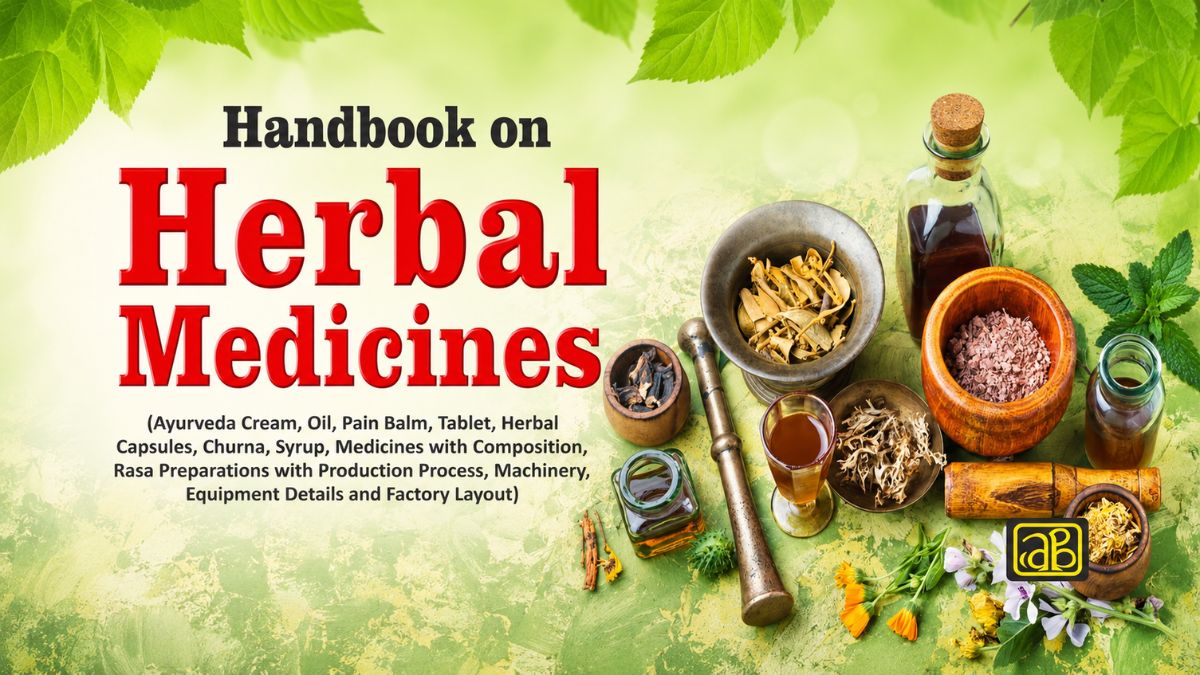
Published by Asia Pacific Business Press Inc. and authored by H. Panda, the Handbook on Herbal Medicines (Ayurveda Cream, Oil, Pain Balm, Tablet, Herbal Capsules, Churna, Syrup, Medicines with Composition, Rasa Preparations with Production Process, Machinery, Equipment Details and Factory Layout) 2nd Edition is one of the most comprehensive technical references available for anyone entering or expanding in India’s herbal medicine manufacturing sector.
At 544 pages, this handbook covers the full spectrum of Ayurvedic and herbal medicine product categories, from classical Rasa preparations to modern dosage forms like capsules and syrups. It is structured as a practitioner’s reference, not a theoretical text, every section moves from formulation composition to production process to equipment specification, giving the reader a complete operational picture for each product type.
What the Handbook Covers
The breadth of this handbook is one of its defining strengths. Product categories covered include:
- Ayurvedic creams, medicated oils, and topical formulations, covering formulation foundations, herbal extraction techniques, ingredient compatibility, and product stability practices for consistent therapeutic performance.
- Pain balms and herbal analgesic products, featuring formulation approaches, medicinal herb profiles, active ingredient combinations, and step-by-step manufacturing procedures.
- Herbal tablets and capsules, including granulation methods, tablet compression, encapsulation techniques, coating systems, and process adaptations for plant-based active ingredients.
- Churna (herbal powder) formulations, addressing raw material preparation, particle size consistency, blending methodologies, dosage balancing, and packaging requirements.
- Herbal syrups and liquid medicines, detailing extraction methods, concentration processes, preservation systems, formulation stability, and filling operations.
- Classical Rasa formulations, exploring traditional mineral-herbal medicines with modern interpretations of processing techniques suitable for contemporary manufacturing environments.
- Therapeutic formulations for multiple health categories, covering digestive health, respiratory care, musculoskeletal disorders, genitourinary wellness, cardiovascular support, neurological conditions, dermatological applications, women’s health, and endocrine-related formulations.
- Immunity and nutritional support products, highlighting one of the fastest-growing categories in the herbal healthcare market, driven by increasing consumer demand for preventive wellness.
- Herbal medicine packaging solutions, focusing on packaging material selection, regulatory labelling standards, product protection, and shelf-life management.
- Factory planning and manufacturing layouts, providing practical floor plan guidance for establishing small- to medium-scale Ayurvedic and herbal medicine production facilities.
- Machinery and equipment specifications, including processing equipment details, operational applications, and sourcing insights for efficient domestic procurement.
The Rasa Preparations Section: A Rare Resource
One section that sets this handbook apart from other herbal manufacturing references is its coverage of classical Rasa preparations — the mineral-herbal formulations that form a core part of traditional Ayurvedic therapeutics. These preparations are notoriously difficult to produce at commercial scale while maintaining classical standards, and reliable manufacturing guidance for them is genuinely scarce. The inclusion of production-oriented Rasa preparation content makes this handbook valuable even for manufacturers who already have experience with simpler herbal dosage forms.
Formulation standards for classical Ayurvedic preparations are maintained by the Pharmacopoeia Commission for Indian Medicine & Homoeopathy (PCIMH) under the Ministry of AYUSH. The commission publishes the Ayurvedic Pharmacopoeia of India (API) and the Ayurvedic Formulary of India (AFI), which define the official standards for composition, quality, and processing of Ayurvedic formulations. The handbook aligns with these established frameworks, making it a practically usable reference for GMP-compliant production.
Why This Handbook is the Right Starting Point for Herbal Medicine Entrepreneurs
The herbal medicine manufacturing sector sits at a demanding intersection of traditional knowledge, pharmaceutical science, regulatory compliance, and commercial engineering. Most entrepreneurs entering this space have strength in one or two of these areas but gaps in the others. This handbook addresses all four dimensions systematically.
Traditional knowledge holders — Vaidyas, Ayurvedic practitioners, or families with generational herb expertise — will find in this handbook the bridge to commercial-scale production: how to translate a classical formulation into a GMP-compliant batch process, what equipment to use, and how to lay out a production floor.
Business entrepreneurs with no prior Ayurvedic background will find the handbook equally accessible. It explains the therapeutic rationale for each product category in practical terms, then moves directly into production specifications. The machinery and factory layout sections are particularly valuable for those preparing capital expenditure budgets and plant design plans for bank financing or investor presentations.
For those preparing a Detailed Project Report (DPR) for bank financing or government scheme applications, NPCS’s DPR preparation services complement this handbook directly. Technical parameters, production capacity, equipment lists, and plant layout data from the handbook can be integrated directly into a DPR framework. More information is available at niir.org.
Who Should Buy This Handbook
This handbook is directly relevant for:
- Entrepreneurs planning to set up a new Ayurvedic or herbal medicine manufacturing unit
- Existing FMCG or pharma companies seeking to enter the AYUSH product category
- Ayurvedic practitioners and Vaidyas looking to commercialise traditional formulations
- MSMEs applying for PMEGP, MUDRA, or CGTMSE funding who need technical project documentation
- Export-oriented manufacturers targeting international herbal medicine markets
- R&D teams in nutraceutical and wellness companies developing plant-based product lines
- Pharmacy, Ayurveda, and life sciences students building applied manufacturing knowledge
- Consultants and project advisors preparing techno-economic feasibility reports for clients
- Investors evaluating herbal medicine manufacturing as a portfolio opportunity
Why Buy This Book
At 1,675/- the Handbook on Herbal Medicines is one of the most cost-effective investments an aspiring herbal medicine manufacturer can make. The cost of a single compliance error a rejected batch, a failed GMP inspection, or an incorrectly formulated product runs multiples of what this handbook costs. The cost of sourcing the same technical depth through consultants, trial-and-error, or fragmented online research runs far higher still.
The 2nd edition reflects updated production processes, current machinery specifications, and expanded disease-area formulation coverage making it a meaningful upgrade even for those who own the first edition. The supplier contacts details and equipment photographs remain among the most practically useful elements, giving manufacturers a procurement starting point that saves significant research time.
Frequently Asked Questions (FAQ)
Q: Does this handbook cover both classical Ayurvedic and modern herbal dosage forms?
A: Yes. The handbook covers classical preparations including Rasa, Churna, and traditional oils alongside modern dosage forms such as tablets, capsules, and syrups making it relevant for both traditionalist and mainstream supplement manufacturers.
Q: Is the machinery information current and suitable for domestic procurement in India?
A: Yes. The book includes photographs of equipment and supplier contact details specifically relevant to the Indian market, making it a practical procurement reference rather than just a conceptual guide.
Q: Does this book help with regulatory compliance under AYUSH and CDSCO requirements?
A: The handbook presents production processes aligned with established GMP frameworks for Ayurvedic medicines. For specific licensing procedures and regulatory filing, it should be used alongside official AYUSH and CDSCO guidelines.
Q: Can this handbook support a DPR or bank loan application?
A: It provides the technical foundation such as production processes, machinery, and plant layout that feeds into a DPR. For a complete financial model with BEP, IRR, and funding documentation, complement it with NPCS’s DPR services at niir.org.
Q: What makes the 2nd edition different from the first?
A: The 2nd edition includes expanded coverage of disease-area formulations, updated machinery details, and additional Rasa preparation content reflecting both market evolution and reader feedback since the first edition.
Where to Buy?
The Handbook on Herbal Medicines (2nd Edition) is available through the following channels:
India’s herbal medicine sector is at an inflection point — the market is large, policy support is strong, consumer demand is accelerating, and manufacturing capacity is still catching up. The entrepreneurs who build that capacity with the right technical foundation will define the next decade of this industry.
Order your copy today. The formulations, processes, equipment, and factory layouts are all inside waiting to be turned into a business.
Authority References used in This Article
- World Health Organization (WHO) — Traditional Medicine Fact Sheet
- Ministry of AYUSH, Government of India
- Central Drugs Standard Control Organisation (CDSCO)
- Agricultural & Processed Food Products Export Development Authority (APEDA)
- Ministry of Micro, Small and Medium Enterprises (MSME), Government of India
- Pharmacopoeia Commission for Indian Medicine & Homoeopathy (PCIMH)


