






India API market
The Indian Active Pharmaceutical Ingredient (API) sector has grown to its current state because it presents exceptional business prospects to both startups and micro, small and medium enterprises and investors. Already the third largest producer of API in the world, India is producing more than 500 APIs and responsible for 57% of the API prequalified by WHO. Despite this, the country imports almost 35% of API requirements, most of them from China. This structural gap and rising domestic demand combined with good government incentives make India an investment destination of high potential in the pharma industry.
India API Market: Size and Forecasts
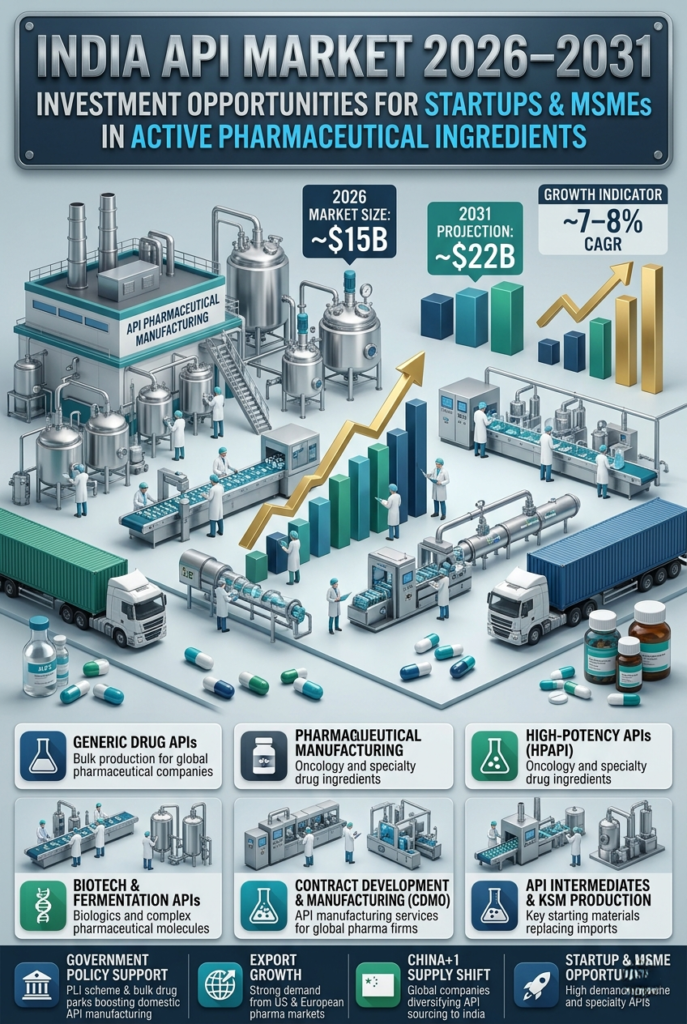
Indian API Market is USD 14.18 billion in 2025, and expected to reach USD 22.18 billion in 2031, with a CAGR of 7.74%. Key drivers include:
- Increasing Prevalence of Chronic Diseases and Lifestyle Disorders
- An aging population that is in need of long-term medication
- India’s growing importance as a world source of generic medicines|
Within the API sector, the high potency API (HPAPI) segment including oncology, hormonal, and cytotoxic compounds will grow faster than the overall market with CAGR of 8.79%.
Key Insights:
- India produces 500+ APIs which makes up a maximum share (57%) of the API’s on the WHO prequalified list
- US FDA-compliant facilities: India is the topmost outside the US
- Pharma exports (FY 2024-25): USD 30.38 billion
Import Dependence: A Critical Challenge
India requires imports of vital raw materials despite having sufficient domestic production capabilities. The country imports APIs worth 4.5 billion US dollars each year and 70 percent of these imports come from China. For antibiotics such as Penicillin G, ciprofloxacin, norfloxacin which are based on fermentation technology, import dependency is 80-100%. Even domestically produced APIs are heavily dependent on imported KSMs (Key Starting Materials), solvents and intermediates which makes the supply chain vulnerable to disruptions in the global supply chain.
Consequences of Import Dependence:
- Volatility in domestic prices: Sudden increases in Chinese supply can raise domestic API prices by 25-30%
- Operational risks: MSMEs may be faced by production stoppage or postponement of increasing capacity
- Strategic importance: The more domestic API manufacturing, the less dependence and the more self-reliance
The vulnerability of this was exposed in the Covid 19 pandemic. Factory shutdown in China caused critical shortages and India was left without any choice but to restrict its exports of 26 essential drugs, including antibiotics and paracetamol.
Government Initiatives That Are Driving API Manufacturing
Recognising the strategic importance of APIs, the Indian government has summited a number of measures to minimise the import dependency and promote domestic production.
- Production Linked Incentives (PLI) Scheme in Bulk Drugs
- Outlay: Rs 6,940 crore
- Support: 41 APIs/KSMs
- Operational projects: 32 generating 56,679 metric tonnes
- Estimated savings in import – Rs 1,362 crore
- Bulk Drug Parks
- Outlay: Rs 3,000 crore in Gujarat, Himachal Pradesh and Andhra Pradesh
- Shared infrastructure, which reduces setup costs by 25 – 35%
- Increases MSMEs and startups to indulge in API manufacturing
These initiatives lower the barriers of entry and make it feasible for small and medium sized enterprise.
High Potential Segments of API for Entrepreneurs
Not all segments of API are as lucrative for growth potential. The areas that are the most attractive are those that have a high import dependence, manageable technology requirements and government support.
Promising Segments:
1.Fermentation-Based Antibiotics
- Import dependence: 80–100%
- Penicillin G, Ciprofloxacin, Norfloxacin
- Opportunity: Domestic production eliminates supply chain risk
2.Oncology/High Potency APIs (HPAPIs)
- Premium Pricing and long term contracts
- CAGR: 8.79%
- Regulatory barriers inhibit competition to make the entry value high
3.Anti-Diabetic APIs
- Increasing demand at home and abroad with increasing lifestyle diseases
4.Custom Synthesis /Contract Development & Manufacturing (CDMO)
- Growing outsourcing trend
- Medium to High technical complexity High Profitability
Techno-Economic Feasibility
Setting up the API manufacturing unit requires proper planning and investment.
Investment Requirements:
- Synthetic APIs: Rs 15–50 crore
- Fermentation or HPAPIs Rs 50 – 200 crores
- Locating in a Bulk Drug Park will incur a saving of up to 35% in infrastructure cost
Operating Margins:
- Average: 12–14%
- Payback Period: 4–7 years
Raw Material Planning:
- Source of at least two independent suppliers for each critical input
- Utilize CSIR’s alternative KSM production to have more sourcing options
Regulatory Compliance:
- Domestic- State Drug Licence, WHO-GMP,PCB environmental clearance, CDSCO registration
- Export – US FDA DMF, EDQM CEP certificate
- Investment in quality control systems and trained personnel is a critical element to competitiveness
Investment Rationale
India’s API sector is a great strategic investment opportunity because of several factors:
- Structural Demand Gap USD 4-5 billion shortfall every year
- Government Support: PLI scheme, Bulk drug parks, CSIR initiatives
- Global Export Tailwind: Pharma companies diversifying out of China
- Cost Competitiveness: Production Costs ~40% Less than Western countries
- Patent Cliff Opportunity: 190 Blockbuster Drug Exclusivity Losses by 2030
Investors and entrepreneurs can take advantage of domestic need and policy support and global market growth.
Conclusion
The Indian API market has reached a critical turning point because domestic demand and government aid and international supply chain changes create market need. For startups and investors the combination of import needs and high-value API components and fiscal benefits creates a highly profitable business opportunity.
With proper planning, adherence to compliance and the right choice of location, India’s API sector can bring sustainable profits while adding to the country’s self-reliance in pharmaceutical manufacturing.
FAQs
Q1: What is the current size of the API market in India?
USD 14.18 billion in 2025; projected USD 22.18 billion by 2031 at a rate of 7.74% CAGR.
Q2: How much India is dependent on China for API’s?
India imports ~35% APIs; China supplies 70%. Import dependence is greater than 90% of 53 critical APIs.
Q3: What are the government schemes that help in API manufacturing?
PLI Scheme (Rs 6,940 crore) and Bulk Drug Parks (Rs 3,000 crore) for a financial and infrastructure assistance.
Q4: Minimum investment needed in an API unit?
Synthetic APIs cost between Rs 15 and 50 crores while fermentation APIs start at Rs 50 crores and can exceed 200 crores.
Q5: Which segments are the most promising for startups?
The company provides fermentation-based antibiotic production and oncology HPA API development and anti-diabetic active pharmaceutical ingredient development and custom synthesis services.
Q6: Is API manufacturing possible for MSMEs?
The company achieves its goals by investing in high-quality systems and hiring qualified staff members and building multiple supply routes.


