






SCGSS Startup Loan Scheme India
In the past decade, India’s nascent startup ecosystem has expanded to present opportunities for business leaders in various sectors, including manufacturing, technology, healthcare, food processing, retail, and services. Despite the ease of starting a business because of digital registration procedures and government assistance, securing funding is one of the major challenges that startups face.
When banks consider giving out loans to a new business, they will likely require the borrower to provide collateral, credit history, financial history and proof of regular income. These are the things that most first-time entrepreneurs will have trouble providing. Early-stage startups don’t typically have these resources. This issue of financing, Government of India had introduced the “Startup Credit Guarantee Scheme for Startups (SCGSS).
This is the SCGSS scheme which provides benefits to startups which enables them to access loans on collateral free basis, by credit guarantee of banks and financial institutions. This enables financial institutions and decreases their lending risks and supports the startups with innovation & scalability.
In this article you will be taught about the eligibility criteria, benefits of taking loan, documents to be carried, process to apply and tips to maximize your chances of getting sanctioned SCGSS start-up loan scheme.
Table of Contents
ToggleTurn your budget into a successful business plan
What is the SCGSS Scheme?
Startup Credit Guarantee Scheme for Startups (SCGSS) is a government initiative to facilitate access to institutional finance for Startups that have been identified by DPIIT under Startup India Scheme.
The government will be guaranteeing the loan, allowing startups to obtain loans more easily without requiring them to provide third-party guarantees or collateral.
This scheme is designed to be of great service to entrepreneurs who require finance for:
- Business setup
- Machinery purchase
- Manufacturing units
- Working capital
- Inventory management
- Technology development
- Marketing and expansion
SCGSS provides funding for both manufacturing and services-oriented startups, it is one of the most practical funding schemes for the early-stage startups in India.
Key Benefits of SCGSS Startup Loans
The major benefit of SCGSS is that startups do not have to offer any collateral security to obtain institutional funding.
Major Benefits Include
Feature | Details |
Loan Type | Collateral-Free Startup Loan |
Maximum Loan Amount | Up to ₹25 Lakh |
Government Guarantee | Yes |
Repayment Tenure | Up to 7 Years |
Moratorium Period | Up to 18 Months |
Eligible Sectors | Manufacturing & Services |
Funding Purpose | Fixed Capital + Working Capital |
Why the Scheme Matters
One of the major reasons why startups fail is due to insufficient working capital before they make money. SCGSS can aid companies to sustain their business in the initial growth stage and limit reliance on informal loans or loans with high interest rates that are not secured by collateral.
This scheme has been beneficial and provides good support for first generation entrepreneurs to build their businesses.
Who Can Apply for SCGSS Loans?
Not all businesses are covered by the scheme. Startups are required to fulfil certain eligibility criteria as laid down by the Startup India initiative.
Eligibility Criteria
A startup must:
- Must be acknowledged by DPIIT (Department for Promotion of Industry and Internal Trade).
- Have less than 10 years of incorporation
- The annual turnover is less than ₹100 crore.
- Concentrate on innovation, scaling up or enhancing the product/service
- Maintain legal status as an organisation
Eligible Business Structures
The following organizations may apply:
- Private Limited Company
- Limited Liability Partnership (LLP)
- Partnership Firm
- Sole Proprietorship
The scheme can be used by both urban and rural start-ups.
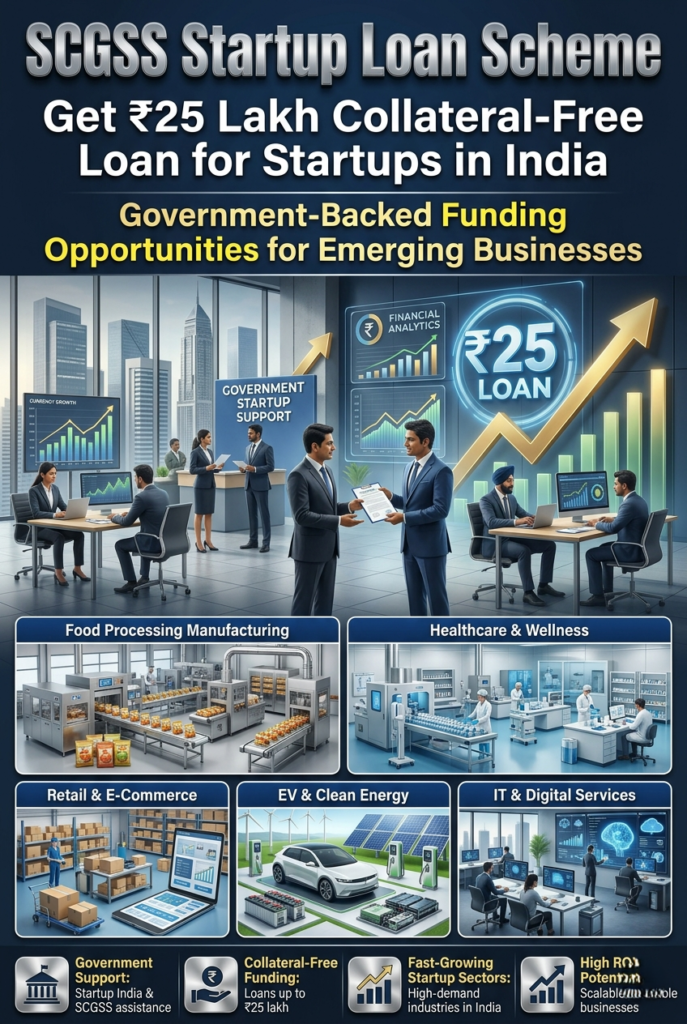
Sectors That Benefit Most from SCGSS
While startups in any industry are welcome, some industries have a higher likelihood of finding the support of lender because there is a demand for them and their industry is scalable.
High-Potential Sectors Under SCGSS
Food Processing
As the demand for packaged and value-added foods is on the rise, India’s food processing industry is on a boom.
Get Detailed Insights from This Book: Handbook on Fruits, Vegetables & Food Processing with Canning & Preservation (3rd Edition)
Manufacturing
For small-scale manufacturing businesses, funding for machinery and setup can be of great benefit, which is where SCGSS comes in handy.
Healthcare & Wellness
Institutional investments are getting more and more common in the healthcare startup ecosystem, diagnostic labs and wellness companies.
Retail & E-Commerce
The scheme is available for digital retail startups and online sellers to use for inventory and operational costs.
EV & Clean Energy
EV and renewable energy companies are making significant strides as attractive options for startup funding.
View Full Project Details: Renewable Energy Sector and Green Power Technologies
IT & Digital Services
Even service businesses that can be done using technology can receive collateral-free funding.
Why the Detailed Project Report (DPR) is Critical
The Detailed Project Report (DPR) is one of the foremost essential elements of a loan application.
The DPR is the main source used to analyse the financial viability of a startup by the bank andNBFC. If submitted, the bank will be confident of the project and its approval rate will increase.
What a Professional DPR Includes
- Business overview
- Market analysis
- Industry demand
- The cost of the machinery and set-up.
- Revenue projections
- Profit and loss estimates
- Cash flow statements
- Breakeven analysis
- Working capital requirements
- Risk assessment
One of the top reasons for the rejection of the startup loan is a weak or unrealistic project report.
Importance of Financial Planning for Startup Funding
Most business owners just look for a loan and don’t think about future planning. Lenders are interested in determining if the business can generate sufficient cash flow to repay the loan, during the repayment term.
Financial Areas Lenders Analyze
- Monthly operating expenses
- Expected sales growth
- Profit margins
- Debt repayment capacity
- Market competition
- Break-even timeline
Well-made financial projections build trust and enhance the chances of approval.
Role of NPCS in Startup Loan Approval
NIIR Project Consultancy Services (NPCS) is an India’s top consultancy firm for project reports of startups and MSMEs. NPCS has extensive expertise in developing professional DPRs, techno-economic feasibility studies and banking standard business research reports.
They are very useful to the entrepreneurs for applying for the various MSME loan schemes such as SCGSS, CGTMSE, PMEGP and other loan schemes.
NPCS Helps Entrepreneurs With:
- Detailed Project Reports (DPRs)
- Financial projections
- Market research reports
- Machinery and cost estimation
- Feasibility studies
- Manufacturing business consultancy
- Startup business ideas
NPCS is particularly sought-after by entrepreneurs who are looking to establish manufacturing units, food processing industries, healthcare projects, and industries.
The entrepreneurs can also use the:
This instrument is useful for the founders to discover profitable startup opportunities depending on the level of investment and demand of the industry.
Step-by-Step Process to Apply for SCGSS Loans
Getting all the required documents and financial information well in advance will make the entire process quite smoother.
Step 1: Obtain DPIIT Recognition
Get your startup registered under Startup India and secure DPIIT recognition certificate.
Step 2: Prepare a Bankable DPR
Develop a clear, tangible and feasible project report along with required financial forecast and a sound market analysis.
Step 3: Select the Right Lender
Approach such banks or NBFCs which enthusiastically sanction loan applications of startups.
Step 4: Submit Required Documents
Following documents are generally required:
- DPIIT Recognition Certificate
- PAN Card
- Aadhaar Card
- Business Registration Documents
- GST Registration
- Bank Statements
- Financial Projections
- Project Report
- Sector-Specific Licenses
Step 5: Loan Evaluation
The lender evaluates:
- Business model
- Financial viability
- Industry potential
- Repayment capacity
- Market demand
Step 6: Approval and Disbursement
After evaluating all the requisite documentation and credentials, a loan to the startup is sanctioned and disbursed under the aegis of the SCGSS guarantee.
It normally takes about 4 to 8 weeks for the loan approval process which varies as per lender and the documents provided.
Common Reasons for Loan Rejection
Although SCGSS is a startup-friendly environment, there are still numerous applications that get rejected due to avoidable mistakes.
Major Reasons for Rejection
Weak Project Report
Poor or incompleteness of the DPRs lowers lender confidence.
Unrealistic Revenue Projections
Exaggerated sales and profits give credibility issues.
Incomplete Documentation
Failure to fill in registrations or financial records causes delay of or rejection of applications.
Poor Banking History
If there is any irregular banking activity or prior defaults, they will have a negative impact on the approvals.
Not conducting market research.
Without appropriate demand analysis, businesses seem to be risky to lenders.
Unclear Business Model
Startups that have a clear path of operations and revenue are favoured by lenders.
Tips to Improve Approval Chances
By putting in the effort to prepare and practice financial discipline, entrepreneurs can boost their chances at loan approval.
Best Practices for Startup Loan Approval
- Keep banking history clean,
- Create reasonable financial forecasts
- Do appropriate market research
- Generate a professional DPR
- Ensure that business registrations are kept up to date.
- Display the demand for the industry clearly
- Don’t overestimate revenue projections
The importance of having a professional plan often decision-makers in lenders should rest on the quality of planning.
SCGSS vs Traditional Business Loans
Typical business loans will typically include the following:
- Property collateral
- Existing business track record
- Strong credit history
- High-value security
These barriers are reduced and the emphasis is more on business potential and innovation in SCGSS.
It is one of the most easily accessible institutional finance options for start-ups who have no assets.
Future of Startup Financing in India
The startup ecosystem in India is poised to expand a lot at Tier 2 and Tier 3 cities during the coming decade. Entrepreneurs are now able to start businesses in areas like manufacturing, healthcare, agriculture, clean energy and digitization with support from the government-run funding scheme, SCGSS.
With easier access to institutional finance, there will be more opportunities for startups with well-developed business plans and ideas that can be scaled up to become successful businesses.
Final Thoughts
The Startup Credit Guarantee Scheme for Startups (SCGSS) is one of the significant schemes provided by the Indian government for the entrepreneurs to avail collateral free funding. The scheme has helped startups get institutional finance during their early growth phase as it is backed by the state, which reduces the risk of the lenders.
SCGSS can assist you in taking your idea from conception to a successful venture whether you are planning a manufacturing unit, food processing business, healthcare venture, retail start up, or a digital service business.
Proper documentation, realistic financial planning and a professionally prepared Detailed Project Report, however, are critical to loan approval. Applying the time to create good applications certainly increases the odds of attracting investment.
With a good approach, professional advice and a scalable business model, start-ups can utilize SCGSS in a stable and profitable way.
Frequently Asked Questions (FAQ)
What’s the highest loan amount possible in SCGSS?
Collateral free loans of up to ₹25 lakh are available for startups that meet the criteria.
Do they need collateral for their SCGSS loans?
No, the scheme has been created to offer startup funding without any collateral.
Are there any restrictions on startups in the service sector?
Yes, both manufacturing and service sector startups can apply.
What is the length of the approval process?
Applications are processed in about four weeks, or quicker, depending on the application.
Can working capital expenses be covered?
Yes, the scheme provides for both fixed and working capital needs.
Do you need to recognise DPIIT?
Generally, it is required that the company be recognised by DPIIT in order to be eligible for the scheme.


