





Introduction: Exploration Licence Model India
The rising need for essential minerals has created a significant shift in India’s mining industry which now affects all mining operations within the country. The country has depended on bulk mineral extraction for its mining activities which have focused mainly on coal and iron ore and limestone mining to support infrastructure projects and industrial expansion. However, the world’s economy is gearing up strongly towards technologies with a higher level of technological complexity that require a new package of mineral resources.
Electric vehicle and renewable energy and electronics manufacturing and defence systems require lithium and cobalt and nickel and graphite and rare earth elements as essential minerals. These materials function as essential components for batteries and energy storage systems and semiconductors and high-performance industrial equipment. The worldwide demand for these technologies drives countries to compete for control over essential mineral resources.
Recognizing this strategic need, Government of India proposed Exploration Licence (EL) model as part of its mining sector reforms under the ambit of the Ministry of Mines. The objective of this policy is to promote private sector participation in mineral exploration, lower the dependence on imports and bolster domestic mineral security.
For entrepreneurs and startups the EL model is a new door of entry into one of the most important industrial sectors of the future.
What Is Exploration Licence (EL) Model in India?
The Exploration Licence (EL) model establishes a regulatory framework which allows private companies to explore deep-seated and critical minerals through government-operated open auction systems. The government established this framework to develop the mining industry while promoting investment in mineral resource exploration activities.
The Geological Survey of India and other government organizations conducted mineral exploration activities in India before the country opened its mineral resources to private companies. The limited involvement of private companies hindered the progress of discovering new mineral resources through exploration work.
Under the EL model, eligible companies can get legal permission to conduct exploration activities, including:
- Geological surveys
- Geophysical and geochemical analysis
- Drilling operations
- Resource estimation
- Feasibility studies
If commercially viable mineral deposit is found, the company may be engaged in the transition towards mining operations or formal partnership with recognized mining companies for large-scale production.
This orderly trajectory from exploration to development lessens regulatory uncertainty and enhances investor confidence in the mining industry.
Why Critical Minerals are Becoming Economically Important
Critical minerals have become increasingly important because they provide for industries that drive economic growth, technological innovation, and energy transition. As countries have shifted to cleaner energy systems and digital infrastructure, the demand for these minerals is projected to become much higher.
For example:
- Electric vehicle uses lithium ion batteries
- Solar and wind energy systems needed energy storage technologies
- Semiconductor manufacturing – Rare earth elements
- Defence equipment needs high strength alloys as well as special materials
India is currently dependent on imports of many of its critical minerals, which adds to the cost of production and leaves industries vulnerable to supply chains disruptions. Developing domestic mineral resources via exploration is thus important for long term economic stability and national security.
The government has identified a number of strategic minerals for development, including:
- Lithium
- Cobalt
- Nickel
- Rare earth elements
- Graphite
- Vanadium
These minerals are expected to play a crucial role in supporting the growth of the Indian industries in the coming decade.
Access Complete Business Plan: Project Reports & Profiles
Business Opportunities Brought About by the Exploration Licence Model
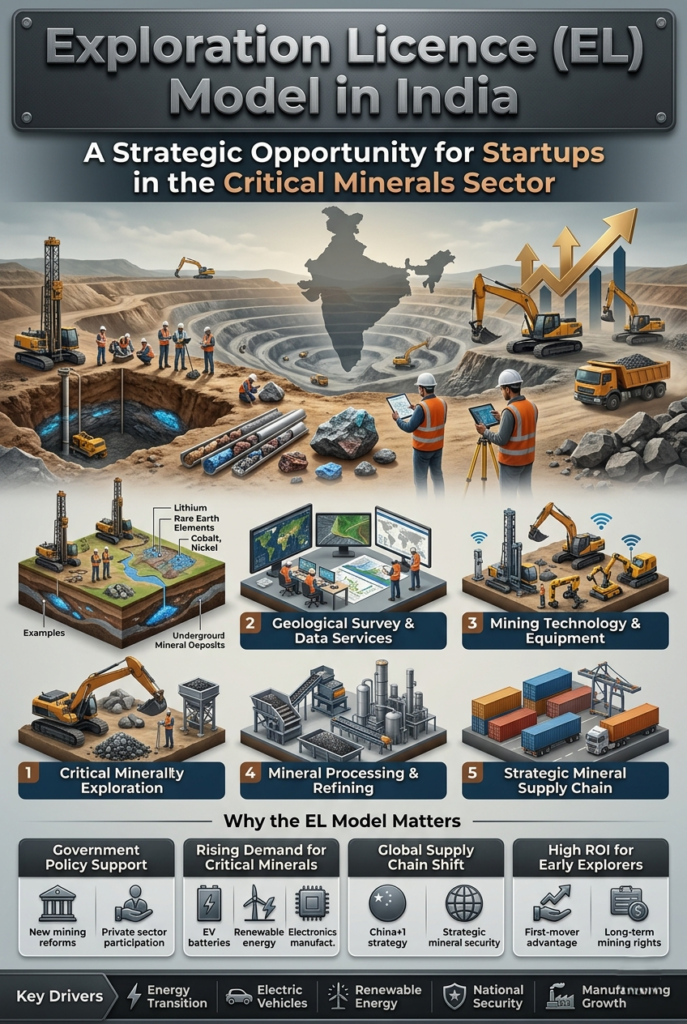
One of the most important benefits of the EL model is the opportunity that it creates for business throughout the entire mining ecosystem. Entrepreneurs do not have to necessarily run big mines to get involved with this sector. Instead, they can access the industry through special service and technology driven solutions.
Below are the significant business opportunities that the Exploration Licence framework creates.
1) Mineral Exploration Companies
The most direct opportunity is to set up a mineral exploration company. These companies specialize in locating mineral deposits by means of scientific surveys, drilling operations and evaluation of resources.
Successful exploration projects can add a lot of value to the company and attract investment from major mining companies and financial institutions.
This business model is usually characterized by:
- Geological research
- Exploration planning
- Field surveys
- Data interpretation
- Resource reporting
Although exploration carries a risk of financial loss, it provides great long-term returns if the discovery of valuable mineral deposits.
2) Geological Drilling and Equipment Services
The exploration work needs special equipment and technical expertise which creates high demand for companies that provide drilling services and equipment to fulfil that need.
Businesses that fit this category are able to deliver their services through their organizations which provide:
- Drilling machinery
- Core sampling services
- Site preparation
- Equipment maintenance
- Safety and environment compliance services
These service-based companies maintain consistent income because they operate multiple exploration projects simultaneously.
3) Startups working in the area of Technology and Data Analytics
Modern mineral exploration is based on the use of advanced technology. AI systems use satellite images together with geographical data tools to precisely locate mineral resources while reducing the dangers connected to exploration work.
Technology-driven startups such as can develop solutions like:
- Geo software (geological data analysis software)
- Remote sensing systems
- Mineral targeting algorithms
- Digital mapping platforms
- Predictive modelling tools
These businesses need less capital investment than traditional mining operations and can be scaled up rapidly across multiple projects.
4) Mineral Processing and Refining Businesses
After minerals reach the discovery stage their actual extraction needs to begin before they become usable resources. This creates business possibilities for industries that operate in refining and chemical processing fields.
Examples of downstream businesses include:
- Lithium processing plants
- Rare earth separation facilities
- Manufacturing of battery materials including
- Metal refining operations
These industries are likely to scale up rapidly as India scales up domestic production of critical minerals.
Financial Potential and Investment Prospect
The financial possibilities in the exploration sector are being fuelled by soaring global demand for critical minerals. Investors are keenly focusing on energy transition, electric vehicles and advanced manufacturing related projects.
A single successful discovery of minerals may generate significant economic value. Exploration companies are often able to attract investment even before production starts because mineral reserves are long-term assets.
Finance characteristics of exploration business include:
- High initial investment
- Long project timelines
- High upside potential
- Strong investor interest
- Strategic importance of industry
However, entrepreneurs should be willing to wait a long time for development. The typical duration for exploration projects ranges from three years to seven years until they achieve their first commercial production.(Exploration Licence Model India)
Government Support and Policy Benefits
Investment risks decrease through government backing which also helps attract private companies to explore mineral resources. The EL model functions as a component of India s mineral supply chain improvement and industrial development expansion efforts.
A number of policy initiatives have been put in place aimed at increasing transparency and efficiency in the mining industry.
Some of the key policy advantages include:
- Transparent auction system for exploration licences
- Clear legal environment for private participation
- Improved speed of approval and licensing
- Access to geological data and geological mapping resources
- Strong focus on critical mineral development
The government is also cooperating with international partners and industry organizations to develop indigenous capacity in mineral exploration and processing.(Exploration Licence Model India)
Future Outlook: Development of Critical Mineral Economy of India
India’s shift towards clean energy and high-tech manufacturing is expected to create high demand for critical minerals in the next decade. The accelerated growth in the production of electric vehicles, renewable energy systems and domestic electronics manufacturing will lead to a stable demand for mineral exploration and development.
The mining industry will experience changes in its development path because of several permanent trends which are currently active in the field:
- Rapid growth in electric vehicle adoption
- Scaling up of renewable energy capacity
- Increased investment in mineral exploration
- Development of domestic battery production
- Increasing world demand for strategic minerals
The mining industry will experience its technological evolution through the increased involvement of engineering startups and data analytics startups and environmental management startups which will shape its future direction.(Exploration Licence Model India)
Conclusion Why the Exploration Licence Model is a Strategic Opportunity for Entrepreneurs
The Exploration Licence (EL) model stands as the primary operational change which has reformed India’s mining industry through its implementation. The government has created new business possibilities for private companies through its decision to permit direct mineral exploration activities.
Startup companies that enter the market during its early stages will gain advantages from both rising customer demand and their exclusive rights to mine valuable mineral resources. While mineral exploration is a business that involves risk, the long-term rewards can be substantial for businesses that approach it with a disciplined and strategic mindset.
As the world demand for critical minerals continues to grow, exploration will become an important driver of economic development. Companies that develop expertise in this field today will have a strong hand in leading the industry in the future.(Exploration Licence Model India)
Frequently Asked Questions (FAQ)
- What is Exploration Licence in India?
An Exploration Licence is a government permit that enables companies to explore for deep-seated and critical minerals using an auction based system.
- Can start-ups apply for exploration licences?
Yes, startups can participate in licence auctions provided that they fulfil financial and technical eligibility requirements.
- How profitable is mineral exploration?
Mineral exploration can be extremely lucrative if a commercial mineral deposit is found.
- How long does it take to do mineral exploration?
Most exploration projects take between three and seven years before commercial production starts.
- What minerals are covered in the EL model?
The model is focused on critical minerals such as lithium, cobalt, nickel and rare earth elements and vanadium.


