






Introduction: Indian entrepreneurs manufacturing success stories
Manufacturing is one of the ways to build wealth in India over a long period of time. While many people talk about startups and digital businesses the truth is that factories that make products like detergent, food and medicine are very good at generating steady income and creating jobs. Many of Indias industrialists started with very little money and no help from investors. They became successful because they made decisions controlled their costs and were patient when it came to growing their businesses.
The medium-sized businesses in India play a very important role in the country’s economic growth. They contribute a lot to the country’s GDP, exports and job creation. The government has created schemes to help these businesses. There is a growing demand for their products in India and abroad. For people who are starting their business manufacturing can be a good option because it is stable can be grown over time and can lead to a long-lasting business.
This article is ten Indian industrialists who built big manufacturing businesses from scratch. It also explains the business logic behind their success so that new entrepreneurs can learn from them when starting their businesses.
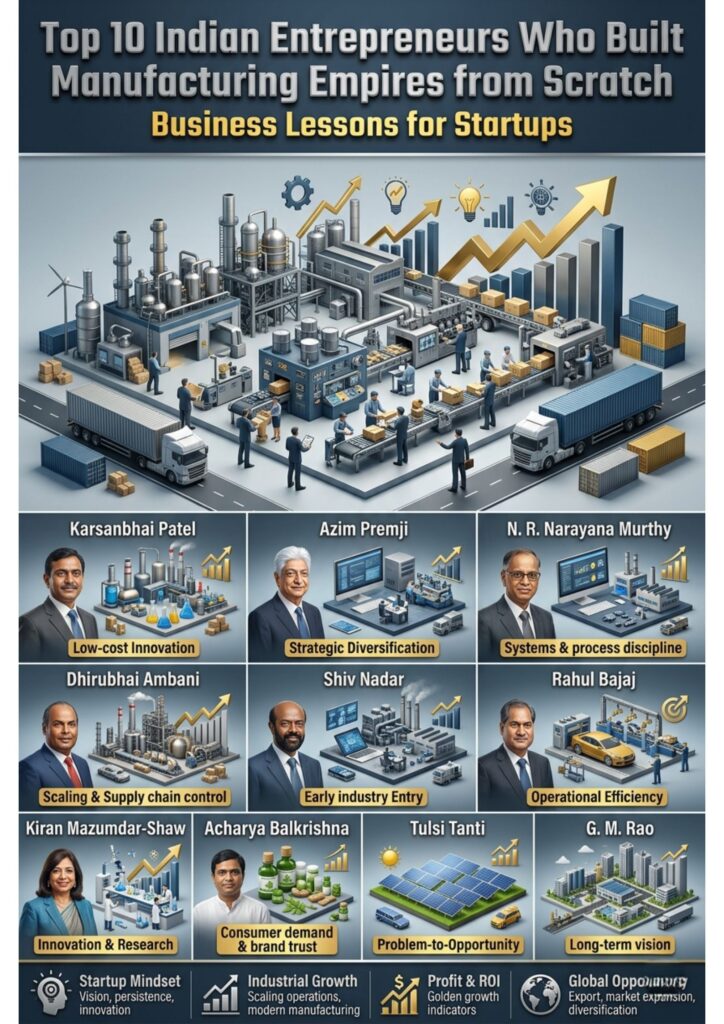
1. Karsanbhai Patel – Building Success Through Low-Cost Innovation
Karsanbhai Patel started making powder in his backyard and selling it directly to peoples homes. At that time the market was dominated by foreign brands. Of trying to compete with them on advertising he focused on making a good product at a lower price. By keeping his costs low and his operations simple he was able to sell his product to a lot of people. His success shows that making efficient products can be more effective than spending a lot of money on advertising.
2. Azim Premji – Growing Through Strategic Diversification
Azim Premji transformed a vegetable oil company into a worldwide technology enterprise. His story shows the importance of carefully diversifying your business. He researched the industry to understand sudden and risky business moves before he would enter new markets which he believed would bring about long-term benefits. The company progressed from its original manufacturing focus to develop its technological and service capabilities while maintaining operational efficiency.
3. N. R. Narayana Murthy – The Power of Systems and Process Discipline
Narayana Murthy started his company with money but built a respected global organization by focusing on standardized processes and consistent quality. The business operations used established protocols which enabled the company to expand while maintaining operational control. This principle is also important in manufacturing, where consistent production determines customer trust and long-term survival.
4. Dhirubhai Ambani – Scaling Fast and Controlling the Supply Chain
Dhirubhai Ambani began his career as a trader and he established the largest industrial company in India through his business development efforts. His strategy involved building production capacity before demand growth while controlling important supply chain components. Of relying on other suppliers he invested in making raw materials and intermediate products within his own business.
5. Shiv Nadar – Entering Industries Before They Become Crowded
Shiv Nadar recognized computing technology potential when it first arrived in India. He created a strong market position through his market entry and technical capability investments before other companies entered. Businesses that enter new markets will gain permanent benefits through their ability to create customer networks and distribution systems before their respective markets reach full development.
6. Rahul Bajaj – Operational Efficiency as a Competitive Advantage
Rahul Bajaj built an automobile manufacturing company by focusing on operational efficiency. He focused on productivity improvement and waste reduction and cost control because he wanted to expand his business but did not have sufficient resources. The company established international competitiveness through disciplined operations which enabled it to maintain its profit margins.
Access Complete Business Plan: Project Reports & Profiles
7. Kiran Mazumdar-Shaw – Building Strength Through Innovation and Research
Kiran Mazumdar-Shaw established her business through initial funding yet she faced difficulties obtaining financial assistance from banks. She dedicated her resources to biotechnology research through her substantial research and development investments. The process required extended time yet it developed a market edge while enabling entry into overseas business territories. Her story demonstrates that companies can achieve worldwide expansion through innovative strategies.
8. Acharya Balkrishna – Understanding Consumer Demand and Building Brand Trust
The market demand for natural and herbal products convinced Acharya Balkrishna to start a consumer goods company. His business operations extended beyond production activities because he dedicated resources to establishing customer trust and creating brand identity. Products will maintain their customer loyalty when customers believe in their quality and essential company values.
9. Tulsi Tanti – Turning a Problem into a Business Opportunity
Tulsi Tanti started his career in the energy industry after he paid his factory’s electricity bills. He found that rising energy consumption would create permanent business prospects so he decided to invest in wind power technology. He developed his company into a worldwide company that operates in the renewable energy sector.
10. G. M. Rao – Building Businesses with Long-Term Vision
M. Rao started his business through industrial operations and he expanded his activities into major infrastructure development projects. His strategy required organizations to adopt a method which combined monitoring progress with making strategic investments. He assessed the worth of business opportunities based on their potential to generate upcoming profits instead of pursuing immediate financial returns.
Key Business Lessons from These Industrialists
New business owners should remember and apply these lessons which successful entrepreneurs have taught through their achievements:
- Start small but think about growing and expanding your business over time.
- Be careful with your costs especially when you are just starting out.
- Maintain consistent product quality to build trust with your customers.
- Choose industries where demand is stable and predictable.
- Only expand your production after your operations are stable and profitable.
- Invest in technology and efficiency to stay competitive in the market.
These principles are simple. They are seen in the success stories of many industrialists across different sectors.
Final Thoughts
The stories of industrialists show a common pattern. They started small controlled their expenses carefully and only expanded after establishing operational systems. The team built their accomplishments through dedicated work and financial oversight while developing their expertise until they achieved success.
For people starting their business manufacturing can be a good option for long-term success. With planning, patience and continuous improvement even a small production unit can grow into a large and respected industrial enterprise.
Frequently Asked Questions (FAQ)
What is the best manufacturing business to start with investment?
Small businesses like making detergent, packaged food, plastic products and basic chemicals are often considered good for entrepreneurs with capital because they require simple machinery and have steady market demand.
How much money is needed to start a manufacturing unit?
The amount of money needed depends on the type of product and production capacity. In cases a small manufacturing unit can be started with an investment of around fifteen lakh to fifty lakh rupees.
Is manufacturing a business for first-generation entrepreneurs?
Yes manufacturing can be an option, for first-generation entrepreneurs because it allows for gradual growth builds tangible assets and generates consistent income when operations are managed efficiently.


