






bootstrapped companies in India
In India people think that to make a business big you need venture capital. You see it everywhere. When companies pitch their ideas, when they announce funding and when they talk about their successes.. Some of Indias most successful and long-lasting companies were built without taking any money from outside investors.
For people who are starting their businesses, especially first-generation entrepreneurs, owners of small and medium-sized businesses and investors in industries these stories of success without outside funding are really inspiring. They also provide a roadmap for building businesses from scratch. Here we will look at eight companies that started small and became leaders in their industries and we will highlight the lessons that entrepreneurs can learn from them.
1. Zerodha – Changing the Brokerage Game in India
Nithin Kamath started Zerodha when the brokerage industry in India was controlled by companies that charged high fees. He saw that this was unfair. Started a new way of doing things. A flat-fee brokerage system that used technology to make it work.
What is really amazing is that Zerodha never took any money from venture capitalists. The company paid for all its upgrades and expansions using the money it made. Today Zerodha makes over 2,000 crore rupees in profit every year, which shows that focusing on what customers need and being efficient can lead to success.
Key things to learn from Zerodha:
- Find areas where the cost’s too high and offer better value using technology.
- Focus on making a profit of growing really fast with outside money.
2. Zoho Corporation – Being Patient and Focusing on Good Products
Sridhar Vembu started Zoho Corporation with network management software which later developed into a complete business system that includes customer relationship management and accounting and human resources and email services.
Vembu believes in taking the time to develop products instead of looking for quick ways to grow. By putting the money the company makes back into research and development and by hiring people from smaller towns Zoho has been able to keep its products at a high level while keeping costs low. With revenues of over 1 billion US dollars every year Zoho shows that being patient focusing on products and being careful with money can be more successful than companies that have a lot of outside funding.
Key things to learn from Zoho:
- Put the money you make back into making your products better.
- Focus on creating value in the term instead of looking for quick growth.
View Full Project Details: Project Reports & Profiles
3. Cello Group – Building a Known Brand in Everyday Plastic Products
The Cello Group, which was started by the Rathod family began by making plastic products for the home and then expanded into writing instruments, kitchenware and insulated flasks. Each new product line was paid for using the money made from the line, which meant they did not need to take any outside funding.
The success of Cello shows that in markets where people buy things for use being consistent reliable and having a wide reach is often more important than being new and different. In areas that might seem boring growing in a smart way can lead to really good returns.
4. Supreme Industries – Growing to a Big Scale and Being Disciplined
Supreme Industries started as a small unit that processed plastic and grew into one of Indias biggest plastic companies. The Taparia family focused on investing in making products before they were needed and on keeping costs under control.
By focusing on plastics they were able to grow over time which allowed them to make more profit. Entrepreneurs who are thinking about starting businesses can learn that focusing on areas with a strong demand, like plastic pipes packaging for industries and processing polymers can provide opportunities for sustainable growth.
5. Haldiram’s – Finding Success in the Food Industry
Haldirams evolution from a Bikaner snack and sweet shop to a multi-billion enterprise demonstrates that reinvesting profits into your company leads to success. The company grew by making products improving its cold chain and building its brand all without taking any outside funding.
This story highlights that the food processing industry is still a margin and high-growth area especially with government incentives like the Production Linked Incentive and PMKSY schemes that support small manufacturers.
6. Jyothy Labs – Using Distribution as a Strategic Advantage
M.P. Ramachandran started Jyothy Labs with a product called Ujala fabric whitener in Kerala. Grew it into a well-known brand across India. His strategy was simple: dominate one area and then use the money and distribution network to launch products.
Today Jyothy Labs has expanded into dishwashing, mosquito repellents, laundry detergents and personal care products. This shows that having a distribution strategy and understanding rural and semi-urban markets can help companies that do not have outside funding compete with big global companies.
7. Nilkamal Ltd. – Growing Through Good Products
Nilkamal Ltd. Grew in both business-to-business and business-to-consumer markets by putting the money it made back into production and distribution. The company was able to grow in a way without outside funding by innovating with its products and managing its cash flow carefully.
Lesson: You can be profitable. Grow without venture capital if your product strategy and distribution are aligned.
8. Presto Lifesciences – Innovating with Internal Revenue
Presto Lifesciences funded innovations in homeware plastics using the revenue from its existing products showing that even in manufacturing using the money you make can drive continuous product development.
Patterns Behind Success Without Outside Funding
When we look at these companies we see some patterns:
- Focusing on revenue first: Making products that generate cash before scaling up.
- Being operationally efficient: Using technology to reduce costs and replace processes.
- Focusing on distribution: Having deep distribution networks often matters more than marketing.
- Funding products internally: Using the money from existing products to grow ones.
- Choosing areas with demand: Picking sectors that will have demand in the long term ensures sustainable profitability.
New Opportunities for Entrepreneurs Without Outside Funding in India
- Packaged and ready-to-eat foods
- Plastic pipes and polymer products
- Business-to-business software for medium-sized enterprises
- Specialty chemicals and agro intermediates
- Consumer homeware and durable goods
Related Article:Union Budget 2026: Boosting Growth in Key Sectors and MSMEs
Why Not Taking Outside Funding Works in India
The government is supporting businesses more than ever. Schemes like loans without collateral, technology upgrades Production Linked Incentives and state-level subsidies make it easier for companies without funding to grow. These companies also get to keep control, which means they do not have to chase metrics that do not matter or grow too fast.
NPCS: Supporting Bootstrapped Entrepreneurs
NPCS (National Productivity & Competitiveness Support) provides Indian SMEs with productivity and operational support. Services include process improvement consulting, lean manufacturing tools, and technology upgrades. When combined with government incentives like credit guarantees, Production Linked Incentives, and state subsidies, NPCS helps entrepreneurs grow without relying on external funding.
Conclusion
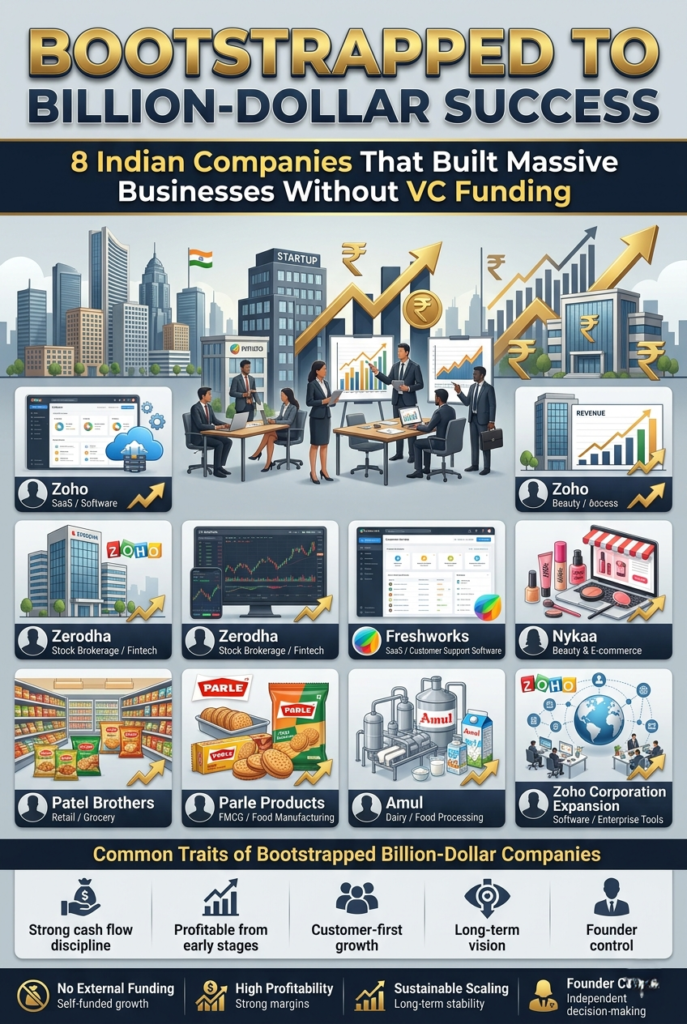
Bootstrapping has transformed from a basic survival method into an effective approach for developing successful long-lasting businesses. The combination of revenue-first products with structural demand and disciplined cash allocation enables entrepreneurs to maintain ownership while achieving sustainable growth to compete against VC-funded competitors. The business paths of Zerodha, Zoho, Cello, Supreme Industries, Haldiram’s, Jyothy Labs, Nilkamal, and Presto demonstrate that vision combined with patience and intelligent execution brings better business success than financial power.
Frequently Asked Questions About Businesses Without Outside Funding in India
Q1: What is the biggest advantage of not taking funding?
Having control and making decisions, which allows founders to focus on profitability.
Q2: Which sectors are best for companies without funding?
Food processing, fast-moving consumer goods, plastics, business-to-business software, specialty chemicals and consumer homeware.
Q3: Can companies without outside funding compete with those that have venture capital?
Yes. Companies like Zerodha and Zoho show that being efficient having products and smart distribution can beat companies with a lot of funding.
Q4: What support does the government offer to medium-sized enterprises?
Schemes include credit guarantees, technology upgrades, Production Linked Incentives and state-level subsidies for land, power and industrial permits.


