






Introduction
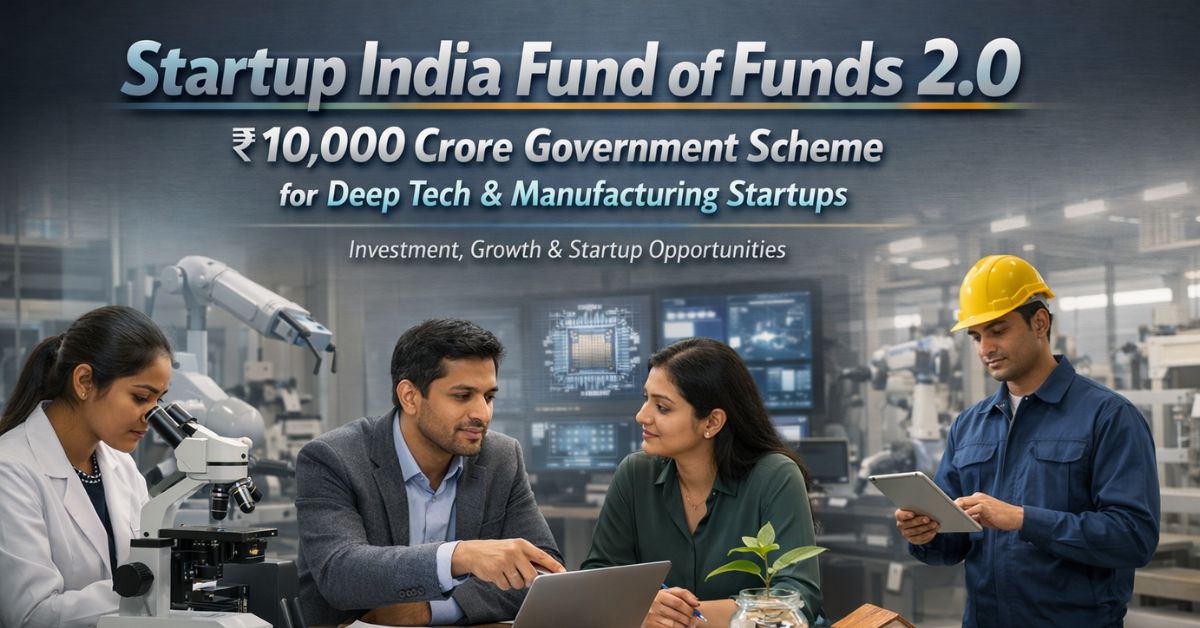
Startup India Fund of Funds 2.0 (FoF 2.0) with a corpus of 10000 crore has been approved by Government of India to speed up the growth of startups in the country. The target of this plan is obvious – fund deep tech innovation, manufacturing startups, and early-stage entrepreneurs, particularly in Tier 2 and Tier 3 cities.
India has since surpassed 2 lakh DPIIT-registered startups, yet it is not the count, but the access to early-stage funding. In hardware, biotech, robotics, and industrial manufacturing, raising equity capital remains a challenge to most startups. FoF 2.0 will address this very gap.
Table of Contents
ToggleWhat is Startup India Fund of Funds 2.0?
Startup India Fund of Funds 2.0 is not a funding scheme. Rather, the government pours money into SIDBI that subsequently investing in the registered Alternative Investment Funds (AIFs). These AIFs make investments in startups.
This system makes it more efficient and market-driven as the money is evenly distributed by professional fund managers. It minimizes the chance of direct government interference in choosing the startups, as well.
Why FoF 2.0 is Important for India
The Indian startup ecosystem is rapidly expanding, with excessive funding being concentrated in some of the major metro areas such as Bengaluru, Mumbai, and Delhi NCR. Over 80 percent of venture capital is concentrated in these areas and many promising startups in smaller cities are left behind.
Investor preference is another significant problem. Software startups have been favored by most of the private investors due to their rapid payoffs. Nevertheless, deep tech and manufacturing startups take more time to develop, in most cases, 18 to 36 months until they start generating revenue.
This is where FoF 2.0 is of great essence – it introduces capital by patients in areas that are usually shunned by private investors.
How the Funding Process Works
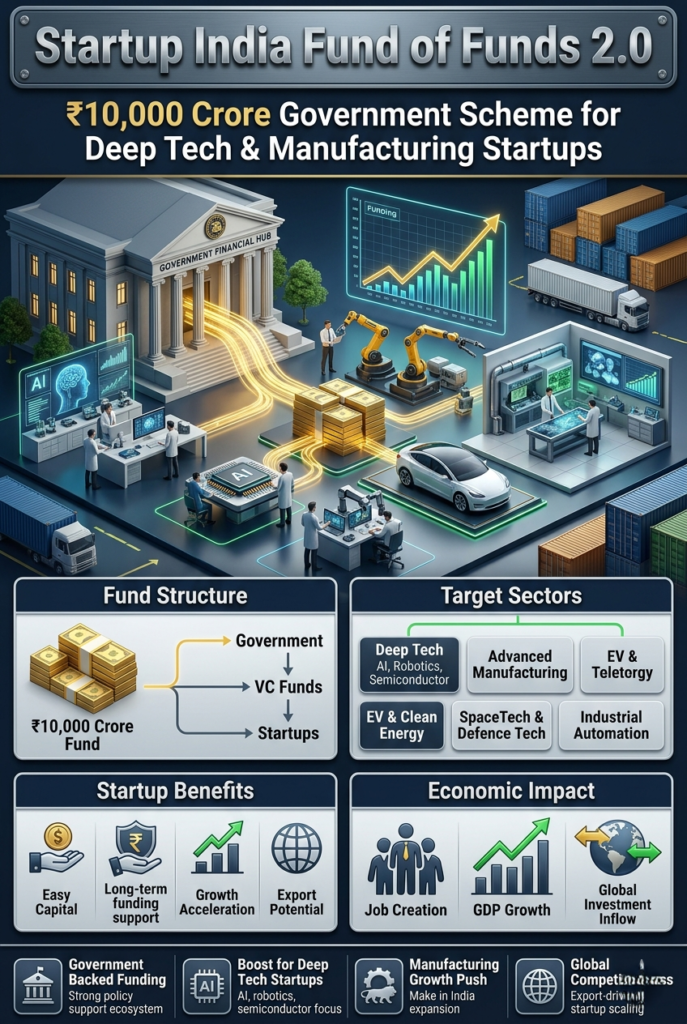
The FoF 2.0 funding structure is systematic and indirect. The government does not directly provide money to startups.
- Government → SIDBI → AIFs → Startups
SIDBI provides funds to venture capital firms (AIFs) and the AIFs make investments in the selected startups after due diligence. This makes sure that when opportunities are considered by experienced investors; they are considered on their actual potential and not policy goals.
Get Detailed Project Report (DPR): Project Reports & Profiles
Who Can benefit FoF 2.0?
FoF 2.0 is targeted at startups in high-impact, innovation-driven industries. These are artificial intelligence, robotics, semiconductor technology, clean energy, agri-tech, medical devices and advanced manufacturing.
Startups in non-metro towns are also a major target since the government aims at decentralizing innovation outside major cities.
Key sectors that benefit most:
- Deep tech and AI-based solutions.
- Automation of industries and robotics.
- Semiconductor and electronics: manufacturing.
- Clean energy and EV technology.
- Medical equipment and biotech innovation.
Get Detailed Insights from This Book: Our Books
Expected Funding Range
In FoF 2.0, funding will be based on the stage and potential of a start-up. Early-stage startups can be funded at ₹25 lakh and more, depending on the previous Fund of Funds performance, whereas deep tech and manufacturing startups can get 2 crore and 25 crore or more.
The manufacturing and hardware are supposed to be more heavily funded due to the capital-intensive nature of those businesses.
How to get funding under FoF 2.0.
Under this scheme, startups have to pursue a systematic route in order to access funds. DPIIT recognition that serves as a gateway to eligibility is the most important requirement.
Then startups need to work on the establishment of a robust base. This involves the right incorporation as a Private Limited Company or LLP and the development of a clear business model with market potential.
Major steps to prepare are:
- Startup India DPIIT recognition.
- Proper company incorporation
- Good business plan or DPR.
- IP filing (in case of tech based startups)
- Connecting with AIFs and incubators
After these steps are made, startups may now turn to venture capital funds, incubators and accelerators which are connected to the scheme.
Other Government Schemes that benefit Startups.
FoF 2.0 is not an independent opportunity. It is also in collaboration with various other government programs which help startups in various stages.
As an example, CGTMSE offers loans, which are without collateral, to MSMEs, whereas PMEGP offers subsidies to manufacturing facilities. Startups in biotechnology can raise funds under BIRAC, and early-stage innovators can avail themselves of the Atal Innovation Mission.
Collectively, these initiatives form a powerful ecosystem in which startups can fuse equity funding, loans, and grants to grow quicker.
Role of NPCS in Startup Funding Success
NIIR Project Consultancy Services (NPCS) has a very significant role to play in the process of making entrepreneurs investment ready.
NPCS has over 45 years of experience in offering comprehensive project reports, feasibility studies as well as market analysis which is highly utilized by banks, investors and other financial institutions.
NPCS helps startups in:
- Drawing up elaborate project reports (DPRs).
- Financial planning and cost estimation.
- Market research and demand analysis.
- Manufacturing project technical feasibility.
This record is very crucial as investors in AIFs do not invest in ideas, they invest in organized, tested and profitable business models. NPCS assists in turning simple ideas into bankable projects.
Conclusion
Startup India Fund of Funds 2.0 is a major step toward strengthening India’s innovation ecosystem. The organization intends to establish an independent economy through its dedication to deep technology development and manufacturing operations.
The funding process requires startups to establish their documentation systems and identify suitable investors before they can receive financial support.
The people who make preparations before the program starts will achieve the greatest advantages when financial resources become available through this initiative.
FAQs
Q1. What is Startup India Fund of Funds 2.0?
It is a government-supported fund of 10,000 crore and it does not directly invest in startups, but rather through venture capital funds (AIFs).
Q2. Who is eligible?
Startups in deep tech, manufacturing, AI, biotech, and other areas of innovation that are recognized by DPIIT.
Q3. Is it possible to apply directly?
No, it is not the government itself but via AIFs and incubators.
Q4. What is the maximum amount of funding that startups can receive?
Depending on stage and sector, funding can be between ₹25 lakh and ₹25 crore.
Q5. Is there a need to have DPIIT recognition?
Yes, it is obligatory to be eligible.
Q6. What does NPCS do to support startups?
NPCS offers project reports and feasibility studies which are used to attract investors and raise funding by startups.


