




An In-Depth Feasibility Analysis for Indian MSME Entrepreneurs
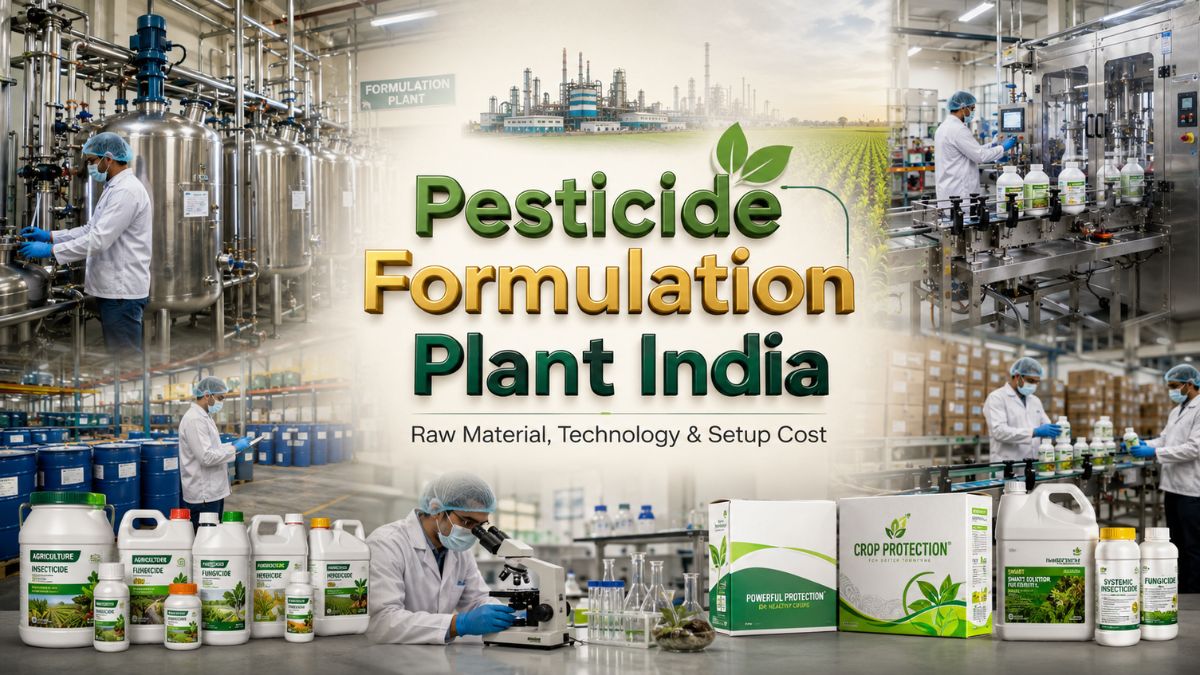
India’s agrochemical industry is emerging as one of the fastest growing manufacturing industries for the MSME entrepreneurs. One of the most lucrative ventures in this line is the manufacture of Pesticide formulation (particularly Suspension Concentrate SC and Wettable Powder WP and Emulsifiable Concentrate EC).
Pesticide formulation manufacturing is drawing in new businesses and existing chemical firms with the rise in demand for crop protection chemicals, high agricultural productivity pressure and increasing export possibilities. India is still playing a key role in agrochemical industry for both domestic and global markets, according to the Ministry of Chemicals and Fertilizers.
Formulation manufacturing does not need the same level of investment as technical grade pesticide manufacturing and is more scalable. Entrepreneurs can start with one formulation category and then move on to multiple products as per market demand.
Table of Contents
ToggleGet Detailed Insights from This Book: Handbook On Chemical Industries (Alcohol Based)
Why the Pesticide Formulation Business Has Strong Future Potential
India is still lower on the use of pesticides per hectare than many developed agricultural economies. This implies that there is a high potential for future development, as more and more farmers turn to crop protection and yield improvement.
Several factors are driving demand:
- Increased awareness of farmers
- The spread of commercial farming.
- Increasing herbicide consumption
- The increase in horticulture farming areas
- Strong export demand
- Government support for agrochemical manufacturing
Global supply diversity is a very significant contributor to the sector’s growth. As many countries are cutting down the reliance on Chinese agrochemical imports, they are finding a way to rely on Indian agrochemical manufacturers for a reliable supply.
Understanding SC, WP & EC Formulations
Suspension Concentrate (SC)
SC formulations are liquid pesticides in which the very fine particles of the active ingredients stay in liquid state. These formulations are said to be environmentally safer due to the minimal number of solvents used.
Major Advantages of SC Formulations
- Better shelf life
- Lower solvent usage
- Safer handling
- Premium market demand
- Higher export potential
Advanced equipment such as bead mills and homogenizers are used in the SC manufacturing process, which requires higher investment, but is more beneficial for long-term profits.
Estimated Investment
Rs. 80 lakhs to Rs. 1.5 crore
Expected Gross Margin
18%–26%
Get Detailed Project Report (DPR): Pesticides from Neem Seeds & Leaves – Project Report
Wettable Powder (WP)
Pesticides made from powder, such as talc, silica or kaolin are called Wettable Powder formulations. These products are dispersed in water prior to spraying.
Mancozeb WP is still one of the top selling fungicide products in India.
Advantages of WP Formulations
- Lower machinery cost
- Easier storage
- High demand for fungicides in the market.
- It is easy to use for small-scale MSMEs.
Compared to other agrochemical plants, the WP plants are easier to install and are also used by the novice agrochemical entrepreneurs.
Estimated Investment
Rs. 50 lakhs to Rs. 90 lakhs
Expected Gross Margin
14%–20%
Emulsifiable Concentrate (EC)
EC formulations are pesticides that are liquid with active ingredients dissolved in solvents and emulsifiers. These formulations are typical of those used for insecticides and herbicides.
Benefits of EC Manufacturing
- Faster production process
- High market demand
- Contract manufacturing application is suitable
- Easier formulation technology
However, fire safety systems and proper solvent storage are necessary with EC plants as there are potential chemical handling risks.
Estimated Investment
Rs. 60 lakhs to Rs. 1.2 crore
Expected Gross Margin
16%–22%
Raw Materials Required
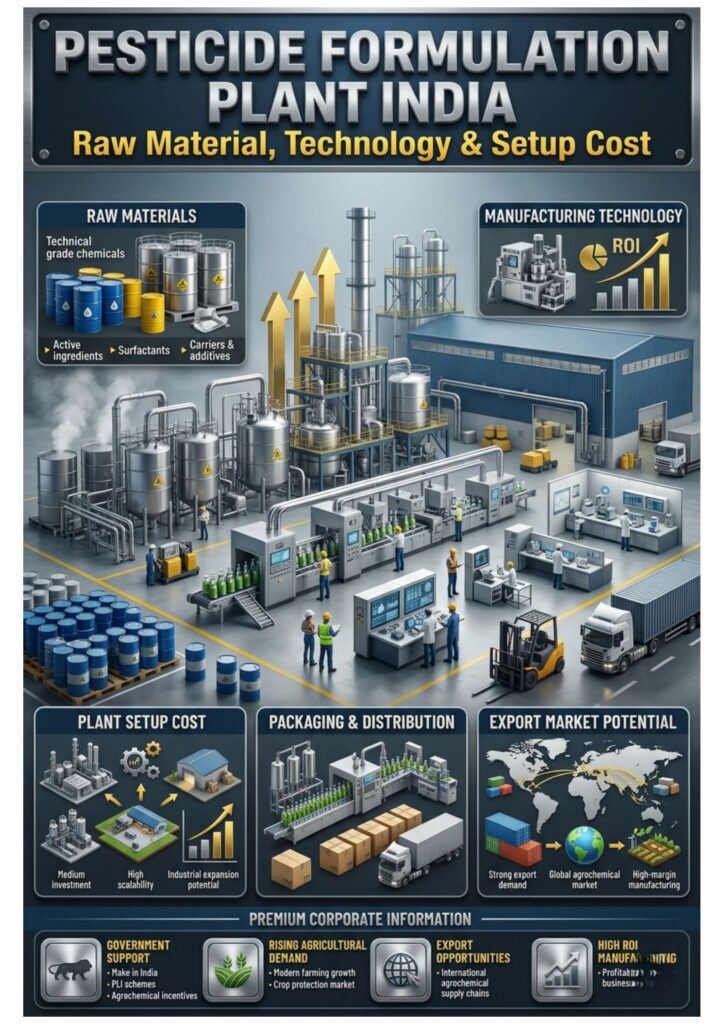
The most important raw material is the technical grade pesticide active ingredient. Other than that, manufacturers need solvents, surfactants, stabilizers, fillers, preservatives and packaging materials.
Common Raw Materials Include
- Technical-grade pesticides
- Talc powder
- Kaolin
- Silica
- Solvents
- Emulsifiers
- Surfactants
- HDPE bottles/pouches
The stability and performance of products is closely linked with this quality of materials.
Machinery Required for Pesticide Formulation Plants
The machinery used will vary depending on the type of formulation being produced.
Common Machinery Used
- Ribbon blender
- Pulveriser
- Bead mill
- Homogenizer
- Mixing tanks
- Filling machine
- Packing machine
- Dust collector
- Storage tanks
In multi-product plants, automation enhances production efficiency and minimizes wastage.
Pesticide Formulation Plant Setup Cost in India
Set up cost is dependent on production capacity, level of automation and the type of formulation.
Plant Type | Investment Range |
WP Unit | Rs. 50–90 lakh |
EC Unit | Rs. 60 lakh–1.2 crore |
SC Unit | Rs. 80 lakh–1.5 crore |
Multi-Product Plant | Rs. 2–3.5 crore |
Working capital and land cost are not included.
Licenses Required in India
The manufacture of pesticides is a highly regulated business. There are several approvals that need to be made before production begins.
Important Licenses Include
- CIB&RC Registration
- Pollution Control Board NOC
- Factory License
- Fire Safety Approval
- GST Registration
- MSME/Udyam Registration
The approval process may take 12 to 24 months and is dependent upon product type and type of registration.
Best Locations for Pesticide Manufacturing
Chemical industrial zones have better infrastructures and logistics support, which is preferred by many entrepreneurs.
Best States for Setup
- Gujarat
- Maharashtra
- Telangana
- Andhra Pradesh
- Rajasthan
Chemical hubs such as Ankles war, Dahej, Tarapur and Hyderabad provide good chemical ecosystem and availability of raw materials.
Export Opportunity in Agrochemical Formulations
Strong Demand for Indian pesticide formulations in following mentioned markets:
- Africa
- Southeast Asia
- Latin America
- Middle East
The competitive price and increasing quality standards make Indian products preferred by the international buyers. Premium export markets are easier to access for manufacturers who have registered and have their product tested by NABL.
Why Multi-Product Plants Perform Better
Many of the successful agrochemical companies produce several formulations rather than relying on a single product.
A combined SC + WP + EC setup aids:
- Reduce business risk
- Improve distributor relationships
- Increase product portfolio
- Improve plant utilization
- Expand export potential
It is a model that is becoming more and more popular for medium-scale entrepreneurs.
How NPCS Helps Entrepreneurs
NPCS (Niir Project Consultancy Services) provides aid to entrepreneurs in preparing detailed project reports (DPRs) and feasibility studies for pesticide formulation projects.
NPCS provides:
- Techno-economic feasibility reports
- Machinery supplier details
- Raw material sourcing guidance
- Manufacturing process information
- Financial projections
- Profitability analysis
- Break-even calculations
- Market demand analysis
Investment risk can be lowered and project planning enhanced for first-time entrepreneurs through reports on NPCS.
Future of Pesticide Formulation Industry in India
The prospects for pesticide formulation manufacturing industry are very promising due to the growth of food demand, the pressure on agricultural productivity and export growth.
Fastest Growing Segments
- Suspension Concentrate (SC)
- Bio-pesticides
- Botanical formulations
- Herbicide formulations
In general, with increasing environmental regulations around the world, eco-friendly and low solvent formulations are likely to rise rapidly.
Conclusion
With proper technical planning, regulatory compliance and market development, establishing a pesticide formulation plant in India can be a very lucrative business in the long run.
The use of WP and EC formulations is a good choice for lower risk MSME entry, whereas the SC formulations provide better long-term positioning and export prospects. Those entrepreneurs who emphasize on quality manufacturing, raw material stability, and robust dealer networks can develop robust agrochemical businesses in the expanding Indian market.
The future of pesticide formulation plants in India is promising as the domestic demand is rising, export opportunities are increasing and pesticide formulation industry is supported by the government to manufacture pesticides.
FAQ
What will be the minimum investment to set up a Pesticide formulation plant?
A small-scale formulation plant will need approximately Rs. 1 crore to Rs. Total asset of Rs 1.5 crore (which includes machinery and working capital).
Which is the largest margin?
SC formulations typically have higher margins in the long-term, because of premium positioning and export demand.
Is Pesticide Business Profitable in India?
Yes, with the right product and expanded reach, profit margins can be as high as 14% to 45%.
What is the best state for manufacturing of pesticides?
Gujarat and Maharashtra are regarded to be among the best ones due to their robust chemical infrastructure.
Are there opportunities for export of pesticide formulations by MSME units?
Yes, if it meets international quality standards and product registration requirements.
Is DPR formulated at NPCS?
Yes, NPCS does prepare a complete project report and feasibility study for pesticide manufacturing firms in India.


