





Papain Manufacturing Business in India
One of the most obvious examples of this is in the case of papain, where an estimated 70-80% of the world’s output is from India and India’s papaya is grown almost exclusively in Tamil Nadu, Karnataka and Andhra Pradesh. Yet, 80–90% of this production is sold as relatively low value crude or semi-refined product, not as high value, pharmaceutical grade product. The downside of raw dominance and downside of value-added capture is where the opportunity lies for an entrepreneur.
What Is Papain?
Papain is a proteolytic (protein-digesting) enzyme, in particular a cysteine protease, produced by the milky latex of unripe, green Carica papaya fruit. Papain is one of two enzymes found in papaya juice, in addition to chymopapain, which is more abundant but less potent. Both of these enzymes are important in the industry because they can break proteins down to smaller peptides and amino acids at a wide variety of temperatures and pH.
Papain is processed and sold in two major forms:
- Crude papain – the dried, unrefined latex, low value, usually sold in bulk to overseas refiners.
- Refined/purified papain – (Enzyme activity and purity levels: > 90% enzyme activity, > 90% purity with modern extraction methods, up from ~ 75% enzyme activity and purity 10 years ago, pH 5-9.5, extraction method: acid fruit juice extraction); processed papain by filtration, purification, and often chromatography purification and verification of its purity, enzyme activity and pH ranges, 5-9.5; it is suitable for pharmaceutical and food-grade applications.
Papain’s uses are quite unusual and run the gamut of industries:
- Food and beverage – natural meat tenderizer, beer/beverage clarifying (chill-proofing) agent, digestive aid additive
- Pharmaceuticals include digestive enzyme supplements, wound debridement ointments (removing dead tissue), anti-inflammatory formulations.
- Food and beverages – for use in food and drinks as a natural exfoliant, anti-aging and brightening agent
- Stain & waterproofing – a variety of treatments for various fabrics, including treatment of wool, silk and cotton.
- Leather processing – enzymatic dehairing is an alternative method in development compared with the chemical-based alternative, which is more environmentally friendly and gaining traction in markets subject to regulation such as the EU market.
View Full Project Details: Papain Extraction from Papaya
Global and India Papain Market Size and Growth
There are several different published market-size estimates, depending on the research firm and the nature of the product (crude and refined papain is either included or not). However, the overall growth pattern is the same. The global papain market is estimated to be in the range of USD 412 million to USD 690 million in the year 2024 and is projected to reach between USD 712 million and USD 1.14 billion by the early-to-mid 2030s, with the average CAGR in the range of 5.7% to 6.8%.
The global capacity for papain production is around 18,600 metric tonnes, with refined papain (11,700 tonnes) surpassing crude papain (6,900 tonnes), indicating that the global market is increasingly being driven by the demand for value-added and purified papain.
Note on figures: The range of figures in the published material is so wide, and there is such a split between crude/raw material and refined product reporting that it is important to regard the figures above as indicative only. NPCS can develop investor grade techno-economic feasibility study based on your scope of work for crude or refined product, food, pharma or cosmetics.
India’s Global Leadership Position
By far, India has the largest production of papain in the world:
- An estimated 70–80% of the world’s papain is produced in India, of which one estimate projects that India will produce over 9,800 metric tonnes of papain in 2024, which is nearly three times the amount produced by China (3,200 tonnes).
- Papaya production is concentrated in Tamil Nadu, Karnataka and Andhra Pradesh where the infrastructure for papaya cultivation and collection of latex is better developed.
- As per history, 80-90% of the papain in India is exported, mostly to the United States and Europe; the importers in the west often import latex or semi-purified latex for final refining in their own plants.
This concentration leads to structural import dependence in major consuming markets, such as the US, the EU and other pharmaceutical and food-processing markets where India’s producers have a real and sustainable structural edge over their competitors.
Policy Tailwinds
- APEDA export promotion: being an agro-processed product, Papain can avail and utilise the export promotion infrastructure of the government of India, APEDA, which helps in accessing markets and documentation for export orders.
- CDSCO API registration framework: For pharmaceutical-grade papain, India’s Central Drugs Standard Control Organisation registration pathway — while adding documentation rigor — also creates a quality-compliance moat that favours integrated, capable Indian processors over informal exporters as global buyers tighten purity requirements.
- MSME and agro-processing incentives: Papain extraction and processing units are agro based value addition enterprises thus can avail capital subsidy schemes for MSME in southern states and agro-processing cluster incentive schemes.
- The global regulatory requirements (REACH and EU F-Gas) further increase the purity requirements of imported enzymes into Europe, but also help established, chromatography capable Indian processors more than the artisanal extraction units, thereby increasing the ‘entry bar’ for these ‘serious and well-capitalised players.
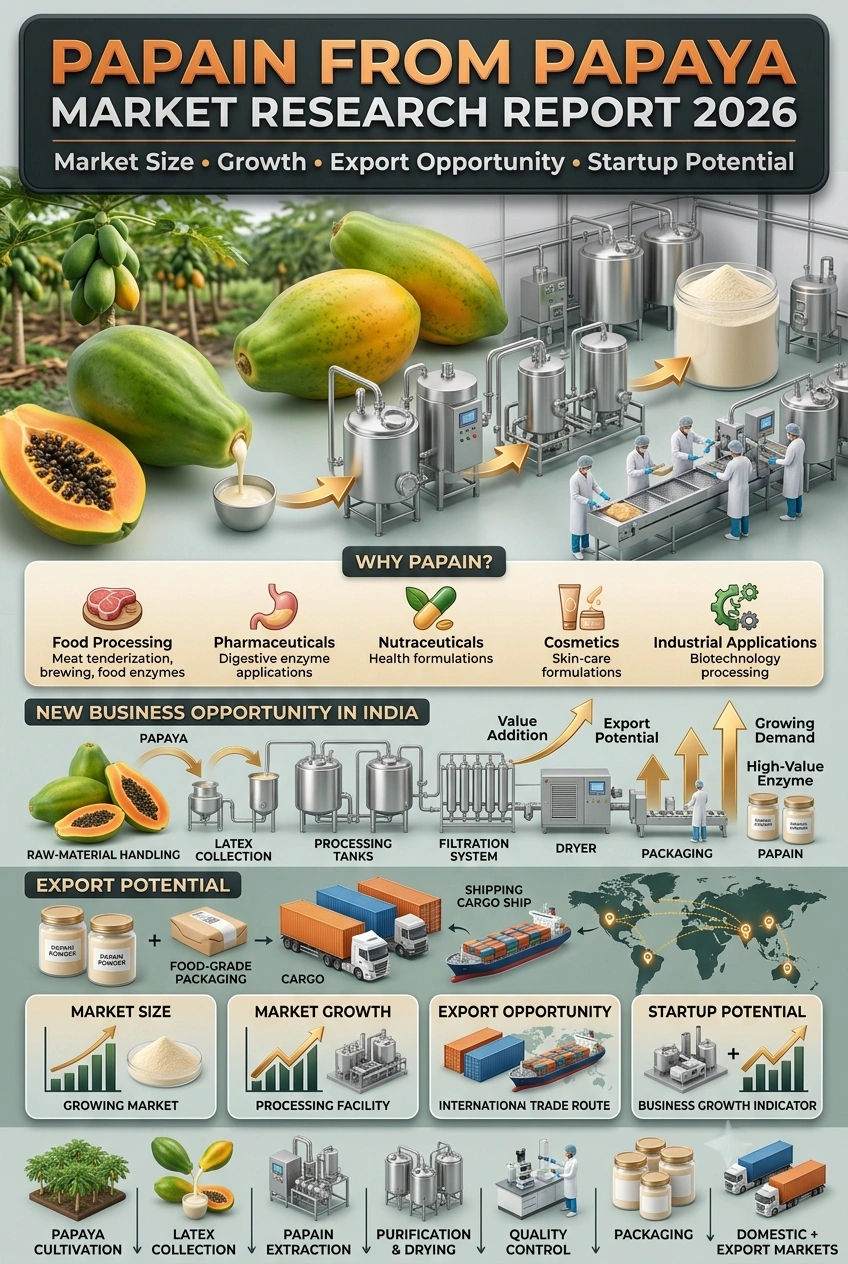
India Demand-Supply/Value-Capture Gap: Papain
| Parameter | Current Position |
| India’s share of global production | An estimated 70–80% of global papain output |
| Export share of Indian production | 80–90% of India’s papain production is exported, historically as crude or semi-refined material |
| Value-added capture | Limited — much of India’s export volume is lower-value crude/semi-refined papain, with final purification and formulation captured by importing countries |
| Processing infrastructure concentration | Chromatography-capable, pharmaceutical-grade processing facilities are concentrated mainly in Hyderabad and Bengaluru, leaving significant regional production still exported at lower purity/value |
| Nature of the gap | Not a supply shortage but a value-addition gap — India dominates raw production and even crude/refined volume but under-captures the higher-margin pharmaceutical- and cosmetic-grade finished product market relative to its raw material dominance |
| Opportunity for new entrants | Significant — particularly in refined, chromatography-verified, pharmaceutical- and cosmetic-grade papain production, and in captive orchard-integrated processing models that improve latex quality control |
Reading the gap: This is a category where India doesn’t need to build market share — it already has it in raw production terms. The opportunity is moving up the value chain: fewer entrepreneurs are positioned to produce chromatography-verified, REACH-compliant, pharmaceutical-grade papain domestically, even though India supplies the vast majority of the world’s raw material. An entrant who can bridge that gap — investing in purification technology and quality documentation rather than just latex collection — captures meaningfully more value per tonne of papaya processed than the historical crude-export model.
Major Indian Papain Manufacturers
| Company | Base/Region | Focus Area | Notes |
| S.I. Chemical | India | Papain refined and crude | Recognised established Indian papain manufacturer and exporter |
| M/S Shri Ganesh | India | Papain processing | Recognised domestic manufacturer among key India papain market players |
| Fruzyme Biotech | India | Enzyme extraction (papain and related enzymes) | Specialised Indian enzyme manufacturer |
| Rosun Natural Products | India | Natural extracts and enzymes, including papain | Recognised Indian natural ingredients manufacturer |
| Patel Remedies | India | Papain and pharmaceutical-adjacent enzyme products | Recognised domestic manufacturer |
| Enzybel-BSC (Enzybel International, India operations) | India (with European REACH-compliant integration) | Refined, pharmaceutical-grade papain | Operates integrated extraction facilities supplying REACH-compliant material to European pharmaceutical buyers — a model of the value-added opportunity available to Indian processors |
| Chromatography-capable processors (Hyderabad, Bengaluru clusters) | Telangana, Karnataka | Pharmaceutical-grade purification | Represents the smaller but higher-value tier of India’s papain industry serving international drug manufacturers directly |
Major International Papain Players
| Company | Country | Notes |
| Mitsubishi Kagaku (Mitsubishi Chemical) | Japan | Major global enzyme and specialty chemicals company with papain-related product lines |
| Enzybel International | Belgium | European specialist in plant-derived enzymes, including REACH-compliant papain, often sourcing latex from India for European-standard purification |
| Pangbo Enzyme | China | Recognised Chinese enzyme manufacturer active in the papain and related proteolytic enzyme market |
| Nanning Doing-Higher Bio-Tech | China | Chinese biotech enzyme manufacturer |
| Huaqi / Tianlv | China | Recognised Chinese papain and enzyme producers |
| Nanning Javely Biological / Guangxi Academy of Sciences | China | Regional Chinese producers and research institutions contributing to China’s papain output (the world’s second-largest after India) |
Related Article: 50 Successful MSME Business Ideas in India
Market Segmentation
By Type
- Crude papain — lower value, minimal processing, typically bulk-exported
- Refined/purified papain — higher value, purity above 90%, required for pharmaceutical and premium food-grade applications
By Application
- Food and beverage (meat tenderizing, beverage clarification, digestive additives) — largest application segment, roughly 40% of consumption
- Pharmaceuticals (digestive aids, wound debridement, anti-inflammatory formulations) — high-value segment demanding the highest purity grades
- Cosmetics and personal care (exfoliants, anti-aging formulations)
- Animal feed and nutrition (improving digestibility)
- Textiles (wool/silk processing) and leather (enzymatic dehairing) — smaller but growing eco-friendly processing applications
By End-Use Region
- North America and Europe — major consuming regions, heavily import-dependent on Indian supply, with tightening purity/regulatory requirements (REACH, GRAS, E1101)
- Asia-Pacific — both a production base (India, China, Thailand, Indonesia) and a growing consumption market, particularly for food processing applications
Key Growth Drivers
- Global clean-label and natural ingredient demand. Rising consumer preference for plant-based, natural processing aids over synthetic chemical alternatives directly benefits papain across food, cosmetic, and textile applications.
- Growth of processed meat industry. The demand for papain, a natural meat tenderizing agent, remains constant due to the increasing demand for meat globally, especially in the emerging markets.
- Growth in pharmaceuticals and nutraceuticals. But higher-margin digestive health and enzyme-based wound care products, which are especially popular in developed markets among the ageing population, are driving papain demand.
- Reformulation of cosmetics to move towards bio-based ingredients. Seeking alternatives to chemical exfoliants, many skin care and cosmetic companies are turning to enzymes such as papain.
- Tightening global purity and regulatory standards. These increase compliance costs, but they also support the more capable and well-documented Indian processors as opposed to artisanal and informal processors, thereby driving value towards serious processors.
- India’s structural raw material supremacy. India is the major source of papain supply, with 70-80 percent of the world’s requirement coming from this country, and the cultivation of papaya is well established in the southern part of the country, which makes India a major source of papain and its demand is likely to remain unachievable in the medium term.
Read the Complete Book Here: Book
Challenges and Restraints
- Labour-intensive latex collection. Upholding the value chain is difficult because of the manual and labour-intensive nature of papaya latex tapping and the narrowing of margins of producers who do not reach the market, as rural wages increase in southern India.
- Oral and Seasonal raw material supply, depending on weather and climate. The yields of papaya and availability of latex is highly variable from year to year, due to unpredictable monsoon patterns and climate variability.
- Logistics constraints in the supply chain and export. Producers who export need to be wary of the operational risks of lead time extensions due to delays in documentation at Indian ports or a shortage of containers.
- Strengthening international regulations. EU REACH and other schemes require chromatographic purity verification and are driving buyers of pharmaceuticals and food grade products to reject producers whose products are not as pure as required.
- Capture value – skewed toward last-stage international processors. India has always exported significant proportions of production as low value crude and/or partially refined product, with the final refinement and formulation margin captured by importing countries and this is an inherent imbalance that needs deliberate investment to fix.
Competitive Landscape
India’s papain industry is divided into two groups: a number of highly established papain exporters from different regions, mostly producing crude papain and semi-refined product, and a smaller group of papain processors capable of chromatography located in Hyderabad and Bengaluru, directly exporting to papain buyers in the pharmaceutical industry. Internationally, China’s current production capacity is second largest, but with a much smaller amount as compared to India, while in Europe, companies such as Enzybel International may rely on Indian latex to manufacture their own REACH compliant product — which highlights India’s competitive manufacturing base and the still available opportunity to add value through processing.
Papain Manufacturing: Business Opportunity for Startups and MSMEs
- Integrated orchard-to-processing operations. Integrating with the latex collection and initial processing, increases the control of raw materials, which is a benefit for the papaya grower as it is increasingly preferred by the CDSCO and international buyers.
- Production of pharmaceutical grade refined papain. The biggest opportunity in this category is the manufacture of chromatographic purification technology for the higher-margin pharmaceutical and premium food-grade segment, as opposed to exporting just pure latex.
- REACH/GRAS-compliant export-focused processing. In order to satisfy European and North American regulations, it offers a direct-to-buyer export option instead of the intermediaries, by building documentation, quality systems and purity verification capabilities specifically to this end.
- Value-added cosmetic and nutraceutical formulation. Moving beyond raw enzyme sale into finished cosmetic exfoliant or digestive supplement formulation captures brand-level margin rather than commodity ingredient pricing.
- Diversified enzyme extraction (papain plus adjacent botanicals). Given seasonal papaya supply variability, an entrepreneur processing multiple plant-derived enzymes or extracts can better utilise processing infrastructure and reduce single-crop dependency risk.
Assumption flag: Investment and margin figures for papain manufacturing vary substantially by target grade (crude vs. pharmaceutical-refined) and whether the venture integrates cultivation. NPCS prepares detailed, bankable Project Reports with processing technology specifications, raw material sourcing strategy, and export-market financial projections tailored to your target product grade and market.
Build a profitable business with the right idea
How NPCS Supports Entrepreneurs Entering This Space
For every entrepreneur considering a papain manufacturing business, the first step is to develop an appropriate Detailed Project Report (DPR) covering the aspects of plant capacity, extraction and purification technologies, raw materials (papaya orchard) procurement approach, manpower planning, project cost and financial viability based on the selected product grade and target market.
About NPCS (Niir Project Consultancy Services)
Founded in 1994 in New Delhi, NPCS is an ISO 9001:2015 Certified Industrial Consultancy Organisation with more than 3 decades of experience in Techno-economic and Project Consultancy. NPCS has produced a total of over 150000 project reports and profiles over the last 30 years covering all kinds of manufacturing and process industries, ranging from agro-processing, enzyme extraction to export oriented food and pharmaceutical ingredients manufacturing industries.
NPCS is a three-platform integration:
- niir.org — the primary repository of industry-specific Detailed Project Reports, business plans, and techno-economic feasibility studies
- entrepreneurindia.co — market research, project profiles, and manufacturing business opportunity content aimed at entrepreneurs and MSMEs
- npcsblog.com — industry insight, trend analysis, and manufacturing sector commentary
The main outputs of NPCS that will be significant for a papain enterprise are:
- Detailed Project Reports (DPRs) covering Plant Capacity, Machinery Specification and Layout.
- Technological feasibility studies containing CDSCO / Pharma grade compliance guidance
- Financial modelling — project cost, profitability analysis, ROI, and break-even calculations
- The raw material and market evaluation is specific to Indian papaya growing areas and markets.
- Support documents to loan applications for MSMEs, subsidy schemes, export promotion assistance etc.
Entrepreneurs evaluating this sector can access relevant papain manufacturing profiles directly on niir.org and entrepreneurindia.co, or request a custom feasibility study scoped to a specific product grade and target export market.
Government and Institutional Reference Links
- Ministry of Agriculture & Farmers Welfare
- Agricultural and Processed Food Products Export Development Authority (APEDA)
- Central Drugs Standard Control Organisation (CDSCO)
- Ministry of Micro, Small and Medium Enterprises (MSME)
- Development Commissioner, MSME (DCMSME)
- Ministry of Food Processing Industries (MoFPI)
- Directorate General of Foreign Trade (DGFT)
- Press Information Bureau (PIB), Government of India
- Startup India
- Invest India (National Investment Promotion and Facilitation Agency)
Conclusion
The case of papain is one in which India’s leadership is already solid – 70-80% of the world’s production is done in India where the geographical zone for cultivating this crop is well-defined with decades of export experience. The chance is not to create market share from scratch – it’s to rake in more of the value chain India currently exports as crude and semi-refined products. A business person who invests in purification technology, quality documentation and direct international customer relationships is well placed to realise pharmaceutical and cosmetic-grade margins on a raw material which India already controls.
Entrepreneurs and MSMEs interested in agro-processing and enzyme investments are offered a unique chance to tap into an existing strength of India’s exports rather than to compete with them, as long as they seek to add value instead of being just crude exporters.


