






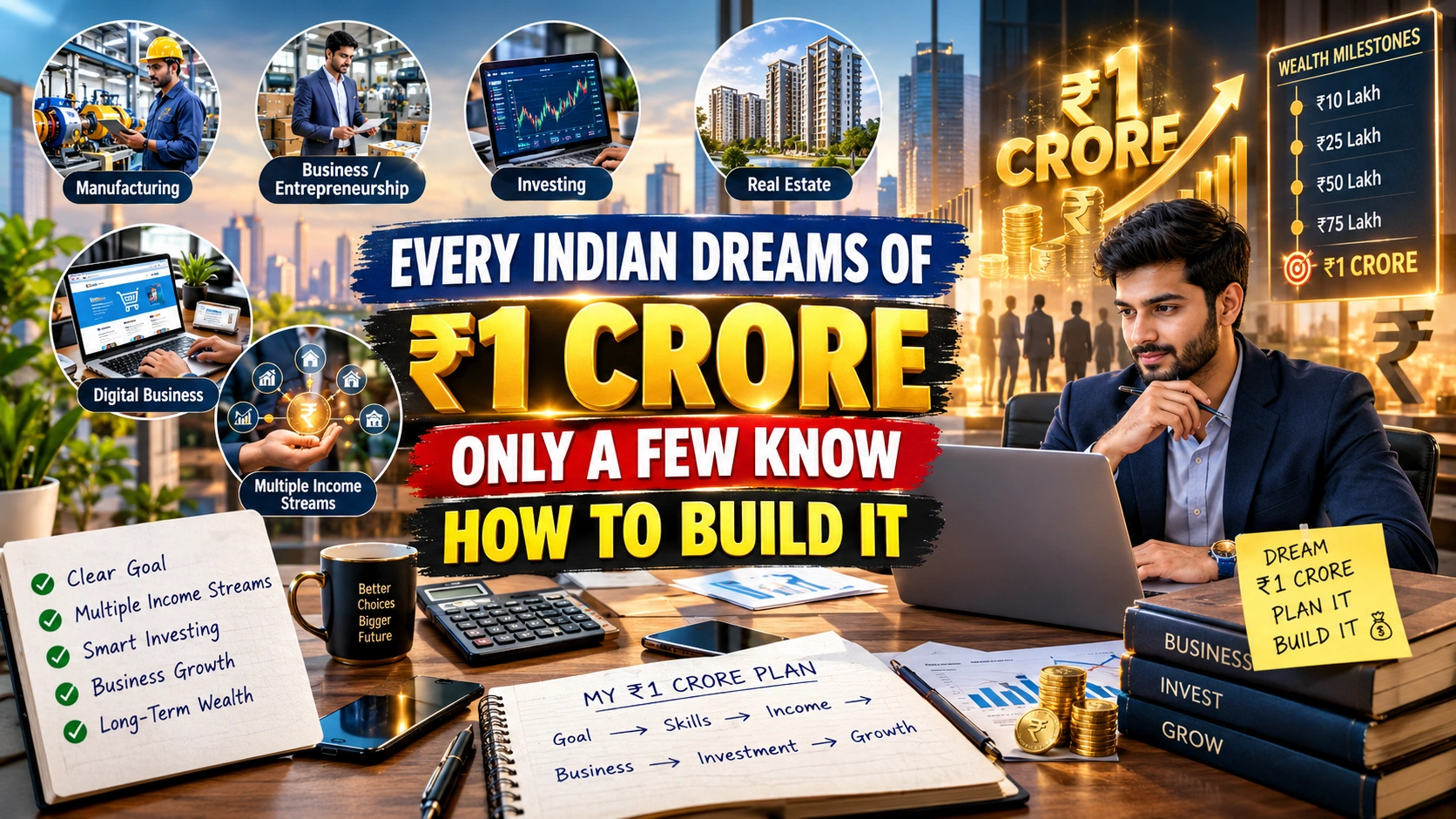
Profitable Manufacturing Business Ideas
Swishing past the milestone of ₹1 crore is not only a financial achievement, but a declaration of independence too. However, millions of working Indians are still deprived of the flexibility of their salary, increasing their EMIs, and reducing their saving. The only question is whether the dream is achievable. The question, however, is: which business ideas really create sustainable and scalable wealth? In India, a first-generation entrepreneur class is realizing that small manufacturing and product-based business ideas, supported by relevant market intelligence and structured planning can be the most dependable indicators towards achieving this milestone.
This is not a get rich quick scheme article. It is a consultant class study of where the true opportunity is and how Government policy can help and what it can realistically take to get over that seven-figure line.
Why Manufacturing Business Ideas Outperform Most Alternatives
India’s manufacturing sector is one of the least explored engines today for wealth creation by a normal entrepreneur. Unlike service companies that need huge budgets for customer acquisition, or tech startups aiming for unicorn status, product manufacturing has something far more predictable — predictable margins on tangible products that have domestic and export demand.
MSMEs contribute to almost 30% of India’s GDP and more than 45% of total exports. It is not a specialized play. Such figures underscore a structural fact of the country: it continues to rely on small and medium manufacturers for its daily consumption of goods, industrial products, chemicals, food products and engineering parts. With investable capital of ₹20-50 lakh, a focused manufacturing unit can generate annual turnover of ₹80 lakh to ₹1.5 crore in first 3 years followed by a growth in turnover by reinvesting the funds.
The greatest benefit is margin stability. Whereas trading can be easily competed and have narrow spreads, a value-added manufacturing business can develop its own ‘moat’. Moreover, the cost of production is competitive in India and provides parallel export markets that few domestic markets can tap.
Government Policies and Incentives Backing the ₹1 Crore Dream
Government support infrastructure is one of the most underutilised resources that is available to new manufacturers. The policy landscape has been greatly expanded in India to facilitate the entrepreneur’s wealth creation through production-based businesses.
The MSME Ministry’s Credit Guarantee Fund Trust for Micro and Small Enterprises (CGTMSE) provides collateral-free loans up to ₹2 crore, which is transformative for first-generation founders who lack tangible assets as security.
DPIIT’s Production Linked Incentive (PLI) Scheme is designed to offer direct financial incentives to manufacturers in 14+ industry sectors, contingent on their incremental production growth. If the small manufacturer is eligible to this, this can equate to lakhs in annual government backed income apart from commercial income.
Under the Pradhan Mantri MUDRA Yojana (PMMY), entrepreneurs can avail of loans in the Kishor category up to ₹5 lakh and Tarun category up to ₹10 lakh without any collateral which is sufficient for establishing or expanding a small production unit in agro-processing, light engineering or consumer goods.
Plus, the government’s Startup India initiative provides income tax exemption for three years and quick IPR registration and access to government procurement lists — benefits that most small business owners do not take benefit of, as they do not know the criteria they must meet.
The offer is even sweeter at the state level. For example, Maharashtra’s MSME Policy provides capital subsidies up to 25%, exemption from electricity duty, and stamp duty waiver for all new manufacturing units from the Directorate of Industries. Such support systems are found in other parts of the state in Gujarat, Rajasthan, Tamil Nadu and Uttar Pradesh.
Profitable Manufacturing Business Ideas That Can Build ₹1 Crore
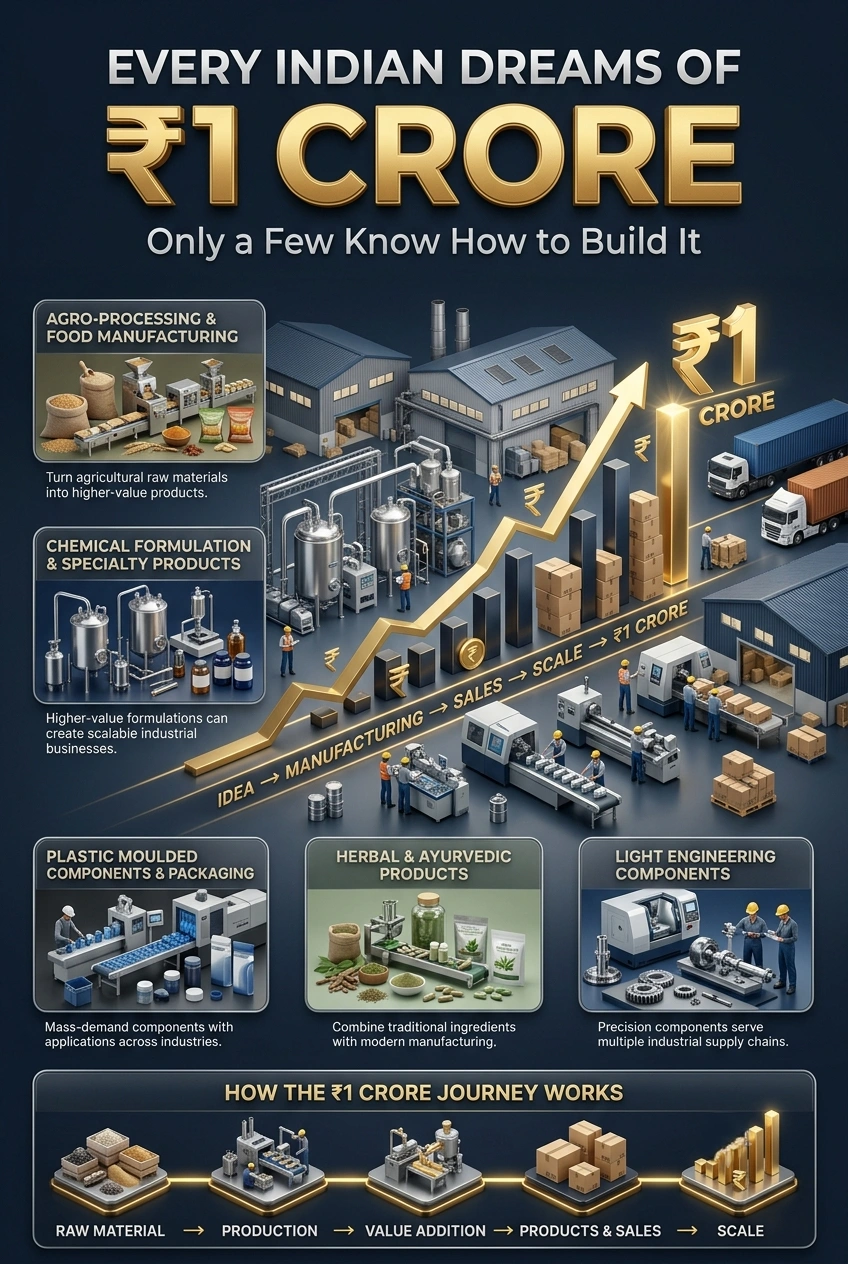
1. Agro-Processing and Food Manufacturing
India is a country, which generates more than 330 million tonnes of fruits and food grain in a year but post-harvest losses are still at 15-20% due to unavailability of processing infrastructure. This space is ripe for the taking for the entrepreneur! The cost of setting up a mid-scale agro-processing unit (pulses, spices, edible oils or fruit-based products) ranges from ₹25 to 60 lakh and the payback period is in the range of 2–3 years. If there are direct-to-retail/e-commerce distribution channels, for example, the retail margins for branded packaged spices and processed dal are 30-40%.
The minimum turnover of a focused agro-processing entrepreneur who wants to cater to the tier-2 city retail and digital market places within 3 years of operation is in the range of ₹1 crore.The minimum turnover of a focused agro-processing entrepreneur with a vision to cater to the retail and digital market places in tier-2 cities is reasonable to be in the range of ₹1 crore within 3 years of operation.
Read the Complete Book Here: Handbook on Fruits, Vegetables & Food Processing with Canning & Preservation
2. Chemical Formulation and Specialty Products
One of the most profitable product categories that small manufacturers can offer is the specialty chemical category, which includes water treatment chemicals, construction chemicals, industrial adhesives, and cleaning compounds. In a specialty chemicals formulation unit, the capital can be made as ₹30 to 80 lakhs. Domestic demand is steady, and B2B customers like construction firms, factories and municipalities order in bulk quantities. Furthermore, a number of chemical formulations are not subject to rigorous regulatory licensing, allowing relatively quick market entry. A well-placed formulation unit servicing 3-5 institutional customers can earn between Rs 70 lakh to Rs 1.2 crore per annum.
Get Detailed Project Report (DPR): Chemicals (Organic, Inorganic, Industrial) Projects
3. Plastic Moulded Components and Packaging Products
Plastic Packaging and Moulded Components industry is growing alongside FMCG, pharmaceuticals and e-commerce industries in India. The cost of machinery investment for a small injection moulding unit or blow moulding unit, which is used to manufacture containers, caps, bottles or industrial components, is ₹40-70 lakh. The benefit of this is that they have long-term supply deals with manufacturing customers who like to work with local suppliers to manage their quality control and logistics. With a narrow, focused client base and the right pricing strategy, a mid-sized moulding shop with two shifts could earn anywhere between ₹90 lakh to ₹1.5 crore per year.
Related Article: Plastic Packaging Manufacturing: A Profitable Business for MSMEs
4. Herbal and Ayurvedic Products Manufacturing
Since then, the consumer’s shift of preference towards herbal and immunity-boosting products is a paradigm shift. It’s no longer a niche; it’s a mainstream market. The demand for the herbal supplement tablets has been consistently doubling in the double digits while Ayurvedic syrups, herbal skin care and herbal wellness teas have consistently grown in double digits. According to the guidelines of the AYUSH Ministry, setting up a small licensed herbal products unit will cost ₹20 – 50 lakhs. Especially strong scalability potential in the case of online distribution. If an entrepreneur creates a known brand for herbs in 3-5 years, the value of the brand per se (apart from its production), is several crores.
Explore This Book: Herbal Cosmetics & Ayurvedic Medicines (EOU)
5. Light Engineering Components for Industrial Use
Indian infrastructure and capital goods sector is expanding at a consistent growth rate. This means that tier-2 suppliers are required to supply precision fabricated brackets, shafts, casings, stampings and sub-assemblies on demand. A particular CNC machining or metal fabrication shop that serves OEM customers for automotive, pump manufacturing, or Electrical Switchgear could earn revenue of ₹1 crore+ after 2-4 years. The initial investment required is between ₹40–90 lakh depending upon the machinery configuration. It’s relatively safe because, in most business models, people have 12–36-month contracts with OEMs they buy from which guarantee predictability of income.
Import–Export Opportunity: The Route to Faster ₹1 Crore Growth
Many Indian manufacturers build their domestic business first and then discover that export income can double revenue without proportionally increasing overhead. India’s export ecosystem — through the Directorate General of Foreign Trade (DGFT) — offers export incentives including Duty Drawback, RoDTEP, and advance authorisation schemes that meaningfully improve export profitability.
The agro-processed products, herbal extracts and specialty chemicals, as well as light engineering products have export markets already in Southeast Asia, Middle East, and Africa. Once a company decides to earn 20–30% of its revenues from exports, it tends to grow faster and make greater margins compared to its domestic-only counterparts, as it will hit that milestone sooner.
The Agricultural and Processed Food Products Export Development Authority (APEDA) provides market development assistance, quality certification support, and buyer-matching services for agro-processors targeting export markets.
Likewise, Federation of Indian Export Organisations (FIEO) links the small manufacturers with recognized foreign buyers from 180+ countries. The institutional bridges have significantly lowered the cost and time for a first-generation manufacturer to get a foothold in the export market.
Indian MSME Leaders Who Built ₹1 Crore — and Beyond
1. Haldiram’s — From a Small-Town Sweet Shop to a ₹10,000 Crore Empire
The Haldiram story is one of the most instructive case studies on the history of Indian MSMEs. Gangabisenji Agarwal began his business with a small “namkeen” shop in Bikaner. Standardising recipes, investing in packaging and scaling up from retail to national distribution became the turning point. The lesson for new entrepreneurs: A product can grow from a room to a national brand if it is well done, of consistent quality and well distributed. It wasn’t a goal that was reached — it was a milestone in a longer compound growth curve of ₹1 crore.
2. Lijjat Papad — Cooperative Manufacturing as Wealth Creation
Shri Mahila Griha Udyog Lijjat Papad started with 7 women in Mumbai and capital of ₹80. Today, the cooperative has over 45,000 members and makes hundreds of crores in annual revenue. The business model with collective production, centralised quality control, single brand identity shows that it is not just capital that is the limiting factor to reach the ₹1 crore milestone. Organisation, consistency and a product ready for the market are.
3. Amul — The Cooperative Industrial Model
Amul model, created by Dr. Verghese Kurien, is a solution to this crisis.Amul model, developed by Dr. Verghese Kurien, is a remedy to this crisis.
The National Dairy Development Board (NDDB) gave life to milk producers as one of the strongest manufacturing cooperative organizations in India. For today’s small manufacturer, the model of the day is: AGGREGATE PRODUCTION, PROFESSIONAL BRAND MANAGEMENT and BACKWARD INTEGRATION WITH RAW MATERIAL SUPPLIERS, which allows the company to recede from the economic cycles and grow every year.
Discover business ideas that actually make money
How NPCS Helps Entrepreneurs Plan for the ₹1 Crore Milestone
The end users at Niir Project Consultancy Services (NPCS) are first time entrepreneurs, MSME investors and industrial project planners that are at exactly this decision-making stage, i.e., understanding the right manufacturing business and the financial feasibility of the project before investing money into it.
Our Market Surveys cum Detailed Techno-Economic Feasibility Reports (DPRs) are designed to provide a 360-degree view to the entrepreneurs about their selected business idea. The reports include detailed manufacturing processes, raw material sourcing and costs, process flow diagrams, product mix optimisation and capacity planning, machinery specifications and detailed project financials with projected revenues, profitability and payback analysis.
The MSME Databank maintained by the Ministry of MSME can also be accessed by the entrepreneur for the benchmarks and competitive positioning of the sector before taking a start.
Our goal is simple: to test the viability of a business concept, its potential for profitability, and the amount of time it needs to grow — before you put a single penny into it.
Snapshot: Manufacturing Business Ideas and ₹1 Crore Potential
| Business Idea | Approx. Investment (₹ Lakh) | Estimated Annual Revenue (₹ Lakh) | Payback Period | Export Potential |
| Agro-Processing Unit | 25–60 | 80–150 | 2–3 Years | High |
| Specialty Chemicals | 30–80 | 70–120 | 2–3 Years | Moderate |
| Plastic Moulded Components | 40–70 | 90–150 | 2–4 Years | Moderate |
| Herbal & Ayurvedic Products | 20–50 | 60–120 | 2–3 Years | High |
| Light Engineering Components | 40–90 | 80–140 | 3–4 Years | Moderate–High |
Useful Government and Industry Resources
- Invest India — Government’s Investment Facilitation Agency
- SIDBI — Small Industries Development Bank of India
- CII — Confederation of Indian Industry
- FICCI — Federation of Indian Chambers of Commerce & Industry
- Startup India Portal
Conclusion: ₹1 Crore Is Not a Lottery — It’s a Plan
In India, the imagination and ambition gap between the dreamer and the achiever is rarely the issue. It’s almost always a matter of decision quality. The difference between most people who dream and few people who build is in the business idea, and in fact it is the RIGHT business idea that is based on data and cross-validated with the help of professional feasibility analysis.
With one of the world’s most comprehensive government incentive regimes and domestic consumption and export markets on the rise, India’s manufacturing industry is a true platform for first-generation entrepreneurs to achieve the ₹1 crore milestone. The business ideas are available. Policy support is in place. The market is prepared. The market awaits. All that’s left is the choice to go with a plan based on facts, not hope.


