


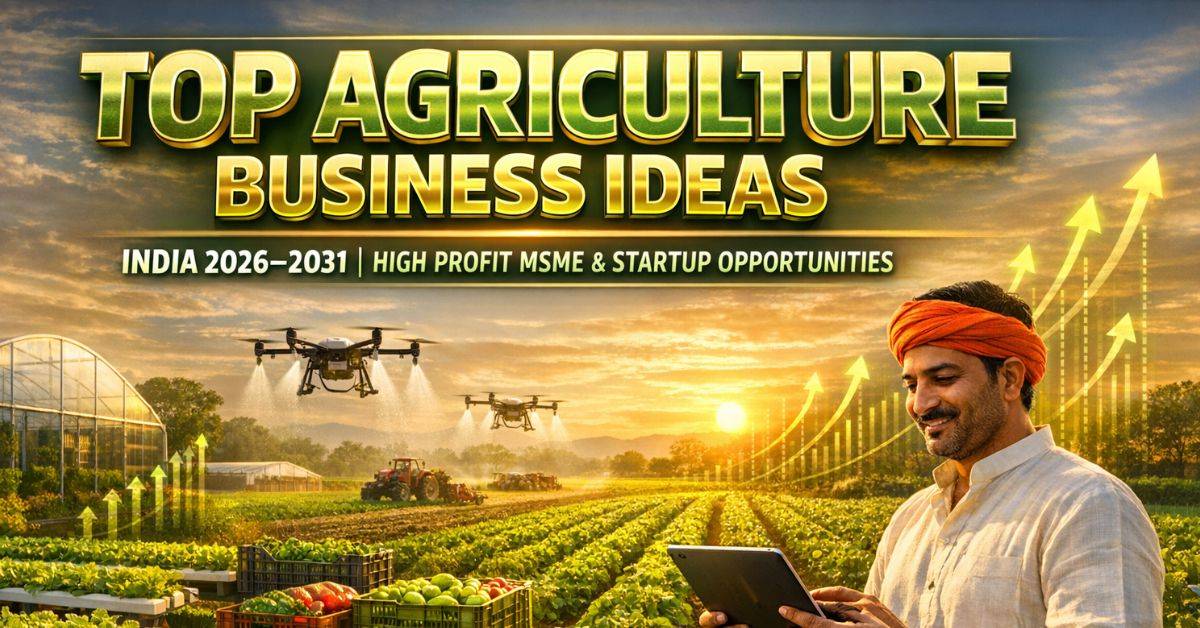
Agriculture Business Opportunities
India’s agriculture sector is undergoing a fundamental change. What was once regarded mostly as a traditional agricultural industry is transforming into a giant ecosystem with food processing, logistical, technology and export-oriented businesses. In 2025, the value of the Indian agriculture industry reached an estimated value of INR 1,09,738 billion, and the expected compound annual growth rate is about 9.68% until the year 2034.
Agriculture serves as one of the key foundations that sustain the Indian economy. It contributes almost 17-18% to the country’s GDP and supports livelihood of about 46% workforce of India. The current production levels reach their highest point in history. Foodgrain output was 354 million tonnes and horticulture output was almost 368 million tonnes.
Despite these impressive numbers, the agriculture sector is still faced with major structural challenges. The production capacity of India creates a significant gap between its actual output and its maximum capacity to handle and distribute goods. Interestingly, these are not just problems but huge business opportunities for startups, MSMEs, and investors who are interested in doing business in agriculture-related industries.
Table of Contents
ToggleRead More: Modern Technology of Agro Processing & Agricultural Waste Products
Major Demand vs. Supply Gaps in Indian Agriculture
There are several segments of the agriculture industry dealing with supply shortages or infrastructure gaps. These shortages open up good opportunities for new businesses to come into the market.
Some of the most important gaps are:
- All edible oil imports: India has been importing almost 60% of its total consumption at a cost of more than USD 15 billion every year.
- Pulses: Domestic level is not enough so imports billions every year.
- Cold storage: The country is facing shortage of almost 35 million metric tonnes of cold storage capacity.
- Food processing: Only about 10% of agricultural output is processed as compared with 60 – 70% in developed countries.
These gaps make it clear that untapped potentials in the agriculture industry are enormous.
Edible Oil Processing: Massive Import Substitution Opportunity
One of the biggest potential areas of Indian agriculture is in the field of edible oil production & processing. Although India is one of the leading producers of oilseeds in the world, the country remains highly dependent on imports to meet domestic demand.
Currently domestic edible oil production is estimated at around 9 million tonnes whereas its consumption is more than 26 million tons. The gap is satisfied by imports of palm, soybean and sunflower oil from countries such as Indonesia, Malaysia and Argentina.
This situation has provided the impetus to the government for encouraging domestic oilseed cultivation and processing under the aegis of the National Mission on Edible Oils.
Entrepreneurs can look for opportunities such as:
- Mustard oil processing units
- Oilseed crushing plants
- Edible Oil Refining and Packaging
- De-oiling of cake production for animal feed
Small-scale oil processing units can often be initiated with moderate investment and can be profitable if the unit is located near oil seed producing regions.
Pulse Processing and Dal Milling
Pulses are an important staple food in India and a necessary source of protein for millions of people. However, domestic production usually does not meet the national demand.
India consumes about 27-28 M t of pulses annually, but production generally varies from 23 to 26 M t per year. This difference causes huge imports from countries like Canada, Myanmar and Australia.
This gap creates opportunities for businesses involved in pulse processing. Dal milling is one of the most accessible agro-processing ventures since the technology is fairly simple in nature, coupled with a constant demand.
Some of the possible business models are:
- Small and medium dal milling unit
- Pulse grading and packaging businesses
- Production of pulse flour like besan
- Ready-to-cook pulse products
Government initiatives to attain self-sufficiency in pulses are also facilitating investments in this sector.
Food Processing: Processing Farm Produce to High Value Products
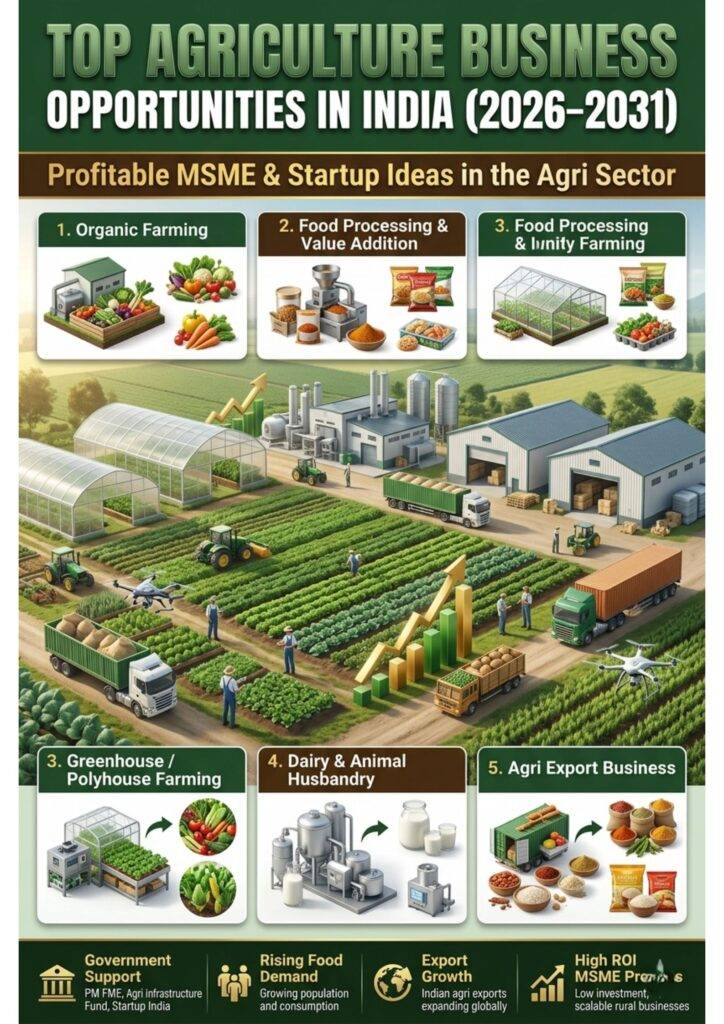
Food processing is among the fastest growing sectors of the agriculture industry. Yet India still processes a small proportion of its agricultural production.
This limited processing capacity results in huge post-harvest losses annually. Fruits and vegetables are especially susceptible to this, with a large percentage of fruit and vegetables wasted due to poor storage and transportation facilities.
Food processing businesses take raw agricultural products and transform them into consumer-ready products. Examples include packaged foods, fruit juices and dairy products, snacks and ready-to-eat meals.
Popular food processing opportunities include:
- Fruit pulp and juice manufacturing
- Dehydration of vegetables processing
- Millet based health food products
- Ready-to-eat foods and ready-to-cook foods
- Small dairy processing units
Government schemes such as PM Kisan SAMPADA Yojana and PMFME scheme are available for entrepreneurs starting food processing units with the financial support and subsidy provided by the government.
Cold Chain Infrastructure: An Expanding Industry
India produces a wide range of perishable food products which include fruits vegetables dairy products and seafood yet the nation lacks sufficient cold storage and refrigerated transportation facilities.
Experts suggest that India has a shortage in cold storage capacity of about 35 million tonnes. In addition, a lot of existing facilities are designed for one commodity and are unable to accommodate multiple types of produce.
Cold chain infrastructure plays an important role to reduce food wastage and to stabilize the agricultural prices.
Key opportunities in this sector are:
- Multi-commodities cold storage facilities
- Farm-level pack houses
- Refrigerated transportation services
- Solar cold rooms for rural areas
Government programs like Agriculture Infrastructure Fund gives concessional loans and interest subsidies to promote investment in this sector.
Agritech and Precision Agriculture
Technology is slowly changing Indian agriculture. Digital tools and smart farming solutions are helping farmers to increase their productivity at a lower cost.
India’s agritech market is growing rapidly with the development of innovative solutions by startups for farmers. These technologies range from drone-based crop monitoring, soil sensors, irrigation automation, and farm management software.
Some great agritech business ideas are:
- agricultural drone services
- IoT-based soil monitoring systems
- Farm management mobile applications
- Solar powered irrigation solutions
Rural digital infrastructure development will create agricultural transformation opportunities through agritech solutions.
Organic Farming and Bio Inputs
Organic farming and bio-input production create a fresh agricultural opportunity for development. Consumers now show increased knowledge about food safety and environmental sustainability which drives their growing interest in organic products.
India has established millions of hectares for organic farming yet the market for organic inputs and certified organic products remains under development.
Some of the opportunities for entrepreneurs include:
- Manufacturing of bio-fertilizer
- Bio-pesticide production
- Organic packaged foods
- Composting and Waste-to-Manure plants
These businesses are not only for serving domestic markets, but there is also export potential.
Future Outlook of the Agriculture Industry
The future of the Indian agriculture industry looks bright. A number of long-term trends will lead to growth over the next decade.
First, the population of India is still growing, which always leads to more demand for food. Second, increasing incomes and urban lifestyles are contributing to higher levels of consumption of processed foods and high-value agricultural products. Third, government investments in infrastructure and digital technology are aiding the improvement of supply chains and market access for farmers.
As agriculture continues to integrate with technology, logistics, and manufacturing, the agricultural sector will continue to provide opportunity for entrepreneurs.
On a more global context, it seems viable to infiltrate into the largely agricultural related industries for start-ups and MSMEs which promise a plausible scenario for the latter’s long-term growth and stability. Businesses that specialize in processing, storage, and technology solutions are likely to benefit the most from the transformation of the sector.
Frequently Asked Questions (FAQ: Frequently Asked Questions)
What is the size of Indonesian agriculture industry?
The Indian agriculture industry was worth at an approximate of INR 1,09,738 billion in 2025 and is steadily growing.
Which are the most profitable agriculture businesses in India?
Some of the most lucrative opportunities are food processing, edible oil production, dal milling and cold storage infrastructure, agritech services, and aquaculture.
Why food processing is important for India?
Food processing is also helpful in reducing post-harvest losses and adding value to agricultural products, creating more income for farmers and businesses.
Are there any government schemes to support agriculture startups?
Yes, schemes like PMKSY, PMFME, Agriculture Infrastructure Fund and National Mission on Edible Oils have provided financial support and incentives.
Is agriculture a good sector for start-ups?
Yes. With an increase in food demand, government support and an increase in export opportunities, agriculture is one of the most promising sectors for startups and MSMEs in India.


