


Aluminum Casting Business in India
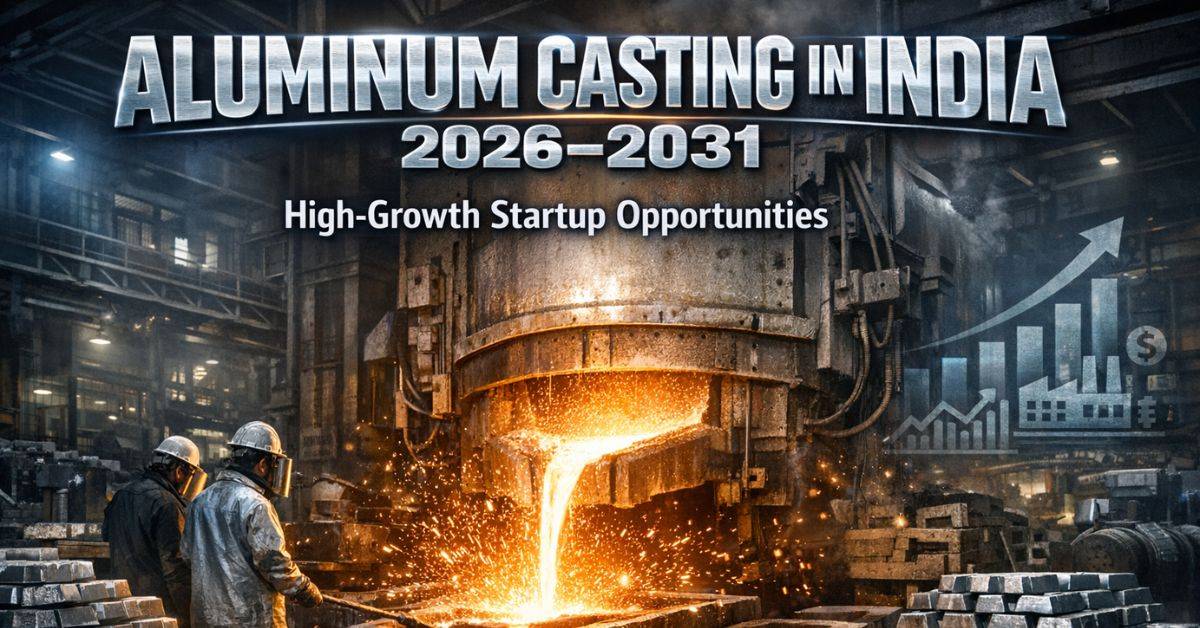
The aluminum casting industry in India is expected to witness a massive growth in the years 2026-2031 owing to the demand in automotive, electric vehicles (EVs), aerospace, infrastructure, and renewable energy industries. Despite the fact that India currently ranks as the second largest producer of aluminum in the world, it is still a major importer of value-added castings. start-ups can achieve better quality and productivity through advanced technologies which include vacuum-assisted die casting and AI-powered defect prediction and semi-solid robocasting.
India had an aluminum casting market which reached a value of USD 2.5-2.8 billion in 2023 and between 2023 and 2031 the market will grow at a compound annual growth rate between 7-11 percent. The actual national aluminum consumption for 2024 reached a total of 4.5-4.9 million tonnes and experts expect the usage to rise to 8.3 million tonnes by the year 2030. The low per capita aluminum consumption in India which stands at 3.9 kg creates a significant market opportunity because it exists at a level which is below the global average of 11 kg.
Table of Contents
ToggleRead More: The Complete Technology Book on Aluminium and Aluminium Products
Understanding Demand-Supply Gap
The country controls approximately 4.1 million tonnes of primary aluminum production capacity and 2-2.2 million tonnes of recycled aluminum production capacity but Indian casting facilities lack sufficient capacity to produce high-precision automotive and EV and aerospace components.
Key points:
- India imported 240,000 tonnes of alloyed ingots (ADC12, A356) in 2024, which is up from 45% year-on-year.
- Total aluminum imports were USD 7.67 billion, exports were USD 7.25 billion, mainly Raw/Semi-finished.
- Auto industries account for ~60% (~Auto industries demand is outpacing domestic HPDC and GDC production) of aluminum castings
This difference in structure represents a market opportunity ready for domestic manufacturing units.
Drivers of Aluminum Casting Demand
The market is driven by demand from the automotive and EV market. Traditional ICE vehicles need engine blocks, cylinder heads and suspension brackets. EVs, on the other hand, require the battery enclosures, motor housings, inverter casings and structural frames, made with advanced Al-Mg alloys.
Additional drivers include:
- Infrastructure & Construction: The elements needed to build bridges and railroad systems and modular construction systems and facade systems exist as separate entities.
- Aerospace & Defence: describe permanent precision investment castings and turbine housing systems and essential structural support brackets.
- Power & Renewable Energy: The combination of solar panel frames and wind turbine housings and transformers and telecom towers creates a unified system.
- Electronics Heat sinks, enclosures, precision connectors.
Leading Players in Indian Market
The Indian aluminum casting industry is moderately fragmented with major players actively pursuing the growth of EV and automotive capacities:
- Britten: – Endurance Technologies Ltd. – HPDC Supplier, good exports, expanding EV drivetrain casting capacity.
- Rockman Industries (Hero Group) – Precision HPDC components, scaling EV component manufacturing.
- Samvardhana Mother son International – Automotive and aerospace castings – 5,500 tonne press.
- Sandhar Technologies / Ascast – ICE & EV Castings, Doubled capacity through acquisition.
- Uno Minda – Die-casting + Electronics integration, greenfield HPDC plant approved.
Even with these expansions, domestic supply will be inadequate, which will provide space for new entrants.
Startup Opportunities
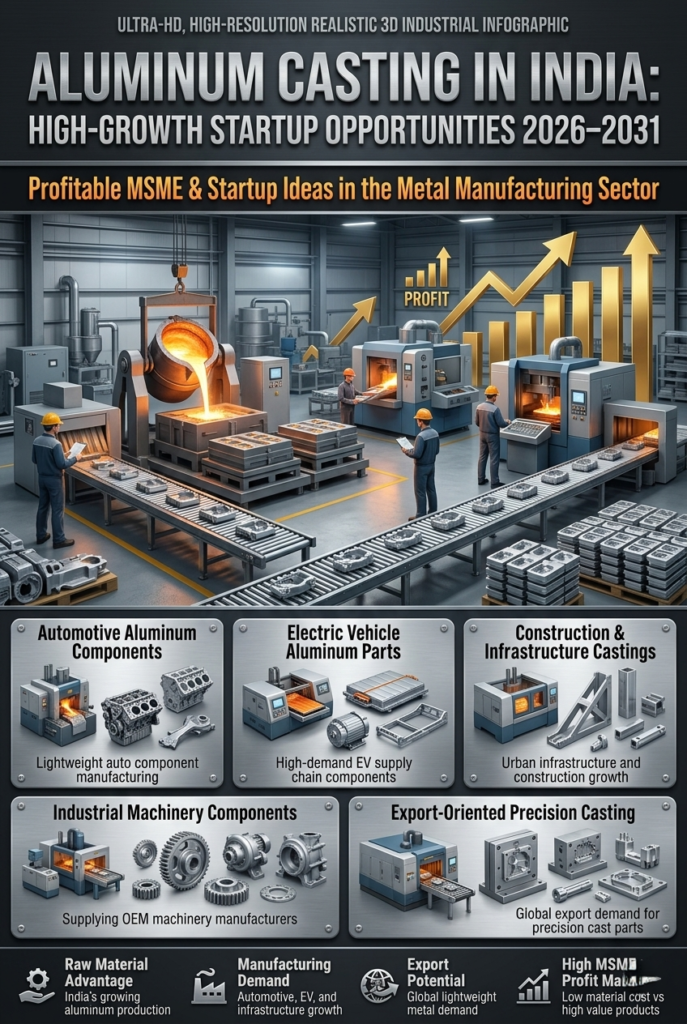
The aluminum casting market provides structurally secure demands to new manufacturing units. Entry points include gravity die casting (GDC), low-pressure die casting (LPDC) and secondary aluminum recycling.
Key advantages for startups:
- It is the domestic revenue revenues from: – Import substitution: Every tonne of imported alloy reflects domestic revenue.
- EV driven growth: The market shows strong demand for both battery housing and motor housing products.
- China+1 strategy: The export market presents new opportunities because OEMs are expanding their supply chain operations.
- Low-cost entry: GDC and LPDC units can start with an INR 1-5 crore investment.
Secondary Aluminium Recycling: Energy Efficient Margin Enhancing Vertically Integrated.
Strategic Locations
Selecting the right location affects logistics, manpower and access by OEMs:
- Western India (Pune, Rajkot, Ahmedabad, Sambhaji Nagar) – OEM Proximity, 40% market share.
- Southern India (Coimbatore, Chennai, Hosur, Bengaluru) – Fastest growing, high concentration of automobile and electronics
- Northern India (Faridabad, Manesar, Ludhiana) – Access to supply chain Maruti-Suzuki & Hero MotoCorp.
- Eastern India (Jamshedpur, Rourkela, Bhubaneswar) – Close to Smelters, low raw material logistics cost.
Coastal locations such as Mumbai, Mundra, Chennai ports are ideal locations for export-focused units.
Technology and Process Choices
The type of casting process makes capital intensity, the type of product, and the target customer:
- High Pressure Die Casting (HPDC) – Automotive, thin wall parts, high volume production, OEM grade quality.
- Low-Pressure Die Casting (LPDC) – Wheels, Cylinder Heads, Symmetric Components, Moderate Volume.
- Gravity Die Casting (GDC) – Pump housings, valves, general engineering, reliable low tooling cost.
- Sand Casting & Investment Casting – Large industrial parts, Aerospace, Precision applications.
The advanced technologies which start-ups use include vacuum-assisted die casting and AI-powered defect prediction and semi-solid robocasting to achieve better quality and improved productivity.
Conclusion
Between 2026 to 2031, India has one of the most lucrative industrial opportunities in aluminum casting. Structural demand growth, import substitution, government support and EV adoption are ushering in an environment of low risk and high reward.
Entrepreneurs can work through small-scale GDC/LPDC units, mid-scale HPDC plants or vertically integrated recycling-casting operations. Success depends on early investment in quality, certifications, strategic location and process automation.
The market is rapidly changing and those who are proactive and take action can seize huge domestic and export market opportunities before imports eventually take over.
FAQs
Q1: What is the current market size of Aluminum Casting in India?
The market was worth USD 2.5 – 2.8 billion in 2023, expanding at a CAGR of 7 – 11% until 2031.
Q2: What sectors drive demand?
Automotive, EVs, infrastructure, aerospace, defense, renewable energy and electronics.
Q3: Is there a real demand-supply gap?
Yes. India imports a large amount of ADC12 and A356 alloyed ingots because of the lack of domestic capacity.
Q4: How much investment is required for small casting unit?
GDC/LPDC units: INR 1–5 crore. Mid scale HPDC units: INR 10 to 50 crore.
Q5: What type of certifications are needed?
ISO 9001, IATF 16949 (automotive), ISO 14001, Quality standards OEM
Q6: When is it possible for a new unit to break even?
Small-scale units: 18–30 months. Mid-scale HPDC: 30–48 months.


