


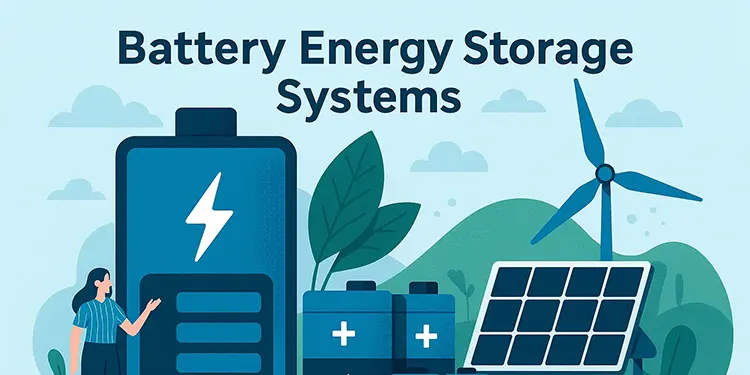
Battery Energy Storage Systems are rapidly redefining India’s power, renewable energy, and industrial landscape. In an era where India is scaling renewable capacity, modernizing its grid, and embracing electrification, energy storage has become a cornerstone of stable, reliable power supply. From compact residential batteries to utility-scale installations, Battery Energy Storage Systems are no longer futuristic — they are essential.
For MSMEs, startups, and entrepreneurs, India’s emerging BESS boom presents one of the strongest industrial opportunities of this decade. This in-depth, business-focused article explores market trends, government support, demand–supply gaps, manufacturing potential, export opportunities, and profitable business models — all directly linked to Battery Energy Storage Systems.
Read Our Project Report: Click Here
Why Battery Energy Storage Systems Matter in India Today
Growing Renewable Energy Footprint & Inherent Intermittency
- India’s renewable energy capacity (solar, wind, hybrid) is growing rapidly. However, solar and wind are intermittent. Battery Energy Storage Systems provide the buffer — storing excess energy and releasing it during peak demand.
- As renewable capacity expands, grid stability challenges grow. BESS helps smooth supply–demand fluctuations, reduce frequency variations, and delay costly grid upgrades.
Grid Stress, Peak Demand & Load Shifting
- BESS enables load shifting — storing energy during low-tariff hours and discharging during peak demand.
- Behind-the-meter Battery Energy Storage Systems can significantly reduce electricity bills through peak shaving, ideal for commercial/industrial customers.
Electrification Push & Energy Security
- With the electrification of transport, industry, and agriculture, reliable and dispatchable power becomes essential. BESS ensures power stability during outages and demand spikes.
- For off-grid regions, hybrid renewable + battery systems offer a sustainable alternative to diesel generators.
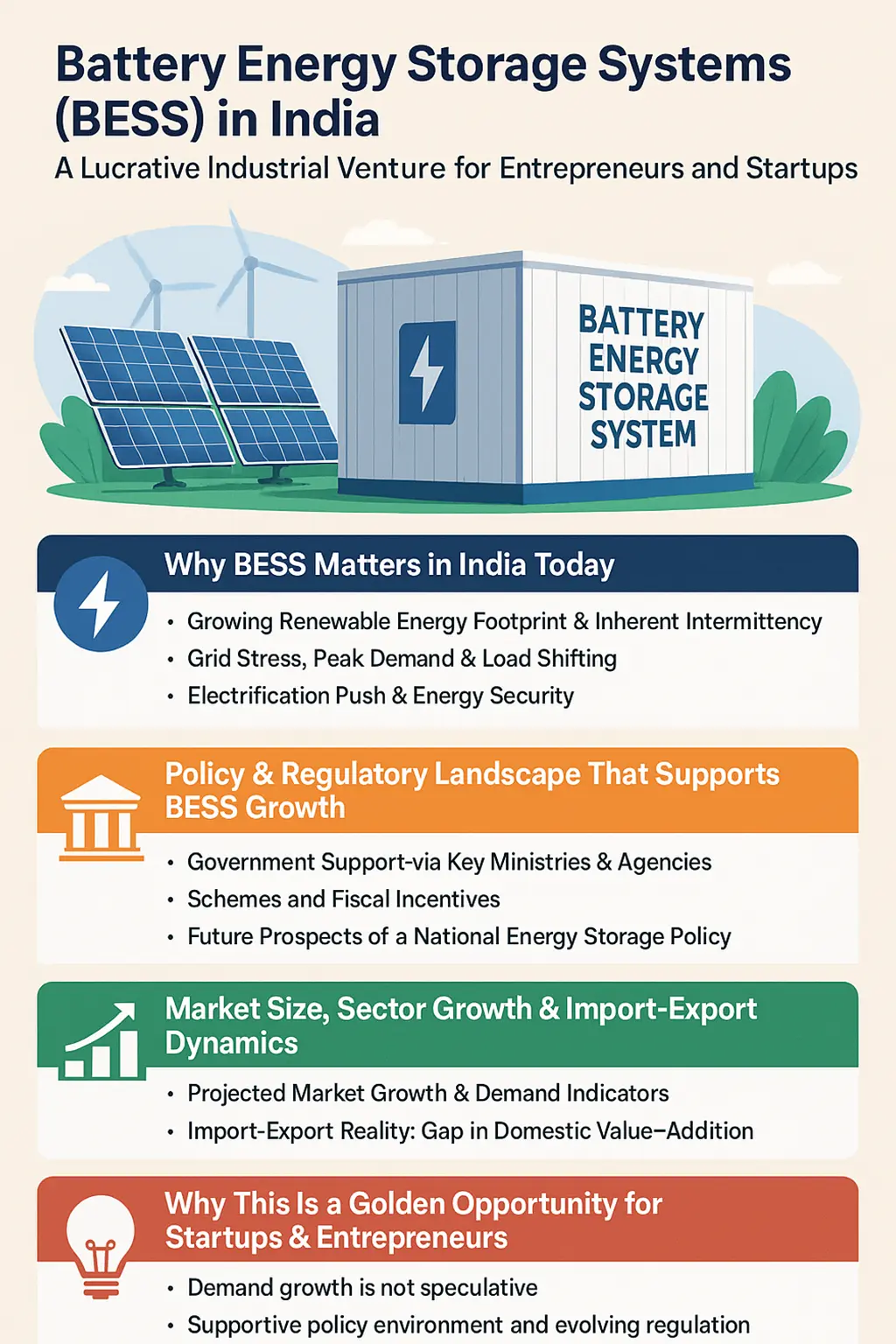
Policy & Regulatory Landscape Supporting Battery Energy Storage Systems
Government Support via MNRE, MoP & BEE
- Key ministries strongly support the integration of Battery Energy Storage Systems for grid balancing, frequency regulation, and renewable integration.
- State electricity regulatory commissions (SERCs) are introducing storage-friendly net metering and wheeling norms.
Schemes and Fiscal Incentives
- Subsidy-linked renewable projects are beginning to recognize the value of bundling BESS.
- Import duties for battery raw materials are being recalibrated under the Make in India initiative.
- FDI-friendly policies support domestic manufacturing of BESS components.
National Energy Storage Policy – Future Outlook
- A unified National Energy Storage Policy is under formulation. Clarity regarding grid-scale storage, open-access models, and ancillary services will significantly accelerate BESS adoption.
- Once launched, the policy may introduce dedicated tenders, auctions, and subsidies.
Market Size, Sector Growth & Import–Export Dynamics for Battery Energy Storage Systems
Market Growth & Demand Indicators
- India’s BESS market is expected to grow at a CAGR of 25–30% over the next decade.
- Commercial and industrial sectors will drive 40–50% of the total Battery Energy Storage Systems demand.
- Grid-scale applications will form 20–30% of the market.
Import–Export Reality: India’s Value-Addition Gap
- 70–80% of lithium-ion cells and battery modules are still imported from China, Korea, and Japan.
- This dependency reveals a huge manufacturing and assembly opportunity for MSMEs.
- Once domestic manufacturing matures, India can export BESS solutions to Africa, South Asia, and the Middle East.
Why Battery Energy Storage Systems Are a Golden Opportunity for Entrepreneurs
- Demand growth is already visible and accelerating.
- Government agencies and policies strongly support storage integration.
- High import dependency creates a large opportunity for domestic value addition.
- Multiple scalable business models exist — manufacturing, integration, leasing, recycling, and exports.
Read more : Renewable Energy Manufacturing Guide
Business Opportunity 1: Domestic Manufacturing of Battery Cells, Modules & BMS
As the core of all Battery Energy Storage Systems, cell, module, and BMS manufacturing holds massive value. India imports most of these components, creating a clear high-value opportunity for local manufacturing.
| Aspect | Insights |
|---|---|
| Market Gap | 70–80% of lithium-ion cells/modules are imported. Domestic capacity is insufficient. |
| Investment | Requires clean rooms, cell assembly lines, QC labs. “Make in India” incentives can offset CAPEX. |
| Raw Materials | While some materials need importing, electrode fabrication, assembly, and testing can be localized. |
| Quality Standards | International certifications and safety compliance are essential for market success. |
Business Opportunity 2: Battery Pack Assembly & BESS Integration
This is the most accessible entry point for MSMEs. Entrepreneurs can assemble packs using imported cells/modules, integrate inverters and BMS, and deliver ready-to-install BESS units.
- Sourcing high-quality cells/modules.
- Designing flexible assembly lines for 5 kWh–500 kWh packs.
- System integration expertise (inverter + BMS + thermal management).
- Offering installation, service & warranties.
- Export potential to regions lacking manufacturing capacity.
Business Opportunity 3: Turnkey BESS Project Implementation & Installation
This segment includes designing, procuring, installing, commissioning, and maintaining full Battery Energy Storage Systems for C&I clients, utilities, and institutions.
Target Segments
- Factories & SMEs
- Real estate & housing societies
- Hospitals, data centers, telecom towers
- State utilities
- Conduct site surveys and load analysis.
- Design battery configuration and system architecture.
- Procure BESS components.
- Install, test, and commission.
- Provide maintenance contracts for recurring revenue.
Business Opportunity 4: Battery Renting, Leasing & Energy Storage-as-a-Service (ESaaS)
The OPEX model removes upfront costs for customers. Providers install and maintain battery systems, while users pay monthly fees.
- Ideal for SMEs, retail chains, educational institutions, societies
- Offers predictable recurring revenue
- Requires strong maintenance and monitoring systems
Find the Best Idea for Yourself With our Startup Selector Tool
Business Opportunity 5: Battery Recycling & Second-Life Applications
As BESS and EV batteries age, recycling and second-life applications will become critical. This sector is still largely untapped in India.
- Collection of spent batteries
- Testing and grading
- Refurbishing for secondary usage (telecom towers, microgrids)
- Recovering metals and materials
- Complying with environmental regulations
Import–Export Opportunities for Battery Energy Storage Systems
- Assembling packs in India and exporting to Africa, Middle East, Southeast Asia
- Exporting BESS kits (battery + inverter + PCM + BMS)
- Supplying inverters, enclosures, and BoS components globally
- Exporting recycled battery materials
Entrepreneurs can build India as a cost-efficient export hub for Battery Energy Storage Systems.
Success Stories & Lessons from MSMEs in Related Sectors
- A leading inverter brand began with home UPS systems, slowly integrating lithium-ion pack assembly.
- A solar EPC firm diversified into solar + storage bundles.
- An electronics manufacturer exported power modules to Asia–Africa markets.
Role of NPCS: Professional Feasibility Guidance
NPCS provides detailed techno-economic feasibility reports, market analysis, process diagrams, financial projections, and machinery/plant layouts. For BESS entrepreneurs, a well-structured DPR is invaluable for planning and execution.
Challenges & Risks in the Battery Energy Storage Systems Industry
- Raw material price fluctuations
- Rapid technology changes
- Regulatory uncertainty
- Safety & compliance risks
- Competition from global players
- Capital intensity for cell manufacturing
Strategic Recommendations for Entrepreneurs Entering the BESS Industry
- Start with low-capital segments like pack assembly or installation.
- Focus on quality and compliance.
- Leverage Make in India incentives.
- Build strong supply-chain partnerships.
- Design products for export readiness.
- Add recycling & circular economy models.
- Start with pilot projects.
- Use expert consulting support.
Conclusion: Why Battery Energy Storage Systems Are India’s Next Big Industrial Bet
India is undergoing a transformational clean-energy shift. Battery Energy Storage Systems lie at the center of this transition, creating long-term opportunity across manufacturing, integration, services, and recycling. For entrepreneurs prepared to innovate and execute with quality, the BESS sector offers enormous potential.
For detailed feasibility reports, market insights, or project planning support, contact NPCS.
External References:
MNRE – Ministry of New and Renewable Energy
Related Articles:
Solar Business Opportunities in India
Renewable Energy Manufacturing Guide


