


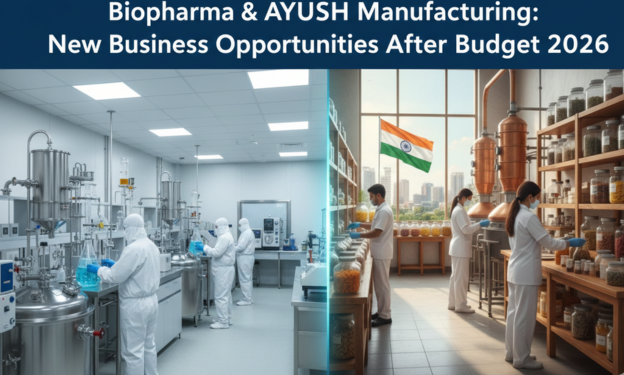
The ecosystem of India’s pharmaceutical and traditional medicine has passed a phase of a different structure. The industry that was previously a volume-intensive, formulation-intensive industry is being re-packaged as a science-based, export-focused and quality-insured manufacturing hub. The new policy orientation as indicated by the Union Budget 2026-27 of India is a firm thrust towards the empowerment of biopharma, modernisation of AYUSH production, and creation of a globally reputable certification and testing ecosystem.
To startups, MSMEs, and first-generation entrepreneurs, such a shift provides a new category of business opportunities that are capital-efficient, margin-resistent, and scalable, as long as it is coupled with feasibility discipline and not enthusiasm per se. Instead of the traditional pharma entry routes where the players are large in terms of market share, the current biopharma & AYUSH manufacturing provide a variety of entry points, including intermediates, contract manufacturing, extracts, testing services, and export-oriented niche.
Why Biopharma and AYUSH Are No Longer Parallel Industries
In the past, modern pharmaceuticals and traditional medicine existed in different spheres where one was a chemical-based and clinical trial-oriented approach, and the other a classical formulation and local demand-oriented approach. That division is quickly fading away. The overlapping of biopharma & AYUSH manufacturing has been brought about by regulatory harmonisation, world need of plant-based therapeutics, and scientific validation of traditional systems.
It is not an ideological convergence, but a commercial one. Herbal and traditional products are now required by global buyers to be traceable, standardised and to prove their efficacy through evidence. Meanwhile, biologics, fermentation-based APIs, probiotics, and plant-derived actives are all biopharma areas being pursued more and more. The Biopharma SHAKTI policy emphasis, the enhanced drug testing laboratories and the emergence of Ayurveda colleges can only be interpreted as an effort to industrialize the convergence.
Biopharma SHAKTI: A Structural Opportunity, Not a Scheme
Biopharma SHAKTI is not simply the promotion of big pharmaceutical plants in terms of vaccines or biologics. The further meaning is the development of supporting manufacturing depth, which includes inputs, intermediates, processing units, and validation infrastructure that biopharma relies on.
Regarding feasibility, the best opportunities that MSMEs have are in mid-chain manufacturing where capital intensity is not that high and margins are not hard to defend. These are fermentation intermediates, biological buffers, culture media components, enzymes, nutraceutical-grade actives and diagnostic reagents. These units enjoy steady demand, recurring orders and reduced fluctuations in prices as opposed to finished formulations.
Any business venturing into this field should be aware that, in this sector; biopharma appreciates the consistency of the process rather than the amount of money dedicated to marketing. Once quality has been demonstrated, customers do not change suppliers easily. This is a traditional patient scale industry because growth capital is a cumulative asset.
New Ayurveda Institutes: What They Mean for Entrepreneurs
When the new Ayurveda institutes are announced, it is always taken as a scholarly or employment-oriented initiative. These institutes, in fact, serve as anchor demand generators to a broader ecosystem of manufacturers and service providers.
The demand in every new institute is for standardized raw materials, classical formulations, pilot-scale production, analytical testing, and validated extracts. What is more important is that they assist the formalisation of formulation protocols that lessen vagueness to manufacturers and exporters.
To an entrepreneur this provides a chance to escape the generic churn products and work towards institutional-congruent manufacturing- products and intermediates, which are prescribed, researched, or proven in institutional contexts. This kind of alignment greatly enhances the visibility of demand in the long run and the credibility of exports.
Upgraded Drug Testing Labs: The Hidden Business Catalyst
Not a lot of policy intervention has as thorough a downstream effect as drug testing labs. To biopharma manufacturers and AYUSH manufacturers alike, testing is not a cost of compliance; it is an access enabler to the market.
The modernisation of labs increases the quality standard in the industry. This is good news to the compliant manufacturers. It sifts through non-serious players and establishes pricing power to units that invest in processes that have been tested to work. Meanwhile, it creates a parallel business opportunity for independent testing, validation, and certification services.
The scientific talent and moderate capital MSMEs can introduce NABL-conformable testing units on herbal actives, fermentation products, stability research and export documentation. Credibility and not capacity is the basis of scaling of these types of businesses and it is especially appealing to the technically-minded founders.
Export-Oriented Pharma Manufacturing: Where New Startups Can Compete
The export-led pharma development is no longer confined to big formulation exporters. International consumers are aggressively finding niche specialised, compliant, and small-batched producers.
There are opportunities in the form of herbal extracts, nutraceutical ingredients, probiotic blends, fermentation-based compounds, and AYUSH-based wellness products that have been modified to fit international markets. Facilitation of imports and exports, longer compliance periods and better customs systems make it less arduous to the new exporters who develop quality-first operations.
Product selection is the critical success factor here. Volume is not as critical as differentiation, documentation and reliability in driving the export profitability. Companies that build their facilities with export compliance in mind also do not have to incur expensive retrofits later in their lives.
Read Also: Drugs and Pharmaceutical Based Manufacturing Business Ideas
Learning from Indian Industry Leaders: Decision Logic That Matters
Dilip Shanghvi, Promoter of Sun Pharmaceutical industries, created scale through complex generics and specialty products as opposed to commodity formulations. His reasoning approach, such as not to enter crowded markets, ability to deal with complexity, and reinvest in ability can be directly applied to biopharma startups nowadays.
The founders of Patanjali are Baba Ramdev and Acharya Balkrishna who showed that traditional knowledge integrated with manufacturing discipline could result in mass-market brands. Branding is of secondary importance but control of sourcing, processing, and formulation is the primary message learned.
Biocon Founder Kiran Mazumdar-Shaw demonstrates that biologics and fermentation-based manufacturing is a patient and scientifically rigorous business. In the case of MSMEs, her experience underscores the need to own processes and look at the long-term vision despite the seeming slowness in the initial phase of growth.
Read Our Book: Drugs & Pharmaceutical Technology Handbook
High-Potential Project Ideas for New Entrants
Standardised Herbal Extract Manufacturing Units
These units are at the crossroads of AYUSH and biopharma. Sourcing discipline, solvent recovery efficiency and batch consistency are the key components of profitability. Exporters, nutraceutical brands and institutional buyers are the drivers of demand.
Fermentation-Based Nutraceutical Ingredients
The recurring demand and export potential are with probiotics, enzymes and bio-actives. The level of capital is mid-level, whereas the knowledge of processes is essential. Customer stickiness is high once it has been proven.
AYUSH Formulation Contract Manufacturing
Asset-light models are popular with many brands. Brand-led startups cannot scale as fast as GMP-compliant contract manufacturers that have approved formulations.
Independent Drug Testing and Validation Labs
The higher the quality standards, the more essential third-party testing is. The scale of these labs is through reputation and accreditation and not physical growth
Botanical APIs and Phyto-Chemicals
These products bridge pharma and wellness markets. Export margins are strong, but success depends on documentation and standardisation.
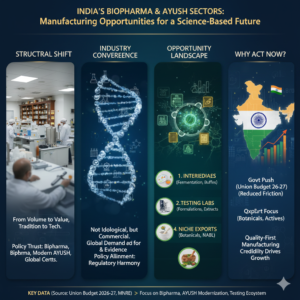
Table: Structural Drivers Supporting Biopharma & AYUSH MSMEs
| Policy Driver | Commercial Impact | MSME Opportunity |
| Biopharma SHAKTI | Strengthened bio-manufacturing ecosystem | Intermediates, fermentation inputs |
| New Ayurveda Institutes | Institutional demand creation | Standardised formulations, extracts |
| Upgraded Drug Testing Labs | Higher compliance baseline | Testing, certification services |
| Export Facilitation Measures | Reduced trade friction | Niche export manufacturing |
Where Feasibility Thinking Separates Winners from Followers
In consulting practice, the most successful biopharma and AYUSH projects are those that start with feasibility, not fashion. Entrepreneurs who understand cost drivers, yield sensitivity, regulatory timelines, and market elasticity make better capital allocation decisions.
At Niir Project Consultancy Services (NPCS), we consistently work with entrepreneurs at this evaluation stage—helping them assess whether a proposed biopharma or AYUSH project is not only viable, but scalable. Our Market Survey cum Detailed Techno-Economic Feasibility Reports combine the design of the manufacturing process, demand analysis, machinery planning, raw material economics and an in depth financial modelling in order to assist decision making on informed investments.
Frequently Asked Questions (Founder-Focused)
Can first-generation entrepreneurs survive in biopharma manufacturing?
Yes, when it comes to entering via a middle man, contract manufacturing or testing instead of finished formulations.
Are AYUSH exports truly scalable?
They are scalable when products are standardised, documented, and aligned with international regulations.
Which segment offers faster break-even?
Testing services and contract manufacturing typically achieve earlier break-even than brand-led models.
How critical is regulatory planning at the start?
It is fundamental. Delayed compliance planning is the most common cause of cost overruns.
Can one facility serve both domestic and export markets?
Yes, if designed with export-grade compliance from inception.
Final Perspective: A Manufacturing Opportunity Rooted in Credibility
The manufacture of biopharma and AYUSH is no longer a sentiment-based opportunity space subsidized or not. They are industries with a focus on credibility where quality, documentation, and process control is the measure of success. The present policy landscape provides a unique opportunity to create businesses that are stable, export-oriented, and internationally oriented to startups that are ready to think as feasibility consultants rather than as traders.


