



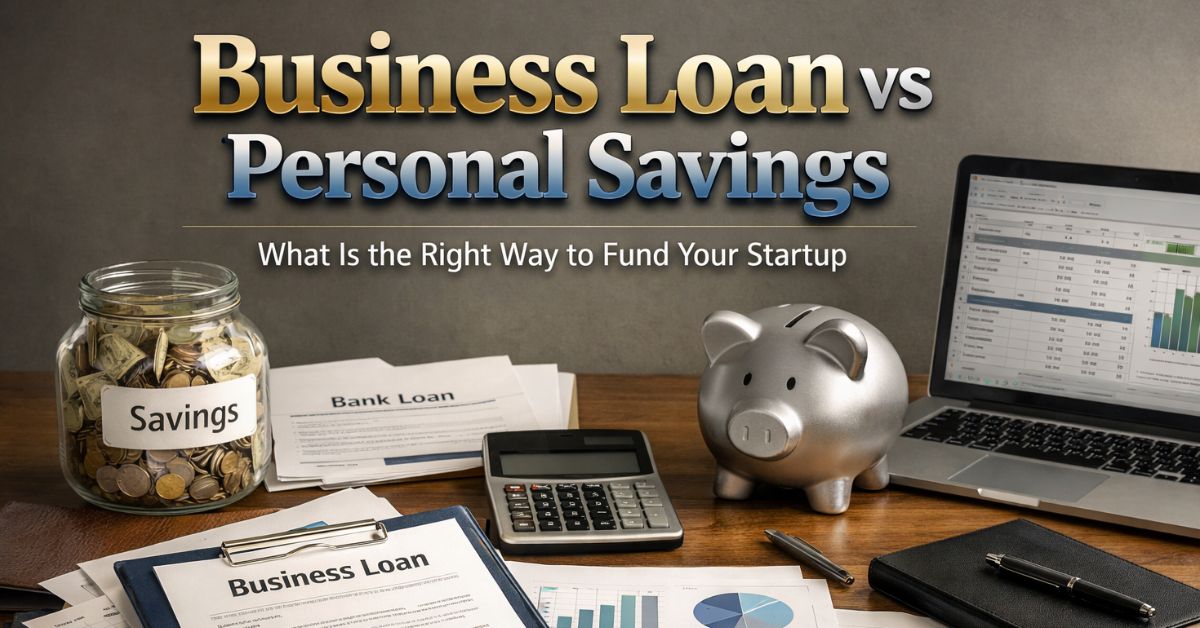
Introduction: Business Loan vs Personal Savings
Every entrepreneur eventually reaches a point where an idea must turn into action. At that stage the critical question is not about marketing, branding or even the product. The real question is how to fund the business in a way that supports growth while keeping risk under control.
The Business Loan and Personal Savings question is an one. Business Loan and Personal Savings are two ways to fund a startup. Some people believe using Personal Savings is always safer because there is no debt involved. Others assume that taking a Business Loan is the path to expansion. The truth lies somewhere in between. The best funding decision depends on the size of the investment the risk level of the Business Loan and Personal Savings and how quickly revenue will begin for the Business Loan and Personal Savings.
Many startups fail not because the idea was weak. Because the funding structure was wrong. Businesses that choose the mix of capital usually survive longer and grow faster. That is why understanding the difference between Business Loan and Personal Savings is essential before launching any venture. The Business Loan and Personal Savings decision is an one.
Understanding Business Loan vs Personal Savings
Using Personal Savings means investing your money into the Business Loan and Personal Savings. This approach gives you control and flexibility. There is no interest to pay and no monthly repayment pressure for the Personal Savings. However the amount of capital is limited to what you personally have saved for the Personal Savings.
A Business Loan on the hand provides access to additional capital from banks or financial institutions for the Business Loan. This allows the Business Loan and Personal Savings to start at a scale purchase better equipment and meet market demand more effectively for the Business Loan. The downside is that the Business Loan and Personal Savings must generate income to repay the Business Loan on time.
In terms Personal Savings provide freedom while Business Loan provides power for the Business Loan and Personal Savings. The challenge is choosing the balance between the Business Loan and Personal Savings.(Business Loan vs Personal Savings)
Read More: Business Plans / Project Profiles
When Personal Savings Is the Right Choice
Personal Savings work for businesses that require small investments and can start generating revenue quickly for the Personal Savings. The businesses show higher risk combined with less time needed to recover their investment when they use Personal Savings. Your money lets you enter the market because it creates an opportunity to explore without signing permanent financial contracts through Personal Savings.
Personal Savings are especially suitable for:
- Small-scale startups with investment below ₹20–25 lakh
- Businesses with cash flow
- Service-based or home-based ventures
- Entrepreneurs who want to test a new idea before scaling
The most important benefit of Personal Savings allows users to choose their own spending times. The system lets you make choices immediately since it bypasses both loan processing times and required documentation for the Personal Savings. The Personal Savings system enables fast market entry which will benefit users who need quick access to their funds.
However it is essential to protect your stability for the Personal Savings. Investing all your savings into a business can create unnecessary stress if the venture takes longer than expected to become profitable for the Personal Savings.(Business Loan vs Personal Savings)
Read More: Project Reports & Profiles
When a Business Loan Becomes the Better Option
As businesses grow larger and more complex the need for funding increases for the Business Loan. Manufacturing units, processing plants and industrial businesses often require capital for machinery, infrastructure and working capital for the Business Loan. In cases relying only on Personal Savings can limit growth and reduce competitiveness for the Business Loan.
A Business Loan allows entrepreneurs to start at the scale from the beginning for the Business Loan. Of expanding slowly over several years the company can launch with the capacity needed to meet demand immediately for the Business Loan.
A Business Loan is usually the better option when:
- Project cost exceeds ₹25–30 lakh
- Machinery or equipment is required
- Production capacity must be
- Market demand is already established
- Rapid expansion is part of the business plan
Loans are particularly useful when the investment creates long-term assets for the Business Loan. Machinery and equipment can continue generating income for years making the cost of borrowing more manageable for the Business Loan.(Business Loan vs Personal Savings)
Read More: Startup Selector
Advantages and Risks of Business Loans
Taking a Business Loan can be a growth strategy but it must be managed carefully for the Business Loan. Entrepreneurs need to understand both advantages and disadvantages of Business Loan financing when they make their business decisions.(Business Loan vs Personal Savings)
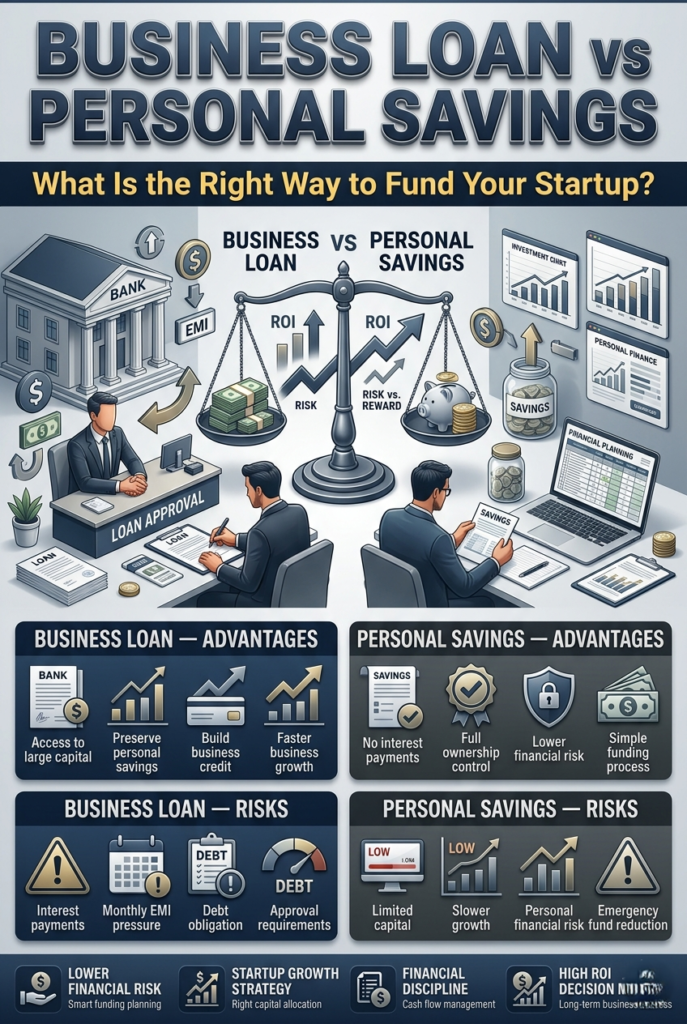
Advantages
- Enables production capacity
- Supports faster business growth
- Preserves Personal Savings
- Builds business credit history
- Allows investment in better technology
Risks
- Monthly EMI obligation
- Interest cost increases expenses
- Cash flow pressure during slow periods
- Credit score impact if payments are missed
Successful risk management requires actual financial forecasts together with sufficient operating funds maintenance for the Business Loan.(Business Loan vs Personal Savings)
Why Successful Startups Use a Combination of Both
Most successful companies in the world use multiple funding streams for their Business Loan needs and for their Personal Savings requirements. The companies combine Personal Savings with borrowed funds to secure their Business Loan and Personal Savings. The Business Loan and Personal Savings system offers users both security measures and growth opportunities through its current operational structure.(Business Loan vs Personal Savings)
Entrepreneurs demonstrate their commitment to Business Loan and Personal Savings projects by investing their personal funds to decrease overall project risks. The business requires additional financing through a loan which will allow it to expand operations for the Business Loan and Personal Savings.
A balanced funding structure often looks like this:
- 25–35% from Personal Savings
- 65–75% from bank or institutional loan
Banks and financial institutions endorse this model because it distributes risk while showing that the entrepreneur holds equity in the Business Loan and Personal Savings.(Business Loan vs Personal Savings)
Government Support for Startup Funding in India
India has introduced programs to support new businesses and encourage entrepreneurship for the Business Loan and Personal Savings. The Business Loan and Personal Savings programs enable startups to obtain funding, while they also decrease risks for upcoming businesses.(Business Loan vs Personal Savings)
The Business Loan program provides government-backed loans which include interest rates and flexible repayment terms together with partial guarantees. The Business Loan program offers subsidies which reduce project costs through its funding system.(Business Loan vs Personal Savings)
Popular startup loan schemes include:
- MSME Loans for medium businesses
- MUDRA Loans for small enterprises
- PMEGP Scheme offering capital subsidy
- CGTMSE Scheme providing collateral-free loans
The programs assist first-generation entrepreneurs who lack financial resources because they do not possess substantial funds or assets to use as security for the Business Loan and Personal Savings.(Business Loan vs Personal Savings)
Common Funding Mistakes Entrepreneurs Should Avoid
Many new business owners make decisions based on emotion rather than data for the Business Loan and Personal Savings. Avoiding mistakes can significantly improve the chances of success for the Business Loan and Personal Savings.(Business Loan vs Personal Savings)
One frequent mistake is underestimating working capital requirements for the Business Loan and Personal Savings. Businesses often focus on setup costs. Forget about daily operating expenses for the Business Loan and Personal Savings. This can lead to cash shortages when sales are strong for the Business Loan and Personal Savings.(Business Loan vs Personal Savings)
Another mistake is starting too small to save money for the Business Loan and Personal Savings. While minimizing risk is important insufficient capacity can prevent the business from meeting demand and achieving profitability for the Business Loan and Personal Savings.
Common mistakes include:
- Investing all Personal Savings into the business
- Taking a Business Loan without planning
- Underestimating working capital needs
- Ignoring market research
- Starting with insufficient production capacity
Learning from these mistakes can help entrepreneurs build a financial foundation for the Business Loan and Personal Savings.(Business Loan vs Personal Savings)
How to Decide the Right Funding Strategy
Choosing the funding option requires careful analysis of your business model for the Business Loan and Personal Savings. The first step is to estimate the total investment required and determine how quickly the business will start generating revenue for the Business Loan and Personal Savings.(Business Loan vs Personal Savings)
If the investment is relatively small and revenue begins quickly Personal Savings may be enough to start the business for the Personal Savings. If the project involves infrastructure or equipment and requires more time to become profitable borrowing capital is usually the better choice for the Business Loan.
Before making a decision consider these key factors:
- Total project cost
- Expected monthly revenue
- Time required to reach profitability
- Risk tolerance
- Availability of government support
Answering these questions honestly will help you select the funding strategy that best matches your business goals for the Business Loan and Personal Savings.(Business Loan vs Personal Savings)
Conclusion: Choose the Right Structure, Not Just the Cheapest Option
The decision between a Business Loan and Personal Savings should never be based on cost for the Business Loan and Personal Savings. The real objective is to create a funding structure that supports long-term growth and financial stability for the Business Loan and Personal Savings.(Business Loan vs Personal Savings)
Successful entrepreneurs focus on sustainability for the Business Loan and Personal Savings. The organization uses its funds to run its operations while keeping emergency reserves and it borrows money when needed to finance business growth through The Business Loan and Personal Savings option.
Whether you start with Personal Savings, a Business Loan or a combination of both careful planning is the important factor for the Business Loan and Personal Savings. A designed financial strategy can turn a simple idea into a profitable and lasting business, for the Business Loan and Personal Savings.(Business Loan vs Personal Savings)
Frequently Asked Questions (FAQ)
- Can a new entrepreneur get a business loan without experience?
Yes many banks and financial institutions provide loans to entrepreneurs especially when the business plan is clear and the money makes sense.
- What percentage of project cost do banks usually fund?
Most banks will give you money for 65 to 75 percent of the total project cost and you have to put in the rest yourself.
- Is it risky to use savings for a startup?
Using all your personal savings for a startup can be very risky. You should always have some money set aside for emergencies.
- Which funding option is better, for manufacturing businesses?
For manufacturing businesses it is usually best to use a combination of your money and a business loan. This way you can. Sell things at a price that competes with other businesses.
- What is the safest way to fund a startup?
The safest way to fund a startup is to be careful and use a mix of your money, a loan that you can afford to pay back and always have enough money to keep your business running.


