


chemical manufacturing business
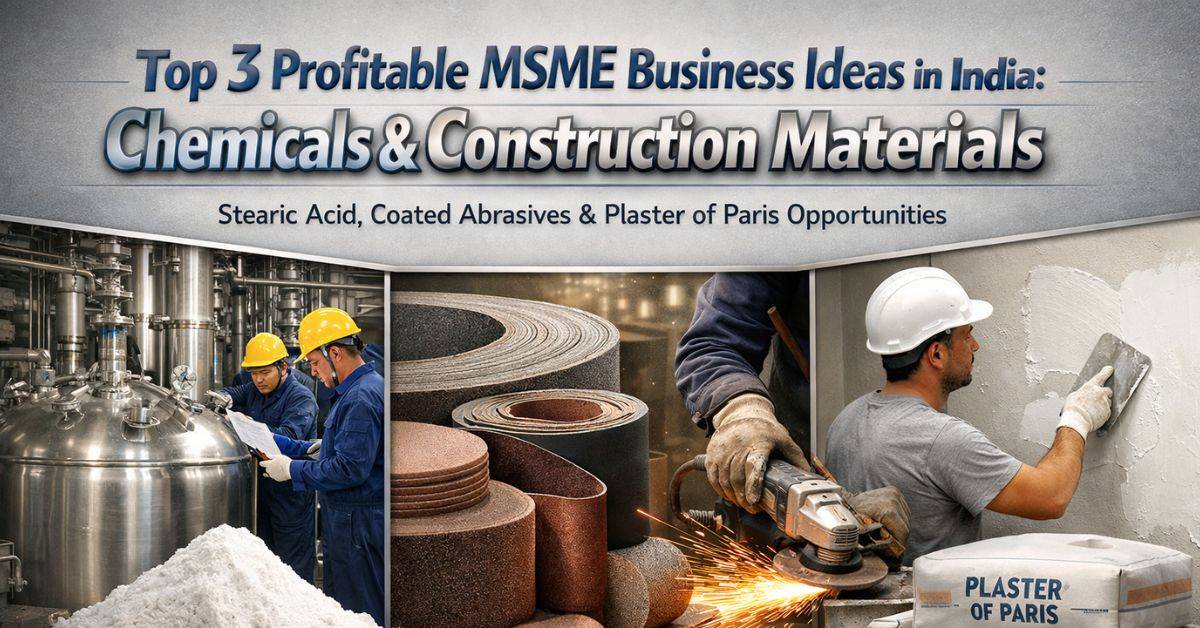
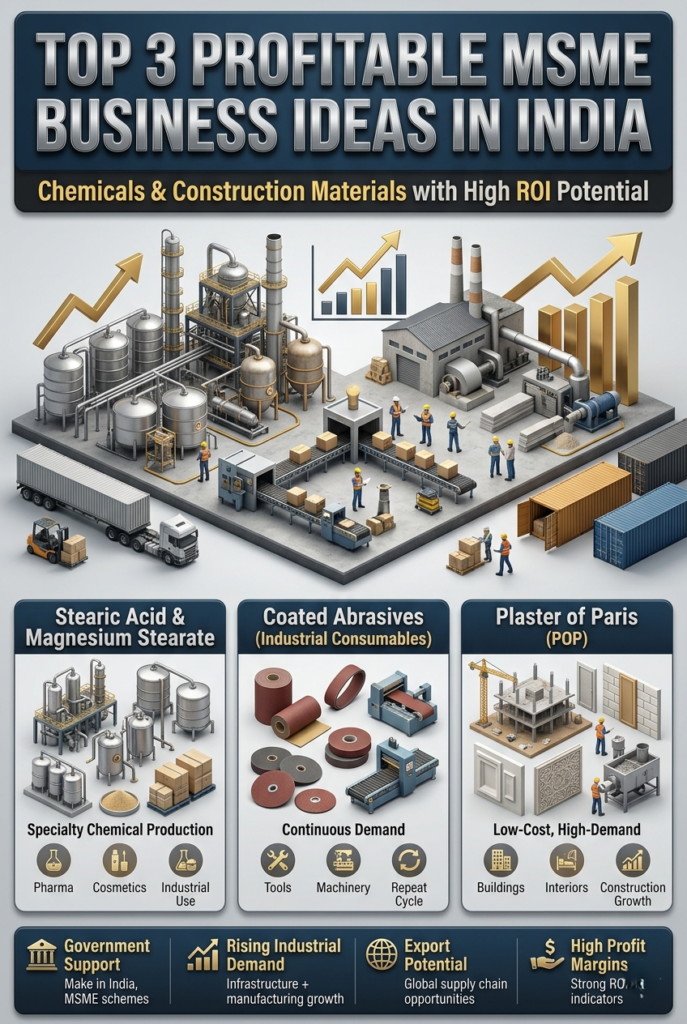
India is experiencing rapid changes to its industrial sector which creates profitable business possibilities for first-time business owners and micro small and medium enterprises. Specialty chemicals performance materials and construction inputs have become the focus of the market because these niche sectors show potential for growth and their demand remains constant while they maintain high profit margins. Some of the most promising MSME business ventures are Stearic Acid and Magnesium Stearate, Coated Abrasives and Plaster of Paris (POP). These products address multiple industries which provides for steady demand but moderate barriers to entry.
In this blog, we uncover these lucrative business ideas, production processes, market potential, and success tips to make it easier for entrepreneurs to make informed investment decisions.
Table of Contents
Toggle1. Stearic Acid and Magnesium Stearate Important Specialty Chemicals
Stearic Acid is a versatile chemical used widely in rubber processing, plastics, detergents, cosmetics and in candle-making. Its derivative, Magnesium Stearate, is important in pharmaceutical tablets, food processing and cosmetics. The chemicals serve as essential industrial materials because they create steady demand which supports the operations of micro small and medium enterprises.
Access Complete Business Plan: Stearic Acid Manufacturing Plant Business Plan and Feasibility Study
Key Applications
- In the following applications, stearic acid plays a role: – Rubber Industry: Stearic acid works as a vulcanization activator.
- Plastics Industry PVC compounders are used as a stabilizer.
- Paints and Coatings: Metallic stearates provide better texture and dispersion.
- Pharmaceuticals: Magnesium stearate helps to avoid sticking of tablets during compression.
- Flavouring Agents: 10 Ways to Add Fragrance to Food and Cosmetics and Skin Care Products. 60+ Scented Products: Serves as a lubricant, anti-caking agent, food and cosmetics.
Production Process
- Stearic Acid: Derived from the splitting of vegetable oils or animal fats, distillation and crystallization.
- Magnesium Stearate: Created by bringing stearic acid and magnesium salts together and then filtering, drying and milling.
- Pharma-Grade Compliance Production must be strictly adhered to purity and regulatory standards.
Why Entrepreneurs Should Take This Segment into Account
- Growing Market: The market of pharmaceuticals in India has been growing at 8-10% every year.
- Prices: $3.67 per barrel of-research paper-2007-12-13$3.67 per barrel October 2007 and July 2007 – Steady Demand: Rubber and plastics industries ensure consistent orders.
- Potential markets: High demand in Southeast Asia, Africa and Europe.
- Profit Margins: Normally 12-25% based on scale and quality.
2. Coated Abrasives: Industrial Consumables that have Recurring Demand
Coated abrasives which include sandpaper and abrasive belts and discs serve essential functions in metal finishing and woodworking and automotive repairs and heavy engineering. The industry uses cloth-backed abrasives for demanding tasks while paper-backed abrasives serve the woodworking and furniture manufacturing sectors.
Production Steps
- Choose Backing Material: Cloth or paper.
- Apply Adhesive and coat with abrasive grains of aluminum oxide or silicon carbide.
- Cure and Finish as Sheets, Rolls or Belts
Business Advantages
- Recurring Revenue: Abrasives are used in manufacturing and repair industry, which are used continuously.
- MSME Dominance: Most of the regional markets are controlled by small and medium enterprises.
- Market Growth: Estimated 6 – 8% per year.
- Profit Margins: 15 – 25%, with much higher profit margins on niche industrial belts.
- Scalability: Build a semi-automatic plant, then scale up by automating it.
Read the Complete Book Here: Handbook On Chemical Industries (Alcohol Based)
3. Plaster of Paris (POP): Low Cost and High Demand Construction Material
Gypsum-derived POP serves as a construction material which interior designers use for decorative mouldings and medical professionals use for casting and artisans use for making handicrafts. Rapid urban housing development and infrastructure growth are in Favor of solid demand for POP in India.
Production Process
- Crush and Grind Gypsum.
- Calcine at 120-180C to partially de-hydrate.
- Cool, Pulverize and Package for sale.
Reasons Why POP Is a Smart MSME Pick
- Moderate Capital Investment: Lower than specialty chemicals.
- High Profit Margins: 18 – 30% depending on location and competition.
- Raw Material Abundant India has huge reserves of Gypsum in Rajasthan.
- Alternative Feedstock Synthetic gypsum from fertilizer plants is also an option.
Lessons to Learn from the Successful Industrial Players
India has examples of MSMEs and large companies which thrived in niche industries:
- Pidilite Industries (Balvant Parekh): Developed a strong brand in adhesives and specialty chemicals.
- Asian Paints (Ashwin Dani): Emphasis on quality, innovation & distribution network.
Important lessons for entrepreneurs:
- Smooth production is ensured because of consistent sources to get reliable raw materials.
- Investing in Quality Control: Good products attract quality clients.
- Develop Distribution Channels Early: Reach retailers, wholesalers, institutional buyers.
- Expand Incrementally: Do not over-invest, expand capacity gradually.
- Conduct Feasibility Studies: There are companies such as Niir Project Consultancy Services (NPCS) that do market surveys, techno-economic reports, and financial projections.
Profitability and Potential for Export
Each segment has good profitability and export opportunities:
Product | Target Market | Export Potential | Profit Margin |
Stearic Acid & Magnesium Stearate | Pharma, rubber, plastics | Southeast Asia, Middle East, Africa | 12–25% |
Coated Abrasives | Metal, woodworking, automotive | Middle East | 15–25% |
Plaster of Paris (POP) | Construction, decorative, medical | Neighbouring developing countries | 18–30% |
Export Advantages:
- Pharma Grade- Magnesium stearate is in demand in Middle East and Southeast Asia.
- Coated abrasive belts are the requirements of industrial hubs in Gulf countries.
- POP has markets in Nepal, in Bangladesh and in Africa.
Certifications, technological improvements and uniform quality can prove to be very beneficial in gaining a competitive edge in the international market
Conclusion
India’s MSME ecosystem is conducive for focused and knowledgeable manufacturers who understand the raw materials, have a high standard of quality, and are expansionary. Stearic Acid, Magnesium Stearate, Coated Abrasives and POP provide grounded, scalable and commercially feasible pathways for entrepreneurs to enter manufacturing.
Success is not driven by mere trade of goods but instead by procurement efficiency, quality controls, excellent distribution networks and process excellence. By utilizing niche products, cost management, and export prospects, MSMEs can establish profitable and sustainable businesses in the specialty chemicals and construction materials industries in India.
Frequently Asked Questions (FAQ)
Q1. How much money is needed as an investment?
POP manufacturing not needing a great deal of capital and specialty chemicals needing enough investment due to equipment and matching of regulatory bodies.
Q2. Which segment provides more rapid returns?
Coated abrasives and POP usually allow for faster returns because of short production cycles and recurring demand.
Q3. Are these businesses appropriate for first generation entrepreneurs?
Coated abrasives and POP are examples of: – Yes, especially coated abrasives. Specialty chemicals need technical expertise or experienced people.
Q4. What are the necessary certifications?
Pharmaceutical grade magnesium stearate requires regulatory approval. POP and Abrasives must conform to quality requirements for institutional and export sales.
Q5. Are these products exportable?
In response to the question “Do specialty chemicals and coated abrasives have high international demand


