


Container Manufacturing Business
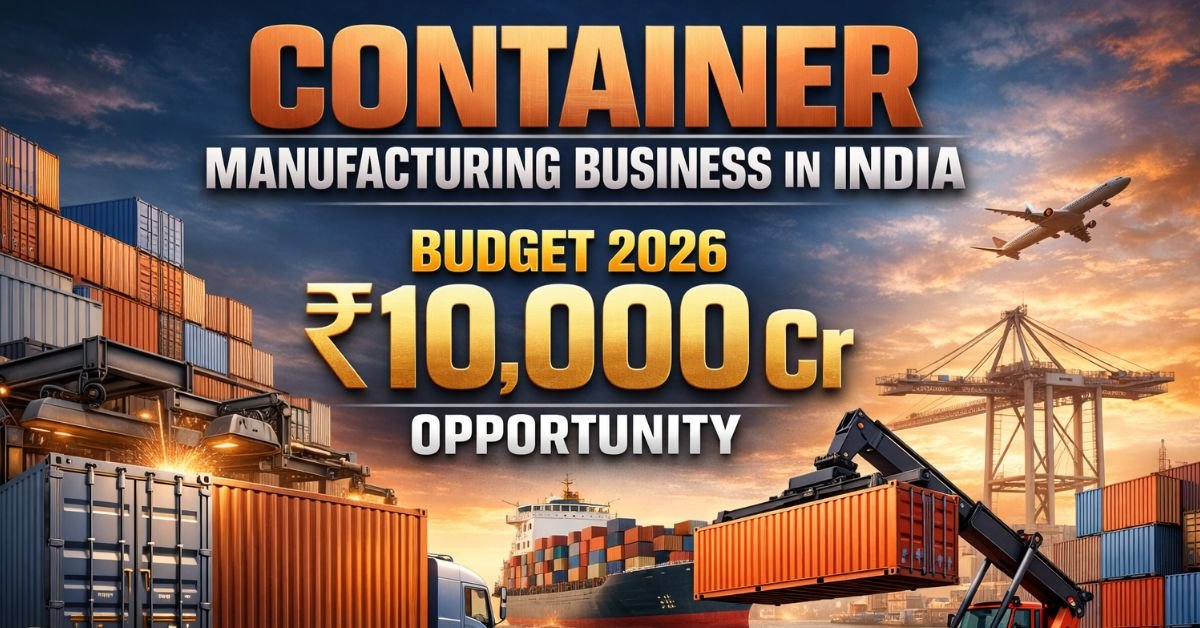
Budget 2026 has quietly opened the floodgates to one of the most potent manufacturing opportunities of the decade.
With the announcement of a Container Manufacturing Scheme of Rs. 10,000 Crore, the Government of India has been directly addressing a long-ignored structural gap in the country’s logistics and industrial ecosystem.
While capex and infrastructure spending received the headlines, this scheme is notable because it opens a new manufacturing market rather than one that supports an existing one. For MSMEs, first-generation entrepreneurs and industrial investors, container manufacture is turning out to be a rare policy-backed import substitution-led scalable business opportunity.
This article is broken down to why container manufacturing is important, where opportunities are, and how an entrepreneur can get a head start early with a well-planned SEO-based structure aimed at ranking on Google and acquiring high-intent readers.
India does not produce a sufficient volume of shipping containers.
Globally, almost two-thirds of international trade in value terms is carried through shipping in containers, but India relies heavily on imports – primarily from China, which dominates container production (80%+ of the world).
In the past Indian manufacturers had problems because:
- Domestic containers were 30-40% more expensive
- Steel input costs were high
- Limited economies of scale, which were discouraging investors
The new Budget 2026 scheme directly addresses these barriers by providing subsidizing of capacity creation, providing incentives for scale, and enhancing cost competitiveness.(Container Manufacturing Business)
According to the official communication sent out by the Press Information Bureau, the goal is to build a globally competitive container manufacturing ecosystem that will be able to cater to the domestic as well as the export markets.
This makes container manufacturing not just a reform in logistics – but a manufacturing revolution in disguise.(Container Manufacturing Business)
Import-Export Gap: The Crux of the Business Logic
India currently imports almost 2 million empty containers every year for exports and movement on coastal. This results in:
- Massive outflow of foreign exchange
- Increased logistics cost for Indian exporters
- Supply uncertainty in global disruptions
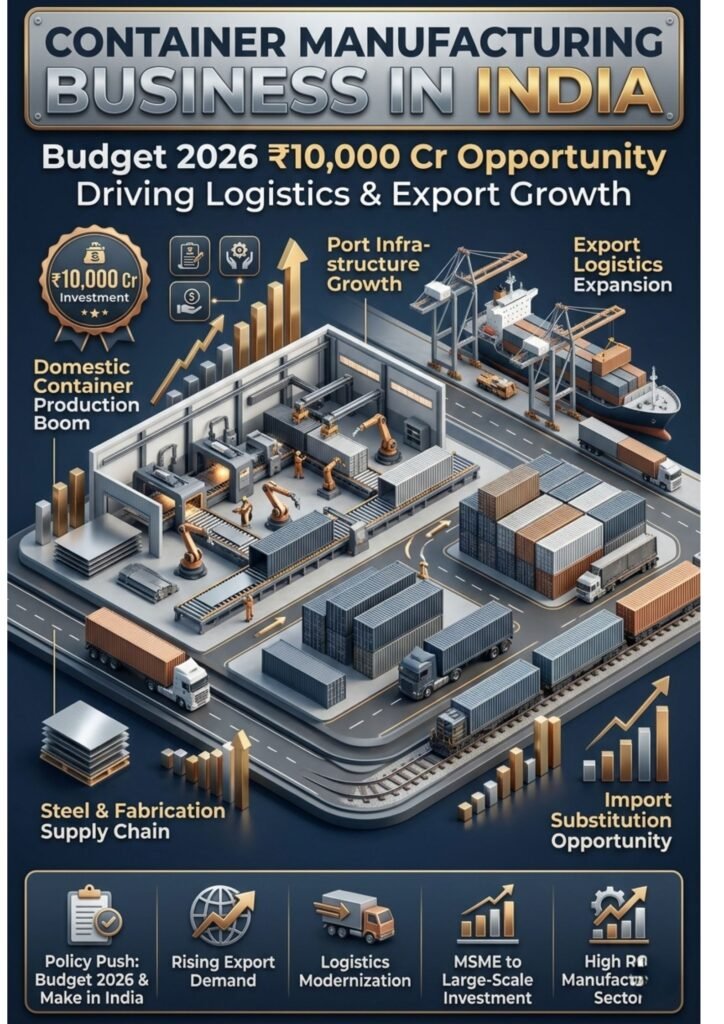
The goal of the entire scheme of about 10,000 Crore INR is to construct a capacity of about 1 million TEU per annum in the domestic market, unlocking a market estimated at 80,000 Crore INR over time.
Additionally, the container demand is expected to increase from:
- Coastal shipping
- Dedicated Freight Corridors
- Inland waterways (20+ waterways being operationalized).
- Multimodal logistics parks
For entrepreneurs, this entails policy-backed demand visibility, not speculative market risk.(Container Manufacturing Business)
Important MSME & Entrepreneurial Opportunities in Container Manufacturing
1. Dry Cargo Container Manufacturing Units
Setting up a TEU-based container fabrication plant is now commercially viable.
Ideal project profile:
- Capacity: 10,000–25,000 containers/year
- Customers: Logistics operators, rail freight companies, exporters
- Output: ISO dry cargo containers
A real life example is APPL Containers Ltd. that entered the segment with an investment of around ~133 crores and supplies to institutional buyers such as CONCOR and DP World – and prove that Indian private players can compete at scale.
This “MSME-to-institutional supplier” model is very replicable under the new scheme.(Container Manufacturing Business)
2. Container Component Manufacturing (High Potential MSME Segment)
Container manufacturing is assembly driven so there is great demand for ancillary units such as:
- Corner castings
- Structural steel frames
- Marine grade plywood flooring
- Locking rods & hinges
- Anti-corrosion industrial coatings
Each component reflects an independent MSME scale opportunity with:
- Lower capital investment
- Faster break-even
- Stable B2B demand
This ecosystem-led growth resembles strategy by industrial leaders such as Sajjan Jindal where downstream manufacturing strengthened control of value chains.(Container Manufacturing Business)
3. Modular Container Development for Infrastructure & Housing
Beyond logistics, containers are now popularly used for:
- Site offices
- Worker housing
- Portable hospitals
- Disaster relief shelters
- Cold storage modules
Entrepreneurs can use a asset-light model by transforming semi-finished containers into modular infrastructure solutions.(Container Manufacturing Business)
Large infrastructure groups such as Adani Group have already shown how containerized solutions can be combined with infrastructure-led growth.(Container Manufacturing Business)
Read More: Project Reports & Profiles
4. Inland Waterway & Specialized Containers
With capital coming to inland waterways, the demand is increasing for:
- Flat rack containers
- Open-top containers
- Refrigerated containers
- Tank containers
This opens doors for engineering focused start-ups and niche manufacturers that are aligned with multimodal corridors of logistics.(Container Manufacturing Business)
Scalability & Profitability: Why Containers is a Low Volatility Manufacturing Business
Contrary to consumer goods, container manufacturing provides:
- Long asset life cycles
- Institutional, Repeat Buyers
- Policy-aligned demand growth
Key advantages:
- Capital goods demand – > with infrastructure investment
- Export growth works directly to increase container requirements
- Shipping lines are on long term procurement contracts
According to updates from the Press Information Bureau, India’s capital goods exports are already showing steady growth – downside risk is reduced for new entrants.(Container Manufacturing Business)
Risks That Entrepreneurs Should Evaluate Carefully
Container manufacturing is not plug and play. Critical risk factors are:
- Steel price volatility
- ISO and CSC certification compliant
- Research in the area of: – Welding automation & quality control
- Advanced anti-corrosion coating systems
- Logistics partnerships for delivery
This makes a Market Survey cum Detailed Techno-Economic Feasibility Report (DPR) necessary before investment.
Professional feasibility studies help to evaluate:
- Optimal capacity planning
- Machinery selection
- Cost structures
- Break-even timelines
- Long-term scalability
What Industrial Leaders in India Can Teach Us
Industrial pioneers such as Ratan Tata, Gautam Adani, and logistics leaders related to J M Baxi Group entered capital goods manufacturing during the past in the past.
- Imports dominated supply
- Government incentives – reduced barriers to entry
- And all requirements for infrastructure demand cycles aligned
The scheme of container manufacturing is just such a window for new generation investors.(Container Manufacturing Business)
Conclusion: Budget 2026 Has Created a Manufacturing Market
At a macro level, the ₹10,000 crore container manufacturing scheme strengthens India’s logistics resilience.
At a project level, it unlocks multiple MSME and mid-scale manufacturing opportunities across:
- Container fabrication
- Component manufacturing
- Modular infrastructure
- Specialized logistics equipment
Entrepreneurs who comprehend import-driven demand gaps and develop their businesses according to government-supported industrial policies will find container manufacturing to be the most profitable and expandable manufacturing business of this decade.(Container Manufacturing Business)
In capital goods manufacturing, timing is everything—and Budget 2026 has defined that timing window.
Frequently Asked Questions (FAQ)
Q1. Is container manufacturing lucrative for MSMEs in India?
Yes. With the support of government, stable institutional demand and long asset cycles, container manufacturing offers predictable margins and scalability.
Q2. How much investment is needed to start container manufacturing unit?
A mid-scale unit may require an investment of about 80-150 crores while component manufacturing units can start from much lower investments.
Q3. Will there be government subsidy in the scheme of Rs. 10000 Crore?
The scheme is aimed at supporting capacity creation, cost parity and competitiveness. Specific incentives will be notified by means of the implementation of guidelines.
Q4. What are the certifications required for container manufacturing?
ISO standards and CSC certification are mandatory as well as international shipping compliance norms.
Q5. Is this sector good for first generation entrepreneurs?
Yes – the bigger ones, particularly in component manufacturing, modular fabrication and niche parts of the container industry with lower barriers to entry


