


Introduction: A New Opportunity in Livestock Farming
The donkey milk business in India is one of the most discussed opportunities in the agriculture and livestock sector. For decades, farmers were mainly focussed on the cows, buffaloes, goats and poultry, and the donkeys were used only for transportation and labour. Today this is changing rapidly as entrepreneurs find the commercial value of donkey milk and products derived from it.
Donkey milk is considered a premium product, because of its nutritional properties and skin-friendly properties. It is used widely in cosmetics, pharmaceuticals and health supplements. Due to the rarity and demand of the donkey milk, the price is much higher than traditional dairy milk. In many places of India, the price range is between 2000 and 7000 Rs per litre, making it one of the highest priced milk products in the market.
For new entrepreneurs, small farmers and young people in rural areas, donkey farming is a viable business model with a relatively low level of investment and a high level of income possibilities. This business can achieve profitability after short time periods when its operations receive proper organization together with effective marketing and animal management.
Market Demand for Donkey's milk in India
The worldwide and Indian markets are experiencing growing demand for donkey milk. The skincare and health markets are seeing increased consumer awareness about natural and organic products. The vitamins and minerals found in donkey milk provide essential nutrients while its mild nature makes it safe for individuals who have sensitive skin or allergies.
In India there is a growing demand in major cities and via online platforms. Many cosmetic companies and wellness brands are interested in donkey milk as raw material for high-quality products.
Some of the major industries that use donkey milk are:
- Cosmetic and skincare products
- Baby nutrition and health supplements
- Pharmaceutical medicines
- Organic beauty products
- Natural soap and lotion making
As these industries grow, the need for reliable suppliers is predicted to increase greatly in the next several years.
Read More: Donkey Farming Guide
Why Donkey Farming is a good Business
Donkey farming is regarded as profitable, as it comes with low operating costs and high product value. Unlike dairy cattle, donkeys are less maintenance and have the ability to live in harsh environmental conditions. The animals consume basic food items which include dried grass and leftover agricultural materials and harvested crop waste, which results in reduced expenses for their feed.
Another important factor is of the long life span of donkeys. A healthy donkey can live long, from 20 to 30 years, providing an income for a long period. This makes the business more stable as compared to the short-term livestock business.
The key benefits of venturing in donkey farming business are:
- Low initial investment compared to dairy farming
- High market price of donkey milk
- Low maintenance and vet costs
- Multiple sources of income from a single farm
- Increasing demand in the domestic and export market
These advantages make donkey farming suitable for beginners and also experienced farmers as well.
Choosing the Best Donkey Breed for Farming
The success of a donkey farming business depends on selecting the appropriate breed for their operations. The different breeds of animals show various milk production capabilities and body weight ranges and they demonstrate different abilities to adapt to various environmental conditions. The country of India offers multiple breeds but particular ones show superior performance for commercial agricultural operations.
The Gujarat Halari breed receives strong proof of its milk production abilities because this breed can produce milk during hot weather conditions. The first-time users who want to practice riding should select local unmarked donkeys because these animals cost less and they can be found easily.
Farmers need to evaluate these factors when choosing their livestock breed:
- Milk production capacity
- Health and disease resistance
- Availability in local markets
- Cost of purchase
- Adaptability to climate
The most effective method for starting agricultural operations involves using local animal breeds which people can find in their surrounding area.
Read More: Project Reports & Profiles
Investment Needed for a Donkey Farm
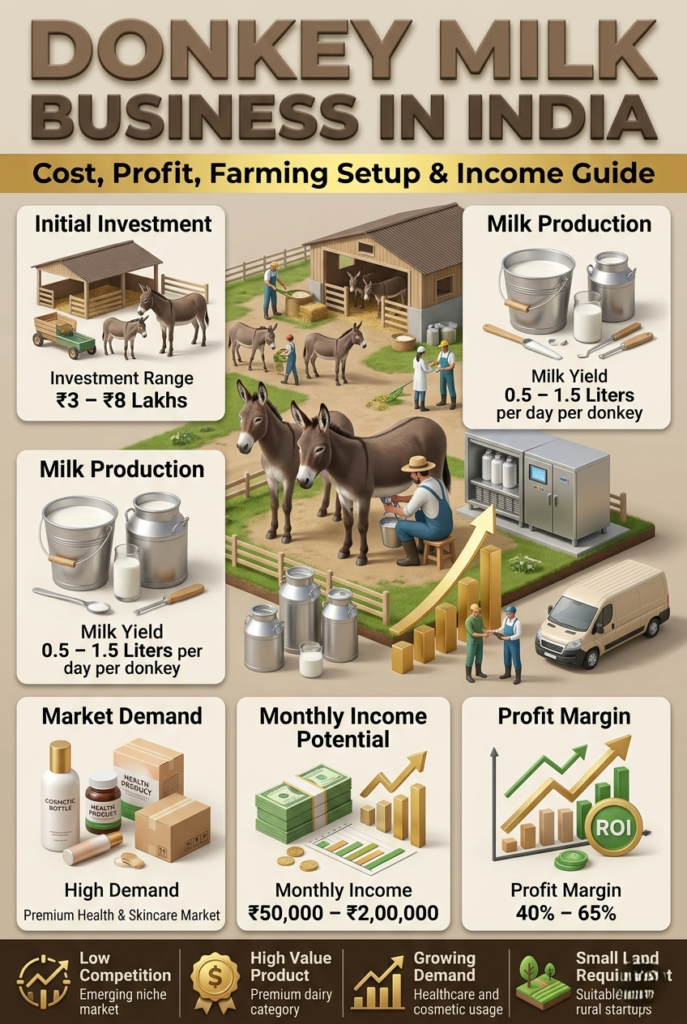
The establishment costs for a donkey farming business require different amounts of money based on both the farm’s area and the total number of donkeys. A small farm with about 20 donkeys will normally need an investment of anywhere between Rs 8 lakh and 16 lakh. This amount covers the construction of the shed, the purchase of animals, feed, equipment and basic vet care.
The infrastructure requirements for donkey farming is simple. Farmers require a clean and well-ventilated shelter, access to drinking water, and a small storage area to feed. Dairy farms need expensive equipment and large facilities but these requirements do not apply to other farms.
The main expenses of a business typically include these particular elements:
- Shed construction and fencing
- Purchase of donkeys
- Feed and fodder expenses
- Veterinary treatment and vaccination
- Equipment and working capital
The establishment of proper financial planning at the beginning of a business operation will create pathways toward achieving sustained business success.
Milk Production Potential & Income Potential
Milk production in donkeys is less than cows or buffaloes but the price is very high for sale. A healthy female donkey generally produces between 0.5 and 1.5 litres of milk a day. Even with a small herd, farmers can bring in a lot of money.
For example, if 15 lactating donkeys in a farm produce one litre of milk each per day, and if the milk fetches a price of Rs. The monthly income begins at 3,000 per litre which results in a monthly income that reaches multiple lakhs of rupees. The farm sustains its financial success because it generates more income than its total operational costs which include costs for feed and labor
The business of donkey farming attracts entrepreneurs who want to establish profitable agricultural ventures because it provides high profit potential.
Read More: Startup Selector
Additional Income Sources of Donkey Farming
The financial potential of donkey farming reaches its highest point through numerous income streams that exist within the business. This type of diversification helps lower financial risk and enhances overall profitability.
Farmers can generate income through two milk-based business activities which include:
- Organic manure made from dung of donkeys
- Breeding services for the production of mules
- Sale of young animals
- Donkey milk soap and cosmetics
- Farm visits and Agritourism activities
Value-added products like soap and skincare products provide higher profit margins than the profit margins achieved from selling raw milk. Many successful entrepreneurs pay attention to branding and packaging so as to add value to their product.
Government Subsidy and Loan Support
The government of India supports and promotes livestock farming with the help of various financial support programs. Farmers can apply for loans and subsidies to offset the initial investment burden. Banks and rural financial institutions support animals purchase, shed construction and equipment.
In many cases, subsidies may also be 25% to 50% of the project cost depending on the scheme and location. Training programmes are also available for farmers so that they learn modern ways of farming and business management.
Preparing proper project plan or business proposal increases the chances for having financial support.
Conclusion Is Donkey Milk Business a Good Business in 2026?
The donkey milk business in India offers profitable business opportunities for both farmers and entrepreneurs who want to start a successful livestock operation. The business becomes highly attractive because it requires minimal investment while delivering high product value and the market demand for its offerings continues to grow.
The combination of proper planning and animal care together with a successful marketing approach will enable a donkey farming operation to generate consistent revenue streams while achieving sustained business development. The industry presents a branding opportunity to entrepreneurs who begin operations at an early stage because they will be able to establish their business presence within an expanding market.
Frequently Asked Questions (FAQs)
- What is the minimum investment needed to commence a donkey farm?
The minimum investment is generally in between Rs 8 lakh and Rs 12 lakh for a small scale farm.
- How much milk does a donkey give every day?
A female donkey will normally produce 0.5-1.5 litres of milk a day.
- Is donkey farming profitable in India?
Yes, it is possible to make money in donkey farming because of high milk prices and low maintenance costs.
- How long does it take to make a profit from donkey farming?
Most farms begin to make a profit in 12 to 24 months.
- Can beginners pursue donkey farming business?
Yes, beginners can start this business because donkeys are easy to handle, and they need simple infrastructure.


