


EV Battery Materials Startup
By strategically entering the critical minerals market, startups will be able to decrease imports, bolster domestic manufacturing, and participate in high growth sectors to ensure sustainable profits for the future.
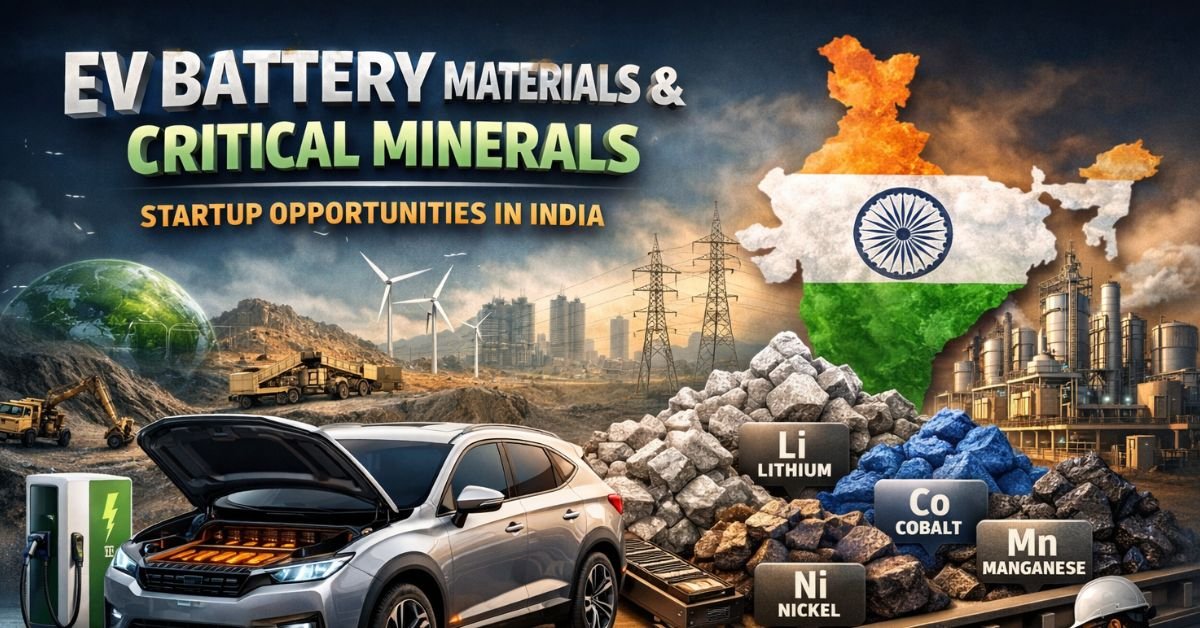
Critical minerals like lithium, cobalt, nickel, graphite, manganese, and rare earth elements are the backbone of EV battery, drivetrains, renewable energy storage and power electronics.
In India, according to market projections, demand for lithium-ion batteries alone is projected to exceed 260 gigawatt hours (GWh) by 2030, signalling an urgent need for the domestic supply of materials. Currently, India depends very extensively on imports:
- Lithium: More than 90% imported, for EV battery
- Cobalt: 100% imported, used in cathode material
- Nickel: 85% imported, necessary for battery chemistry
- Graphite: 70% imported: Anodes materials
- Rare Earth Elements 80% imported, used in motors and magnets
This dependency is a potential industrial opportunity of industrial 2-3 lakh crore for entrepreneurs to set up local processing and manufacturing units.
Why Critical Mineral Processing Is a Golden Startup Opportunity?
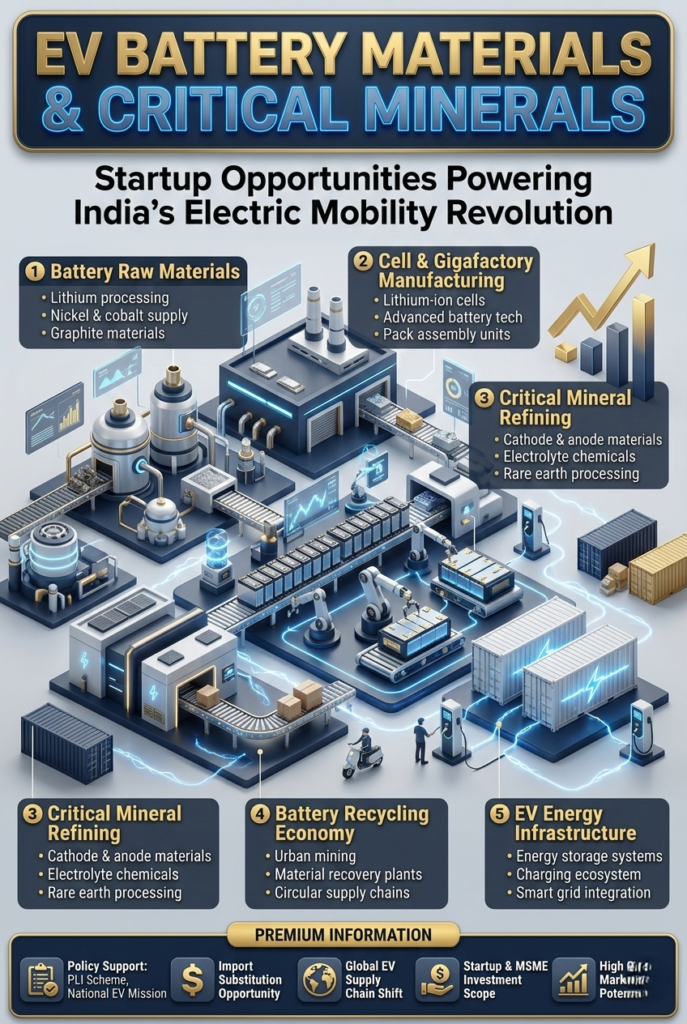
For many startups, assembling EVs is assumed to be the only way to make money. However, upstream processing – refining of raw minerals, manufacturing of battery materials and manufacturing of components – offers industrial value, payback and long-term competitiveness.
Key advantages include:
- High industrial demand from EV and Renewable Energy Sectors
- Import substitution potential, lessening dependence on foreign suppliers
- Government incentives and policy support for the domestic manufacturing
- Export opportunities to Asia and Africa
- Feasibility of MSME-scale projects with lesser ROI
- Integration with EV and Energy Storage Supply Chains
Entrepreneurs who control battery production through their complete battery supply chain process will achieve better project financial results through their operational improvements.(EV Battery Materials Startup)
Promising Start-up Opportunities in India
1. Lithium Carbonate Processing
Lithium carbonate is one of the main materials for EV battery cathodes. Currently, most of it is imported by India, because of lack of refining infrastructure.
Startup model:
- Import lithium ore or spodumene concentrate
- Set up a refining and conversion facility
- Supply battery manufacturers, EV OEMs, and solar energy storage providers
Market outlook: Lithium demand in EV applications is expected to grow eightfold by 2030, presenting a direct supply chain integration with the battery assemblers. Investment range: 8 Crore – 15 Crore | Payback period: 4 – 5 years(EV Battery Materials Startup)
2. Graphite Anode Material Production
Graphite makes up about 25% of lithium ion batteries. Processing natural graphite to anode-grade or spherical graphite enables startups to provide:
- Manufacturers of EV battery cells and packs
- Consumer electronics and drone battery module
- Example, “Energy storage system providers”
With domestic reserves of graphite, India is well poised for MSMEs to enter the market.(EV Battery Materials Startup)
3. Rare Earth Permanent Magnet Production
NdFeB (Neodymium-Iron-Boron) magnets are used for:
- EV motors
- Wind turbines
- Robotics
- Aerospace electronics
Entrepreneurs, can establish magnet sintering and machining plants for EVs motor manufacturers and renewable energy OEMs The increasing demand makes this industry very profitable.(EV Battery Materials Startup)
4. Nickel Sulphate Production
Batteries with high energy density require nickel sulphate that India is presently importing. Processing nickel matte to battery grade nickel sulphate leads to opportunities to serve:
- Manufacturers of Lithium-ion Batteries
- Stationary storage system providers
- Aerospace electronics industries
This is the perfect project type for chemical engineering entrepreneurs.
Inspiring The Success Stories of MSME
The practice of upstream integration has proven to be valuable for Indian entrepreneurs throughout their business ventures:
- Bhavish Aggarwal – Ola Electric: Built a vertically integrated EV ecosystem
- Baba Kalyani – Bharat Forge – Expanded into manufacture of EV components
- Suleja Firodia Motwani – Kinetic Green – Worked on developing EV mobility solutions using supply chain partnerships
The projects demonstrate how essential critical mineral processing technology needs to operate at industrial scale while generating profits to support India’s economic development.(EV Battery Materials Startup)
Critical Mineral Startup Support from Government
Startups can take advantage of programs and incentives from:
- Ministry of Mines – Licensing and exploration support
- From Ministry of Heavy Industries – Subsidies for EV and Battery projects
- NITI Aayog – Policy advice and innovation support
- Bureau of Indian Standards (BIS) – Certification pathways
- Department for Promotion of Industry and Internal Trade (DPIIT) – Investment incentives
The programmes create less risk for domestic production while developing local manufacturing capabilities which establishes India as a business-friendly environment for entrepreneurs.(EV Battery Materials Startup)
How Professional Consulting Can Boost Success
There are companies such as Niir Project Consultancy Services (NPCS) that offer entrepreneurs:
- Technological-economic feasibility studies
- Detailed process flow diagrams
- Market research/demand analysis
- Machinery and raw material planning
- Financial modelling and profitability projections.
First-time business owners can improve their investment results through professional guidance, which helps them manage their business risks.(EV Battery Materials Startup)
Why Now Is The Right Time to Invest
India’s EV revolution is essentially a materials revolution. Rising EV adoption, energy storage requirements and government incentives present a favourable environment for startups to:
- Reduce import dependence
- Develop domestic manufacturing capacity
- Tap into export markets
- Integrate with drones, telecom, renewable energy industries
Delaying investment runs the risk of passing up the early mover advantage in this rapidly growing industry.(EV Battery Materials Startup)
Conclusion
India’s EV revolution is not about vehicles – it’s about building an industrial ecosystem for critical minerals at home. Entrepreneurs who invest today on lithium, graphite, cobalt, nickel, rare earth processing etc. can ensure their place in the centre of India’s new industrial scenario.(EV Battery Materials Startup)
From lithium carbonate refining to rare earth magnets manufacturing, the opportunities are everywhere and the time to strike is now.
Startups in critical minerals market, which operates according to their current needs, use this opportunity to build sustainable operations through local production capabilities while creating new business opportunities which will provide them with future success.(EV Battery Materials Startup)
Frequently Asked Questions (FAQ)
Can MSMEs get into critical mineral processing?
Yes, especially in refining, chemical conversion and component manufacturing.
What approvals are needed?
Environmental clearance, BIS certification and industrial licensing.
Is there export potential?
Yes, especially in battery materials and rare earth magnets.
Which sector is the biggest in terms of demand?
Electric mobility and renewable energy storage.
What investment is required?
Usually between rupees 5-20 Crore depending upon the scale of the project.


