


Introduction: FRP Rebar Market in India
The building and infrastructure industry in India is experiencing a major transformation with the use of advanced materials by engineers and developers to enhance the durability and lifecycle performance of structures. One of these materials, which is receiving more and more attention in recent years, is Fiber Reinforced Polymer (FRP) rebar, or composite reinforcement bars designed to replace conventional steel reinforcement in concrete structures.
FRP rebars are produced with high strength Fibers in polymer resin. Compared with steel reinforcement, FRP rebars are much lighter, corrosion-resistant and have the ability to maintain structural performance in aggressive environments for decades. Because of these advantages, FRP reinforcement is now being used in infrastructure applications like bridge, metro tunnel, marine and water treatment applications.
The rising importance on durable infrastructure along with the huge investments of the government in the transportation and other urban sectors are creating a huge demand for FRP rebars in India. As a result, the FRP rebar market is expected to grow at a fast rate in the coming decade, offering opportunities for manufacturers, investors, and entrepreneurs.
Table of Contents
ToggleRead More: Profitable Manufacturing Business Ideas in India: GFRP Rebar, Camphor Powder & Sodium Hypochlorite
India FRP Rebar Market Overview
Although the FRP rebar industry in India is still quite small compared to the traditional steel reinforcement industry, it is growing at a significantly higher rate. Increasing awareness among the engineers and infrastructure planners about the long-term benefits of corrosion-resistant materials is leading to an increase in adoption of FRP reinforcement.
Industry estimates show that India FRP rebar market was valued at around USD 20 million in 2024, and the sector is projected to show a compound annual growth rate (CAGR) of around 17% till 2030.
At the global level, the FRP rebar market is also growing very rapidly. The global market was worth about USD 868 million in 2024 and is expected to surpass USD 1.3 billion by 2031, indicating the rising demand for high-performance construction materials in the global market.
Key Market Characteristics
There are various features that define the current Indian FRP rebar market structure:
- Glass Fiber Reinforced Polymer (GFRP) is the major market player and holds more than 80-85% of the total demand.
- Polyester resin is by far the most widely used polymer matrix because of its cost-effectiveness and reasonable mechanical performance.
- Demand is mostly supplied by infrastructure projects such as bridges, tunnels, highways and marine construction.
- Domestic manufacturing capacity remains limited compared with potential demand.
As the construction industry looks more toward durability and lifecycle costs as more important than the initial project cost, FRP rebars are increasingly being considered as a viable alternative to steel reinforcement.
Infrastructure Development Drives Demand
One of the biggest reasons behind the adoption of FRP rebar in India is the huge infrastructural development that is in progress across the country. The government has announced several long-term programs with the aim of improving the transportation networks, urban infrastructure, and logistics systems.
Major initiatives include:
- Bharatmala Project for expansion of the national highways
- Sagarmala Program for port modernization
- National Infrastructure Pipeline (NIP)
- Gati Shakti infrastructure development plan of PM
- Rapid metro rail expansion in major cities
India’s highway development programme alone requires the creation of thousands of kilometres of new expressways and highways. These projects need strong reinforcement materials that can stand up to stress from the environment over a period of decades.
Steel rebars face high corrosion risk because of their exposure to moisture and chemical substances and saltwater. Concrete structures with steel reinforcements suffer long-term damage through corrosion which leads to increased maintenance expenses.
FRP rebars have eliminated this problem since they do not rust or corrode and are therefore especially suitable for long-term infrastructure projects where durability is a critical factor.
Read More: Our Books
Advantages of FRP Rebars over Steel
The reason for the increasing interest in FRP reinforcement is mainly due to the performance advantages over conventional steel rebars.
Property | Steel Rebar | FRP Rebar |
Corrosion Resistance | Susceptible to rust | Highly corrosion resistant |
Weight | Heavy | About 4–5 times lighter |
Lifespan | 30–40 years in harsh environments | Up to 80–100 years |
Electromagnetic Transparency | Conductive | Non-conductive |
Maintenance Costs | Higher | Lower over lifecycle |
Due to the lightweight nature of FRP rebars as compared to steel, transportation costs are also reduced and the installation at the construction site is also easy.
The non-magnetic and non-conductive properties of FRP materials create an advantage because they can be used in specific applications which include hospitals MRI rooms laboratories and electrical facilities.
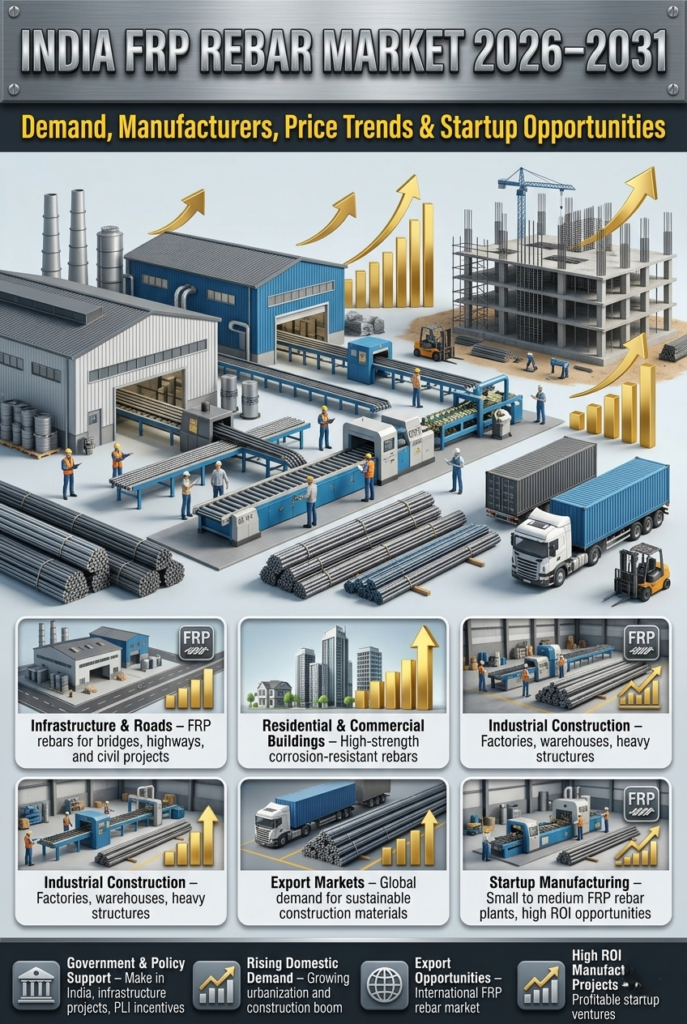
Demand & Supply Gap in Indian Market
Despite increasing demand, supply of FRP rebars in India is relatively low. The country has a limited number of domestic manufacturers who operate with moderate production capacities.
Industry estimates have it that there are currently less than twenty organized manufacturers dominating the Indian FRP rebar sector. Even some of the largest producers usually only make a few hundred tonnes a month.
Large infrastructure projects however, often demand hundreds or even thousands of tonnes of reinforcement material under severe constraints on the project timelines. When domestic manufacturers fail to meet this demand, the contractors often turn to imports.
Major Import Sources
- India imports FRP rebars from:
- China
- Vietnam
Other Asian composite manufacturing centres
At the same time, India is also exporting some of the FRP composite products to the international markets like the United States and the Middle East. This means the domestic industry has the technical capability but is yet to have the necessary large-scale manufacturing capacity.
The ensuing demand-supply imbalance is a potential for new manufacturers entering the market.
Major FRP Rebar Manufacturers India
The Indian FRP rebar industry is fragmented and presently is dominated by a relatively small number of companies. Many of these manufacturers are in the Gujarat and Northern India region where the composite materials industry already has a strong base.
Some notable manufacturers are:
ARC Insulations
One of the most eminent FRP rebar manufacturers in India, ARC Insulations manufactures a range of composite reinforcement products based on advanced pultrusion technology.
Everest Composites Pvt. Ltd.
This company is based in Gujarat and has decades of experience in the composite manufacturing industry and provides various FRP products such as reinforcement bars.
Quad Composites Pvt. Ltd.
Quad Composites produces FRP rebars under the FiBAR brand and has been supplying materials for several infrastructure projects.
Other manufacturers in the sector are:
- Dura Composites
- SMIN Composites
- Shri Rathi Group
- Indurotech Composites
- ASK Enterprises
Because the market is still in its development stage, there is no single company that currently controls the industry. This leaves much room for new players to enter the market and increase the capacity of manufacturing.
Major uses of FRP Rebars
FRP reinforcement is becoming more and more popular in the construction materials used in environments where corrosion resistance and long-term durability are of the utmost importance.
- Metro Tunnels
One of the fastest growing applications is metro tunnelling. FRP rebars are used in soft eye sections, through which the tunnel boring machines pass, without damaging the cutting equipment, in reinforced concrete walls.
- Bridges and Highway Infrastructure
Bridges that are exposed to moisture and environmental chemicals are good candidates for FRP reinforcement as it prevents corrosion-related structural damage.
- Marines and Coastal Structures
Structures in the vicinity of the sea water are especially prone to steel corrosion. FRP rebars offer good durability in marine environment.
- Water Treatment Plants
Water and wastewater facilities can commonly subject reinforcement materials to aggressive chemicals. FRP rebars help in the longevity of such structures.
- Specialized Buildings
Hospitals and research laboratories occasionally have a need for non-magnetic reinforcement materials, and therefore FRP rebars are a suitable solution.
Startup Opportunities In Rebar manufacturing FRP
The combination of rising demand and limited domestic production capacity is an opportunity for entrepreneurs who are interested in entering the composite materials industry.
Small to medium scale manufacturing unit of FRP rebar can generally be set up with an investment in the range of Rs 5-10 crores, depending upon the manufacturing capacity and equipment specifications.
Key Equipment Required
Setting up an FRP rebar manufacturing plant usually requires:
- Continuous rebar production Pultrusion machines
- Glass Fiber creel systems
- Resin mixing and impregnation units
- Heating and curing ovens
- Surface treatment and coating systems
- Quality testing laboratory equipment
The pultrusion process is efficient and scalable. And once a first production line is up and running, manufacturers can add more lines to boost capacity.
Because infrastructure contractors tend to need large volumes of Reinforcement materials, a well-established manufacturing facility can obtain long-term supply contracts.
Future Perspective of the Market
India’s FRP rebar market is likely to grow at a steady rate over the next decade due to rapid infrastructure development and growing awareness regarding corrosion resistant materials.
A number of factors are likely to contribute to market growth:
- Increasing the government’s spending on infrastructure
- Increasing use of advanced construction materials
- Rising lifecycle cost awareness amongst engineers
- Expansion of metro rail and coastal infrastructure;
As the quality of technology improves and the cost of producing it goes down, FRP rebars may become a more common alternative to traditional steel reinforcement in many construction applications.
Conclusion
The FRP rebar industry in India is in an incipient stage and has good potential for long-term growth. Engineers and developers search for durable reinforcement materials which can withstand corrosion and lower their overall project costs because infrastructure development continues to grow.
FRP rebars offer multiple benefits to construction projects because they weigh less than standard steel reinforcement and they do not corrode and they have a longer operational duration.
However, domestic manufacturing capacity is still limited and this leads to a huge demand-supply gap in the market. This situation is a good opportunity for manufacturers and entrepreneur to set up new production facilities.
The growing demand for advanced reinforcement materials like FRP rebars will occur during the next few years because India continues to invest in its highway and metro network and port and water infrastructure development projects.
Frequently Asked Questions (FAQ's)
What is FRP rebar?
FRP rebar is the composite reinforcement bar that is made up of Fibers such as glass or carbon which are embedded in polymer resin. It is applied as an alternative to steel reinforcement in concrete structures.
Why is FRP rebar Used instead of Steel?
FRP rebars provide non-corrosive properties and lightweight characteristics to extend their operational time in demanding situations beyond what traditional steel reinforcement can deliver.
What is the size of the FRP rebar market in India?
The market was valued at about USD 20.1 million in 2024 and is projected to experience a growth of about 17% CAGR till 2030.
What is the most commonly used type of FRP rebar?
Glass Fiber Reinforced Polymer (GFRP) rebars are the most widely used type as they have a good balance between performance and cost.
How much investment is required to launch FRP rebar manufacturing?
A small scale manufacturing unit of a capacity of about 150-200 tonnes per month typically calls for an investment of about Rs 5-10 crore.
Where are FRP rebars being commonly used?
They are typically found in metro passageways, bridges, highways, water treatment plants, marine structures, and specialized buildings.


