



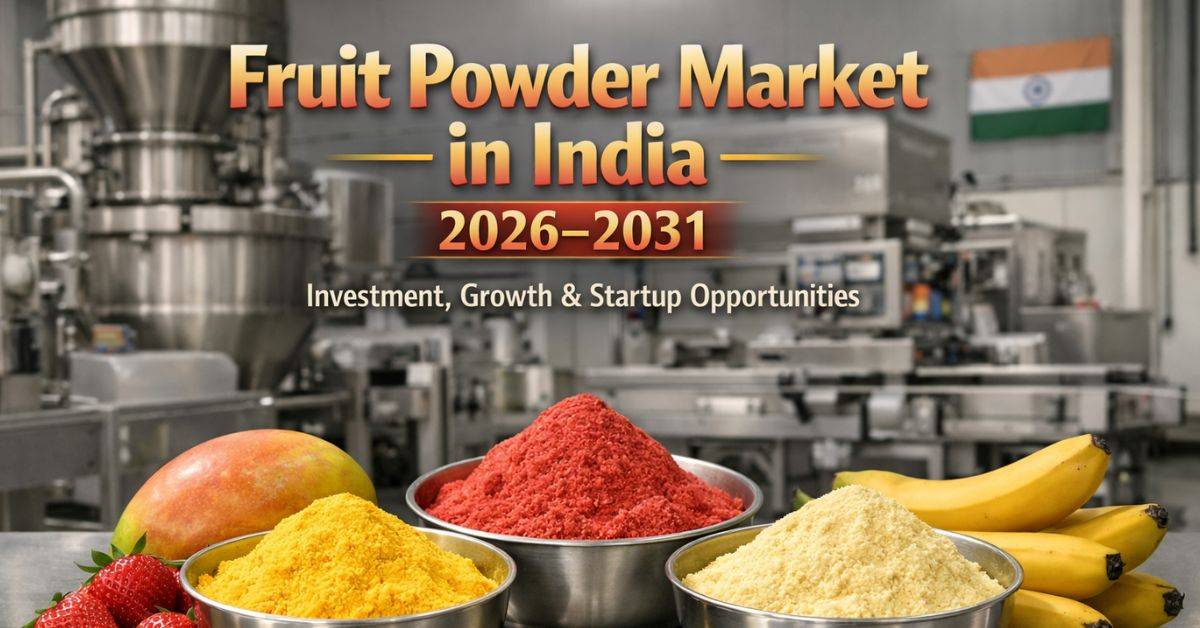
Fruit Powder Manufacturing Business
India’s fruit powder industry is one of the most promising industries for entrepreneurs and MSMEs. Despite the fact that more than 114 million metric tonnes of fruit is produced in India every year, only 2% of it is processed, because of which the rest are prone to post-harvest losses, which may reach up to 30-40%. This gap presents enormous opportunities in the fruit powder manufacturing sector, which involves converting perishable fruits into shelf-stable and nutrient-rich powders for beverages, bakery, nutraceuticals and functional foods.
Table of Contents
ToggleRead More: Handbook on Fruits, Vegetables & Food Processing with Canning & Preservation (3rd Edition)
Market Size & Growth
The Indian market of fruit powder has been expanding steadily:
- Market Size (2024): USD 1.80 billion
- Expected Market Size (2033): USD 2.50 billion (CAGR 3.2%)
- Near-Term Growth (2025-2029): USD 101.5 million incremental growth at a CAGR of 9.5%
Among fruit powders, mango leads with USD 50.1 million in 2023, followed by banana, guava and exotic berries. Berry powders are the fastest growing segment with superfood and wellness trends.(Fruit Powder Manufacturing Business)
The Demand–Supply Gap
India fruit powder opportunity is based on structural imbalances:
- At a September 15, 2014, workshop I attended in New Delhi, the following points were made: – Low Processing Levels: Only 2% of India’s fruit output is processed into powders.
- India loses 30% of its produce and loses 30% – 40% during handling.
- Specialty powders such as berries, acai, and citrus are largely imported; and
Millions of tonnes of fruit waste each year might however be converted into high-value powders, for supply to the growing domestic and international markets.(Fruit Powder Manufacturing Business)
Technology Options
Fruit powder production in India is based on the following four technologies:
- Mango, Banana, Guava (Most common, cost-effective, scalable, suitable for spray drying)
- Freeze Drying: Premium, nutrient-preserving, used for berries and exotic fruits; commands higher pricing.
- Vacuum Drying: Preserves aroma and flavor, niche applications.
- A few are listed below: – Drum Drying: Ideal for pulps and large-scale industrial production.
Tip for startups: To save on capital expenditure, start with spray drying, and transition to freeze drying for premium lines.
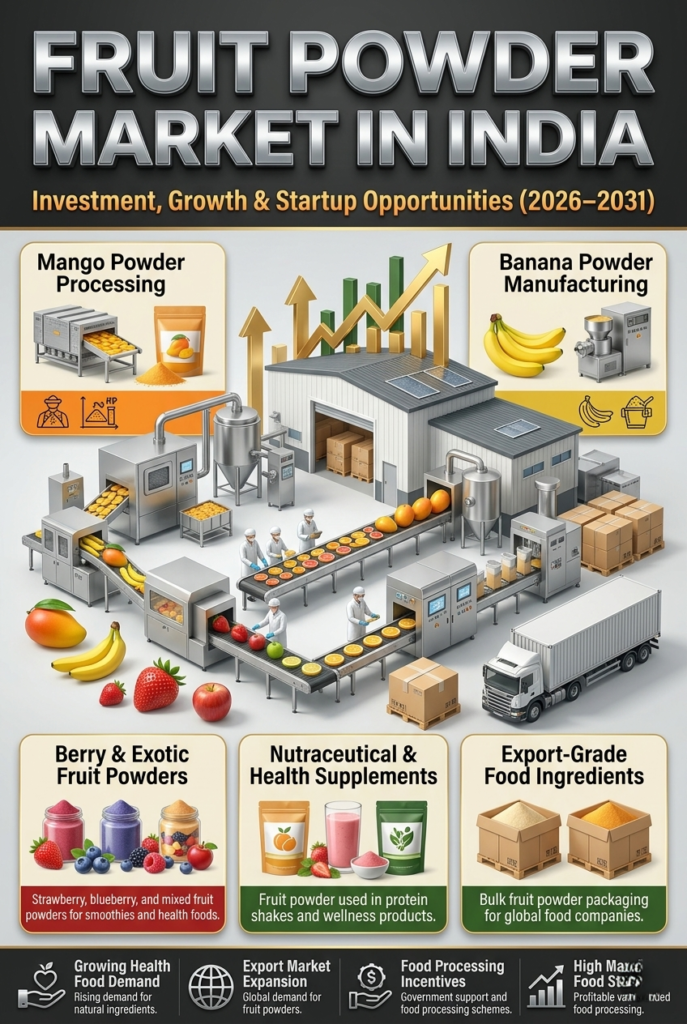
Applications That Are Driving Growth
The demand for fruit powders covers several industries:
- Beverages: Instant beverages, flavoured milk, smoothies, functional beverages.
- Bakery & Confectionery Natural Flavor and Color Replacement for Synthetic Additives
- Nutraceuticals: Supplements and functional foods, at the global level – the intake of nutraceuticals represents 32.6% of the consumption of fruit powder.
- Dairy & Infant Nutrition Vitamins and dietary fibers in shelf stable form.
The popularizing clean-label movement guarantees constant demand for high-quality, minimally processed fruit powders.(Fruit Powder Manufacturing Business)
Government Support
India has a good policy in place to support fruit powder startups:
- PMKSY: Grants for cold chains, food processing units and quality labs.
- PMFME: Credit linked subsidies for micro-scale processors, district-level fruit initiatives.
- PLI Scheme: 4-10% of incentives on incremental sales for 6 years.
- Additional Incentives: Operation Greens, NABARD food processing funds, 100 percent FDI in food processing.
Impact: Subsidies are actually able to decrease capital outlay by 35-50%, making projects financially attractive.(Fruit Powder Manufacturing Business)
Read More: Startup Selector
Startup Opportunities
There are several paths that entrepreneurs can take:
- Spray-Dried Mango Powder Units: Maharashtra, Andhra Pradesh, Uttar Pradesh; low-cost raw material; B2B pricing Rs 800–1,200/kg; payback 2–3 years.
- Multi-Fruit Nutraceutical Units Banana, guava, amla, jackfruit – Supplements, functional food GMP, FSSAI, USFDA compliance
- Freeze Dried Berry & Exotic Powders: Superior Margins (Rs 3,000 – 8,000 / kg) for premium domestic and export markets.
- Organic Fruit Powder for Export- Alphonso mango, Banana, Jackfruit, premium price for US, EU, Japan.
- Direct-to-Consumer (D2C) Products Smoothie Mixes Superfood Blends Infant Nutrition Powders Higher Margins
Indicative Economics
- Plant & Machinery (Spray Drying): Rs 1.5–5 crore
- Plant & Machinery (Freeze Drying): Rs 5 – 12 crores
- Total Project cost is Rs 3-8 crores (including land, building, utilities, working capital)
- Raw Material Cost: Rs 5–25/kg
- Finished Product Price: Rs 400 – 1200 /kg ( sprays) Rs 2,000 – 8,000 /kg (freeze)
- Gross Margins: 35–55%
- Payback Period: 2–5 years
- Government Subsidy Potential: 35-50%
A unit can scale up by adding fruit types, improving technology and growing to export markets with the same infrastructure.(Fruit Powder Manufacturing Business)
Leading Players
Key domestic players:
- Saipro Biotech (Pune) – Organic & conventional powders, export to 15+ countries.
- Farmvilla Food Industries (Ahmedabad) – Fruits, spices, powder ingredients
- Mevive International (Coimbatore) – Spray dried powders, Middle East distribution.
- Aarkay Food Products (Gujarat): Industrial and retail powders.
- Foods and Inns (Mumbai): Fruit pulp and powder production.
International players in India are Future Ceuticals (USA) and Paradise Fruits Solutions (Germany), indicating market potential and competition.(Fruit Powder Manufacturing Business)
Conclusion
The fruit powder industry in India is one of the few sectors where there is a convergence of abundant availability of the raw material, under developed infrastructure for processing the product, surging domestic and international demand and also strong government incentives. Whether via spray-dried or freeze-dried powders, multi-fruit nutraceuticals, organic exports or D2C products, this is a market with high margins, short payback periods and scalability. For entrepreneurs and MSMEs, it is the opportune time to invest in the fruit powder revolution in India.(Fruit Powder Manufacturing Business)
For customized Techno-Economic Feasibility Reports (DPRs) contact Niir Project Consultancy Services (NPCS) at www.niir.org. The organization provides market evaluation and technology consulting and financial forecasting together with practical business solutions to support entrepreneur success.(Fruit Powder Manufacturing Business)
FAQs
Q1: What is the size of the market for fruit powder in India?
The company expects to earn USD1.80 billion in 2024 and to reach USD2.50 billion by 2033.
Q2: Why is there a gap between demand and supply?
India processes only 2% of the fruit output; millions of tonnes are wasted annually.
Q3: Which fruit powders are in the highest demand?
Mango, banana, guava, amla; fastest growing: berry powders.
Q4: What technology is appropriate for startups?
Spray drying to produce cheaply, freeze drying to produce premium products.
Q5: What type of government support is available?
The funding sources for the project include PMKSY PMFME PLI schemes Operation Greens NABRD funds and 100 percent foreign direct investment.
Q6: Minimum investment to start?
Rs 3 – 5 crore for small spray dried unit; subsidies of 35 – 50% effective
Q7: Is there export potential?
Yes. India exports 19% of the world’s fruit powders Premium organic powders are in demand from the international market


