



Introduction: India PCPIR Chemical Clusters
India’s petrochemical and chemical manufacturing industry is undergoing structural change. For decades, the industry faced several challenges such as fragmented production systems, transportation of feedstocks over long distances and heavy use of imported chemicals. These issues raised the cost of production and made it less competitive for domestic manufacturers in the global market.
To meet these challenges, the Government of India came up with the Petroleum, Chemical and Petrochemical Investment Region (PCPIR) Policy in 2007. The idea behind PCPIRs is the creation of large-scale integrated industrial areas where petrochemical manufacturers, downstream manufacturers, logistics operators, and infrastructure developers are located in the same geographic area.
Each PCPIR usually covers an area of hundreds of square kilometres, and a large part of each PCPIR is occupied by chemical processing industries. The objective is to minimize logistics costs, ensure the availability of feedstock, induce downstream industries and attract massive investments.
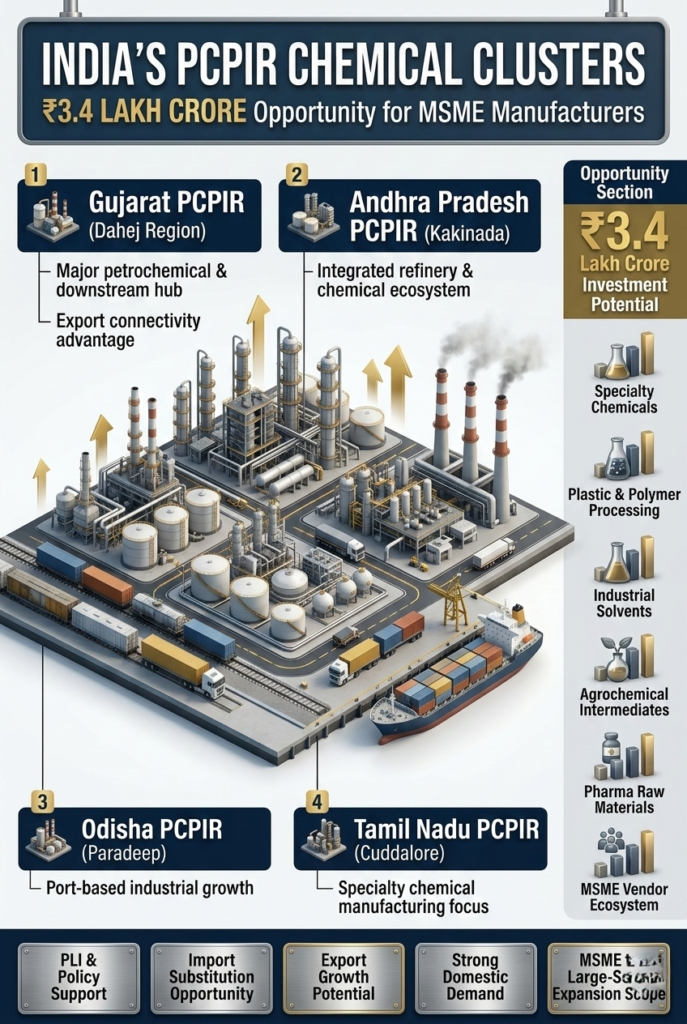
Today, this strategy is bearing real results. According to the Ministry of Chemicals and Petrochemicals, India’s operational PCPIR clusters have collectively attracted investments of ₹3.40 lakh crores and created more than 3.7 lakh jobs and houses more than 2,246 chemical and petrochemical units. These clusters are fast emerging as the backbone of the chemical manufacturing ecosystem in India and offer huge opportunities for MSMEs and startups.(India PCPIR Chemical Clusters)
Table of Contents
ToggleRead More: Handbook On Chemical Industries (Alcohol Based)
Major PCPIR Chemical Clusters of India
Dahej PCPIR: Most Developed Petrochemical Hub Of India
Dahej PCPIR represents the most advanced petrochemical development in India which exists within the Bharuch district of Gujarat. The region has a coverage area of about 453 square kilometres and has received investments of more than 1.28 lakh crores.(India PCPIR Chemical Clusters)
One of the main reasons for the cluster’s success is the presence of major anchor projects to provide feedstock for the downstream industries. The most significant of these is the petrochemical complex operated by ONGC Petro-Additions Limited (OPaL), which operates a dual feed cracker which produces over one million tonnes of ethylene per year, besides substantial quantities of propylene.
These feedstocks are used as the basis for a myriad of downstream products used in packaging, textiles, automotive parts, and consumer goods.
Some of the main highlights of Dahej PCPIR are:
- Total investment more than ‘$1.28 lakh crores
- More than 2000 operating industrial units
- Job for around 2.38 lakh people
- Access to specialised chemical ports and LNG terminals
The availability of world-class port infrastructure has also made Dahej an important base for export of petrochemical goods.
Vishakhapatnam-Kakinada PCPIR: A Growing Industrial Corridor
The Vishakhapatnam – Kakinada PCPIR in Andhra Pradesh is the single largest petrochemical investment area in India in terms of area. Spanning about 640 square kilometres, this cluster has attracted investments of over 68,000 crore and has a growing network of chemical and pharmaceutical industries.
Unlike Dahej, the region is still evolving and has not been able to have a major petrochemical cracker as its anchor project yet. However, the cluster already has several Special Economic Zones dedicated to pharmaceuticals, textiles and chemical manufacturing.
Another big benefit of this region is that it has a good connectivity in terms of logistics. The availability of three major ports, i.e., Vishakhapatnam Port, Gang avaram Port and Kakinada Port has excellent access to world markets and international trade for the export oriented industries.(India PCPIR Chemical Clusters)
Read More: Modern Technology of Industrial Chemicals
Paradeep PCPIR: Refinery Based Development of Petrochemical Plants
The Paradeep PCPIR in Odisha is another major plank of India’s development strategy for the petrochemical sector. Although in terms of industrial units it is smaller as compared to Dahej, the industrial cluster has already attracted investments in excess of Rs. 1.43 lakh crores.(India PCPIR Chemical Clusters)
The major driving force of this industrial region is the huge refinery, run by Indian Oil Corporation Limited. Commissioned in 2016, the refinery processes around 15m tonnes of crude oil a year, and produces important petrochemical feedstocks including polypropylene and mono-ethylene glycol.(India PCPIR Chemical Clusters)
These materials are popular in manufacture of plastics, packaging films, and polyester fibers. As downstream industries keep growing around the refinery, the Paradeep cluster is likely to witness huge growth in the coming years.
Why PCPIR Clusters are Important for Chemical industry in India
The PCPIR model has a number of advantages that make it appealing to large corporations as well as MSMEs. By locating industries in one integrated region, companies get the benefit of better supply chains and infrastructure sharing.(India PCPIR Chemical Clusters)
Key advantages include:
- Proximity of petrochemical feedstock to manufacturing units
- Integrated Infrastructure Not Available e.g., effluent treatment plants, chemical terminals
- Strong logistics connectivity by ports, highways and rail networks
- Government incentives seeking to promote downstream manufacturing
These factors make a big difference by lowering the production costs and enhances the global competitiveness of the domestic manufacturers in the international markets.(India PCPIR Chemical Clusters)
Demand- Supply Gap Creating Opportunities
The petrochemical industry in India has expanded its production capacity but this growth does not satisfy the complete domestic demand for multiple chemical products. Industrial sectors like pharmaceuticals, automobiles, consumer goods, packaging, and textiles are growing very rapidly, resulting in growing demand for petrochemical intermediates and specialty chemicals.(India PCPIR Chemical Clusters)
Many products including phenol, acetone, acrylic derivatives and specialty solvents are still imported on a large scale. The increasing import expenses indicate that there exists substantial domestic need which current local manufacturing cannot completely fulfil.
This demand-supply gap is a good opportunity for those entrepreneurs and MSMEs who are willing to invest in chemical manufacturing in PCPIR clusters.(India PCPIR Chemical Clusters)
Business Opportunities for MSMEs in PCPIR Regions
The creation of petrochemical clusters has provided several opportunities for smaller enterprise to engage in the chemical value chain. Entrepreneurs may set up manufacturing units or service based enterprises that support large industrial facilities.(India PCPIR Chemical Clusters)
Some areas that are promising are polymer processing, manufacturing of plastic components, chemical intermediate, and industrial logistic services.
Examples of potential MSME opportunities are:
- Plastic blow moulding & injection moulding units
- Production of polymer compounding and masterbatch production
- Specialty chemical intermediates used in coatings and adhesives
- Tank farm storage facilities – bulk chemicals
- Chemical Recycling and Solvent Recovery Plants
These businesses have the advantages of being close to suppliers of feedstocks and having a large base of industrial customers in the cluster.
Importance of Feasibility Studies Prior to the Initiation of a Chemical Project
Chemical manufacturing projects demand a large capital investment and technical expertise. Before establishing a plant, entrepreneurs must conduct thorough analysis of factors like market demand, availability of raw materials, production technology and environmental regulations, etc.(India PCPIR Chemical Clusters)
It is a detailed feasibility study to evaluate the technical and financial viability of their project to the investors. Such report usually contains manufacturing process information, requirements for equipment, market analysis, and long-term profitability projections.
A proper feasibility assessment reduces risks and improves the possibilities of successful project implementation.(India PCPIR Chemical Clusters)
Conclusion
The PCPIR initiative has become one of the most important initiatives of India for strengthening the domestic chemical and petrochemical industry. With investments scaling over more than Rs. 3.40 lakh crores and the existence of thousands of industrial units in these clusters already, the industrial clusters have proved their point of integrated industrial development.(India PCPIR Chemical Clusters)
However, demand for petrochemical products and specialty chemicals in India is still growing faster than the domestic production capacity. This imbalance is opening new opportunities for MSMEs and startups who can set up downstream manufacturing units or supporting services in PCPIR ecosystems.
Entrepreneurs who invest early in these clusters stand to benefit from access to dependable feedstock supply, modern infrastructure, government support and access to growing industrial markets. As India seeks to become increasingly self-reliant on chemical goods, PCPIR clusters are likely to play a pivotal role in determining the course of the industry in the future.(India PCPIR Chemical Clusters)
Frequently Asked Questions (FAQs)
What is PCPIR in India chemical sector?
PCPIR stands for Petroleum, Chemical and Petrochemical Investment Region, a large industrial area that was developed to encourage integrated petrochemical production.
How many clusters of PCPIR are in India?
Currently there are three major PCPIR clusters operating in Dahej (Gujarat), Vishakhapatnam-Kakinada (Andhra Pradesh) and Paradeep (Odisha).
How much has PCPIR regions attracted investment?
The three clusters together have attracted over ₹3.40 lakh crore investments.
Why are PCPIR clusters good for MSMEs?
MSMEs are enjoying easier access to feedstock, shared industrial infrastructure, connectivity for logistics and government incentives.
What kinds of business can be launched in PCPIR clusters?
Entrepreneurs can launch polymer processing facilities, specialty chemical plants, compounding plants, logistics operations, and recycling operations.


