




India Tobacco Products Market industry is one of the most influential agro-industrial sectors of the country. Despite stringent regulations and public health campaigns, the industry remains a major source of employment, tax income and also exports. Between 2026 and 2029, it is anticipated that the sector will see consistent, organised growth owing to demand in rural areas, premiumization and export-led strategies.
This report – SEO Optimized – describes the market size, demand-supply gap, competitive landscape, regulatory impact, and startup potential in a practical and investor-focused format.(India Tobacco Products Market)
Table of Contents
ToggleRead More: Manufacture of Pan Masala, Tobacco and Tobacco Products. 2nd Revised Edition
Industry Overview: Size, Production & Economic Role
India is the second biggest producer of tobacco globally and one of the top three consumers in the world. As of 2026:
- Total production is greater than 490,000 tonnes
- Domestic consumption is of the order of 464 000 tonnes
- Exports in FY24-25 is nearing USD 2 billion
- There are more than 45 million people who depend on the sector
Major production clusters are located in Andhra Pradesh, Gujarat and Karnataka, and contribute to the domestic production and also to the international buyer.
The industry combines farming, curing, grading, processing, manufacturing and logistics – a complicated value chain that supports rural and urban economies alike.(India Tobacco Products Market)
Demand-Supply Gap, Quantity Over Supply, Quality Deficiency
On paper, India produces a little more tobacco than it consumes. However, the actual challenge is segmentation and quality alignment.
Key Structural Gaps
- Premium cigarette manufacturers need high grade flue-cured leaf.
- Informal sectors absorb lower grade raw tobacco.
- Processing infrastructure is unequal across states.
This leads to periodic shortages to organized manufacturers in spite of the overall production surplus. Export competitiveness also affects local availability because international demand for high-quality leaf can create local supply constraints.(India Tobacco Products Market)
Industrial Structure & Key Players
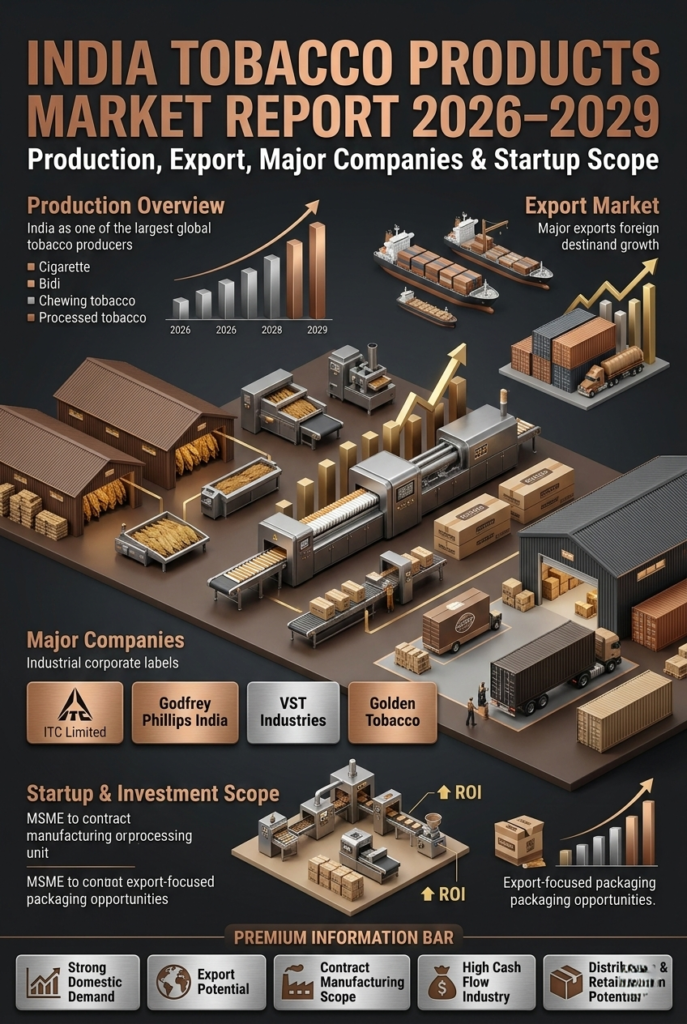
India’s tobacco market is segmented into cigarettes, bidis, smokeless tobacco (khaini, Zarda, gutka), chewing tobacco and export grade leaf.
The organized aspect of the cigarette industry is dominated by big companies:
- ITC Limited – Market Leader with good distribution and premium brands portfolio.
- Godfrey Phillips India – Competes in premium as well as mid-range segments
- VST Industries – Integrated processor and manufacturer with diversified operations
Alongside these firms, a large informal ecosystem dominates bidi and traditional smokeless segments and contributes to the fragmentation of the market and the lack of pricing pressure.(India Tobacco Products Market)
Growth Outlook (2026–2029)
Industry forecasts show a CAGR of between 2% and 4.6% during the period of 2019-2031. Growth is expected to continue at a moderate but stable rate.
Growth Drivers
- Strong rural consumption base
- Smokeless tobacco: ‘Cultural preference for use of smokeless tobacco is high’
- Premiumization in organized cigarette segment
- Export demand for flue cured leaf
And smokeless tobacco is proving resilient because of affordability and accessibility. Meanwhile organized players are investing in premium variants and differentiated blends to safeguard margins facing regulation pressure.(India Tobacco Products Market)
Regulatory & Tax Environment
The industry is strictly monitored with the main law being the Cigarettes and Other Tobacco Products Act.
Regulation impacts:
- Packaging and health warnings.
- Advertising restrictions
- Manufacturing compliance
- Taxation and excise duties
And frequent adjustments in taxes have a serious impact on retail prices and manufacturer profits. Entrepreneurs that are getting into this sector need to design projects with full compliance infrastructure from the start.(India Tobacco Products Market)
Import–Export Dynamics
India is still a net exporter of tobacco, especially flue-cured and unmanufactured tobacco. Export markets are located in Asia, Europe, Africa and the Middle East.
However, global competition can cause pricing pressure. Increase in production from competing countries may moderate export growth in the short-term. Still the cost efficiency and concrete supply chains from India gives strength in the long term.(India Tobacco Products Market)
Opportunities to start up in the Tobacco Sector
Despite regulatory problems there are structured opportunities for disciplined entrepreneurs.
- The Premier Cigarette Manufacturing
- Focus on differentiated branding
- Consideration of the following: Target urban and export markets
- Invest in sophisticated processing systems
- Value Added Smokeless Products
- Regulated manufacturing for export
- Improved packaging and compliance
- Targeted niche international
- Tobacco Leaf Processing & Grading
- Scientific warehousing
- Moisture-controlled storage
- Quality standardization services: –
- Export Oriented Blending Units
- Customized blends for overseas buyers
- Strategic B2B contracts
- Taking advantage of the agricultural cost advantage that India has
The most viable entry strategies are quality-oriented and compliance-oriented rather than price-oriented competition with the informal players.(India Tobacco Products Market)
Investor Considerations
Tobacco manufacturing takes capital outlay and discipline from the regulators. Key factors to be evaluated are:
- Compliance infrastructure costs
- Volatility of Excise and taxation
- Informal sectors competition:
- Export market dependency
At the same time, the sector provides:
- Stable domestic demand
- Strong export ecosystem
- Agricultural base has been established
- Skilled workforce availability
About Niir Project Consultancy Services (NPCS)
Niir Project Consultancy Services offers techno-economic feasibility reports, Detailed Project Reports (DPRs) for tobacco manufacturing and processing projects.
Their services include demand analysis, process design, capacity planning, machinery specifications, financial projections and scalability planning – and that means the entrepreneurs can have their technical feasibility and commercial viability evaluated before investing.(India Tobacco Products Market)
Conclusion
For India, tobacco products industry in the next 3 years (2026 to 2029) will likely witness a disciplined and steady growth and not a quick growth. The real opportunity is in quality enhancement, export orientation and processing infrastructure development and premium positioning.(India Tobacco Products Market)
Entrepreneurs who can combine the readiness to comply with the strategic differentiation will be in the best position to succeed in this mature but economically significant industry.(India Tobacco Products Market)
Frequently Asked Questions (FAQs)
Q1: What is the expected growth rate of Tobacco industry in India?
The industry is expected to grow at a CAGR of 2 – 4.6% through the end of 2020s, underpinned by rural consumption and premiumization strategies.
Q2: Is there a shortage of tobacco supply for India?
Overall production is greater than consumption but shortages may arise with premium grade tobacco as there is a mismatch in quality and processing capability.
Q3: How important are exports for the sector?
Exports added almost USD 2 billion in FY24-25 and thus international markets are a vital revenue source.
Q4: What are the greatest risks for investors?
Regulatory tightening, excise duty increases and compliance costs are the main risks in this sector.
Q5: Are premium or alternative formats on the rise?
Yes. Premium cigarette variants and differentiated blends are becoming strategically more important for the organized manufacturers.


