


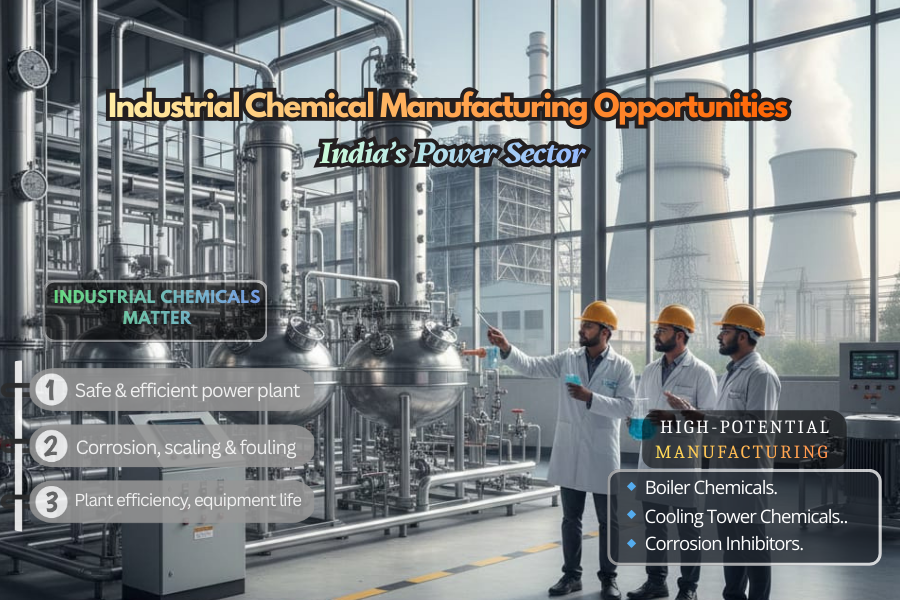
Industrial chemical manufacturing sector is one of the strongest pillars of the country’s industrial growth. While most discussions focus on power generation capacity, renewable targets, and grid expansion, there is another equally important area that works silently in the background—industrial chemicals used in power plants.
Every power plant, whether thermal, hydro, or renewable, depends on chemicals to run safely and efficiently. These chemicals protect equipment, improve performance, prevent corrosion, and extend the life of costly machinery. Without them, power plants would face frequent breakdowns, efficiency losses, and high maintenance costs.
According to the Ministry of Power, India has reached near-zero power shortages, crossed electricity generation of over 1,300 billion units, and significantly expanded its transmission and generation infrastructure. All these assets require continuous chemical support throughout their operating life.
For startups and MSMEs, this creates a strong business opportunity. Unlike heavy machinery, industrial chemicals are consumables—they are used every day. This results in steady demand, repeat orders, and long-term supply contracts.
This article highlights high-potential industrial chemical manufacturing opportunities linked directly to India’s power sector.
Why Power Plants Need Industrial Chemicals All Year Round
Power plants operate under extreme conditions such as high pressure, high temperature, and continuous water circulation. If water and equipment are not treated properly, plants face serious issues like:
- Scale buildup
- Corrosion of metal surfaces
- Fouling of heat exchangers
- Reduced plant efficiency
- Early equipment failure
To avoid these problems, power plants consume large volumes of treatment chemicals every year—regardless of whether new plants are built or not. This makes demand stable and non-cyclical.
1. Boiler Chemicals Manufacturing
Why Boiler Chemicals Are Critical
Boilers are the core of thermal power plants. They generate steam at very high pressure and temperature. Even small impurities in boiler water can cause tube damage, scaling, and corrosion, leading to shutdowns and heavy financial losses.
Boiler chemicals are used for:
- Preventing scale formation
- Removing dissolved oxygen
- Maintaining proper pH levels
- Conditioning sludge
Import Substitution Opportunity
India still imports many advanced boiler treatment formulations, specialty oxygen scavengers, and polymer-based inhibitors. This opens the door for domestic manufacturers to develop effective alternatives.
Startup Opportunity
New manufacturers can focus on:
- Boiler water treatment chemicals
- Oxygen scavengers
- Sludge conditioners
- Combined boiler treatment formulations
Why this works for MSMEs
- Moderate investment
- Regular consumption
- Long-term industrial clients
- Scope for technical differentiation
Many Indian MSMEs began by supplying nearby thermal plants and later expanded into other industries and exports.
2. Cooling Tower Chemicals Manufacturing
Market Need
Cooling towers remove excess heat from power plants and run continuously. They are prone to scaling, corrosion, and microbial growth due to constant water circulation and evaporation.
Cooling tower chemicals include:
- Scale inhibitors
- Biocides
- Corrosion inhibitors
- Anti-fouling agents
Business Potential
India imports several high-performance and eco-friendly cooling water chemicals, especially advanced biocides. Local production aligned with environmental standards has strong growth potential.
Manufacturing Scope
Startups can produce:
- Cooling water scale inhibitors
- Microbiocides
- Corrosion control chemicals
- Complete cooling water treatment packages
Why this segment is profitable
- High volume usage
- Continuous demand
- Performance-based pricing
- Strong repeat business
Suppliers who offer technical monitoring and support often secure long-term contracts.
3. Corrosion Inhibitors Manufacturing
Why Corrosion Control Matters
Corrosion causes hidden but massive losses in power plants. It affects boilers, pipelines, condensers, storage tanks, and cooling systems. Corrosion inhibitors are essential to protect these assets.
Import Dependency
India depends heavily on imports for:
- High-temperature corrosion inhibitors
- Multi-metal protection formulations
- Specialty inhibitor blends
Startup Opportunity
MSMEs can manufacture:
- Water-based corrosion inhibitors
- Oil-based inhibitors
- Volatile corrosion inhibitors
- Multi-metal protection chemicals
Why startups can succeed
- Knowledge-driven business
- Customized solutions
- High value per unit
- Export potential
Below is ONLY THE EXTRA CONTENT, written in the same tone, structure, and format, and repeatedly optimized around the keyword industrial chemical manufacturing.
You can directly attach this after your existing content.
4. Water Treatment Chemicals for Zero Liquid Discharge (ZLD)
Why ZLD Is Becoming Mandatory
India’s power sector is moving rapidly towards Zero Liquid Discharge (ZLD) systems to reduce freshwater consumption and environmental impact. Thermal power plants, especially in water-stressed regions, are now required to recycle and reuse wastewater.
This has sharply increased demand for industrial chemical manufacturing related to advanced water treatment.
Chemicals Used in ZLD Systems
ZLD systems rely heavily on specialized chemicals such as:
- Coagulants and flocculants
- Antiscalants for RO membranes
- Anti-foaming agents
- pH correction chemicals
- Biological treatment additives
Manufacturing Opportunity for MSMEs
Many of these formulations are still sourced from large suppliers or imported blends. MSMEs can enter this space by producing:
- RO antiscalants
- High-efficiency flocculants
- Membrane cleaning chemicals
- Effluent treatment chemicals
Why This Segment Is Attractive
- Regulatory-driven demand
- High entry barrier protects margins
- Long-term supply contracts
- Strong linkage with environmental compliance
Industrial chemical manufacturing aligned with ZLD compliance offers stable growth and premium pricing.
5. Emission Control Chemicals for Power Plants
Rising Focus on Emission Norms
Stricter emission norms for SOx, NOx, and particulate matter have increased chemical usage in pollution control equipment such as:
- Flue Gas Desulphurization (FGD) systems
- Electrostatic precipitators
- Wet scrubbers
These systems cannot function without continuous chemical dosing.
Key Chemicals in Demand
- Limestone and lime-based chemicals
- pH stabilizers
- Anti-scaling agents
- Oxidation control chemicals
Industrial Chemical Manufacturing Scope
MSMEs can manufacture:
- FGD treatment chemicals
- Slurry stabilizers
- Corrosion inhibitors for scrubbers
- Performance-enhancing additives
Long-Term Business Advantage
- Mandatory compliance ensures steady demand
- Chemicals are consumed daily
- Low sensitivity to power market cycles
This makes emission-control-focused industrial chemical manufacturing a resilient business model.
6. Specialty Chemicals for Renewable Power Plants
Chemicals Are Critical Even in Renewables
While renewable energy is often seen as “chemical-free,” this is a misconception. Solar, wind, and hydro plants also depend on industrial chemicals for:
- Equipment protection
- Cooling systems
- Cleaning and maintenance
Examples of Chemical Usage
- Solar panel cleaning chemicals
- Anti-corrosion coatings for wind turbines
- Transformer oils and additives
- Cooling water treatment chemicals
Manufacturing Opportunity
Startups can focus on:
- Eco-friendly cleaning chemicals
- Anti-corrosion formulations for offshore wind
- Specialty maintenance chemicals
Why This Segment Will Grow
- Rapid renewable capacity addition
- Long equipment life cycles
- Focus on performance optimization
Industrial chemical manufacturing linked to renewables offers future-ready diversification.
7. Chemical Blending and Formulation Units: Low-Capex Entry Model
Ideal Entry Point for First-Time MSMEs
Not all industrial chemical manufacturing requires heavy chemical synthesis. Many successful MSMEs started as:
- Blending units
- Formulation-based manufacturers
- Customized solution providers
What Can Be Done
- Blend imported or locally sourced raw materials
- Develop application-specific formulations
- Supply ready-to-use chemical packages
Benefits
- Lower capital investment
- Faster time to market
- Easier regulatory compliance
- Strong customer stickiness
This model allows entrepreneurs to enter industrial chemical manufacturing with controlled risk.
8. Digital Monitoring and Chemical-as-a-Service Model
Evolution of Chemical Supply
Power plants now prefer performance-based contracts rather than simple chemical supply. Suppliers who combine chemicals with monitoring services gain a strong advantage.
Opportunities for MSMEs
Industrial chemical manufacturers can offer:
- Online water quality monitoring
- Dosing optimization services
- Predictive maintenance support
Why This Matters
- Higher margins
- Long-term contracts
- Reduced price competition
This service-led approach transforms industrial chemical manufacturing into a solution-driven business.
9. Logistics, Storage, and Safety Chemicals
Often Ignored but Essential
Power plants require chemicals for:
- Safe storage
- Spill control
- Fire suppression
- Hazard handling
Manufacturing Scope
- Spill neutralization chemicals
- Fire-retardant additives
- Safety cleaning agents
Business Advantage
- Regulatory-driven demand
- Limited competition
- High compliance value
This niche strengthens industrial chemical manufacturing portfolios.
10. Export Opportunities for Indian Chemical MSMEs
Global Demand Alignment
Many developing countries in:
- Africa
- Southeast Asia
- Middle East
are expanding their power infrastructure and face similar chemical needs.
Why Indian Manufacturers Can Compete
- Cost advantage
- Comparable operating conditions
- Growing technical expertise
Export-Ready Products
- Boiler treatment chemicals
- Cooling water chemicals
- Corrosion inhibitors
Industrial chemical manufacturing with export orientation increases scale and profitability.
Strategic Takeaway for Entrepreneurs
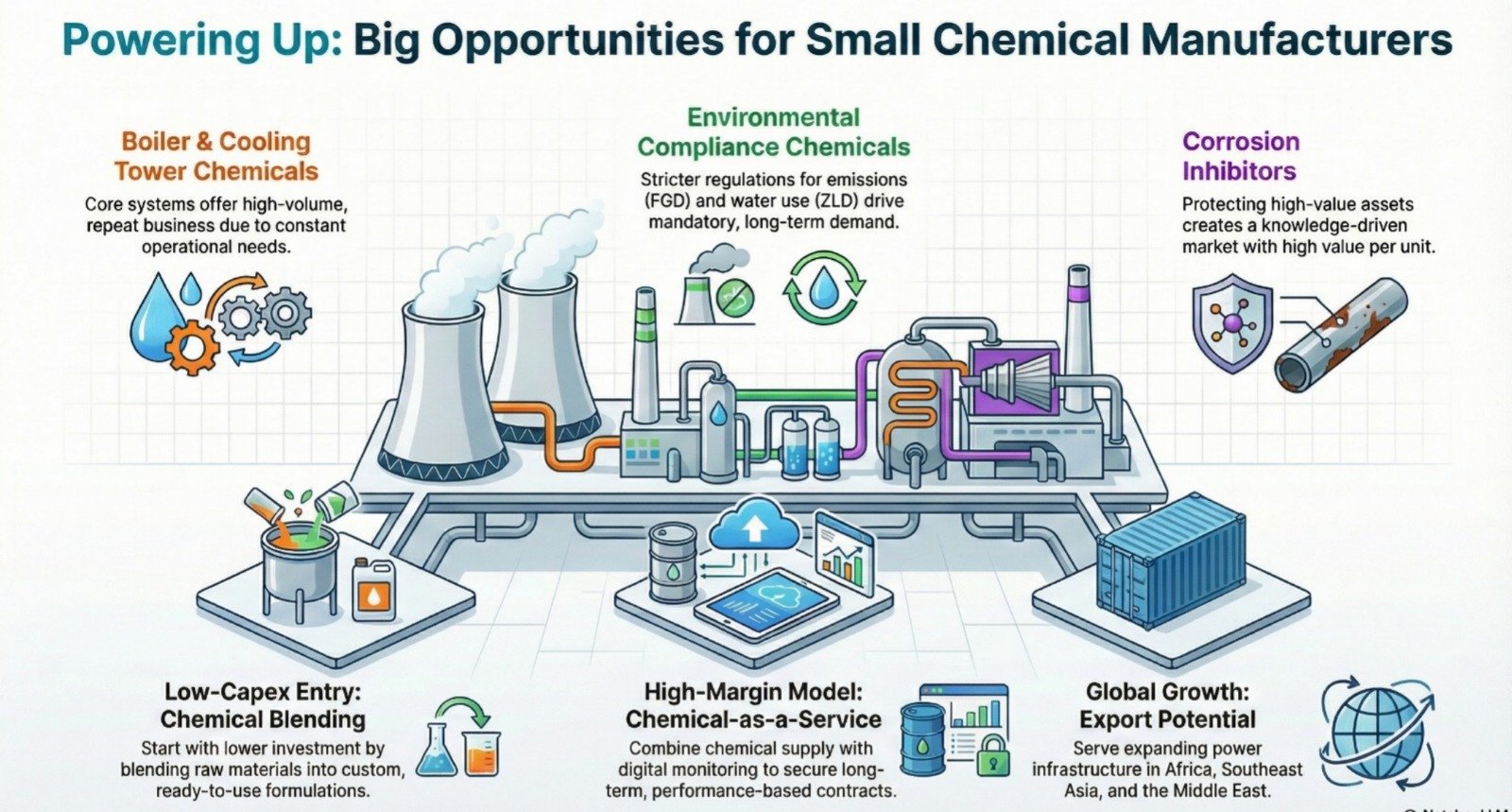
Industrial chemical manufacturing linked to India’s power sector is not limited to a few products. The ecosystem includes:
- Core treatment chemicals
- Environmental compliance chemicals
- Renewable energy support chemicals
- Service-integrated solutions
Entrepreneurs who focus on technical capability, regulatory alignment, and long-term relationships can build scalable and resilient chemical manufacturing businesses.
Import Substitution Advantage for MSMEs
Despite strong domestic demand, many specialty chemicals used in power plants are still imported. With competitive manufacturing costs and improving technical capabilities, Indian MSMEs can replace imports and also explore export markets.
High-potential categories include:
- Boiler treatment chemicals
- Advanced cooling tower biocides
- Specialty corrosion inhibitors
- Polymer-based formulations
Investing in formulation development, testing, and performance validation is the key to success.
How Power Sector Reforms Are Increasing Chemical Demand
Government initiatives focused on:
- Higher plant efficiency
- Emission control
- Water conservation
- Energy optimization
are increasing, not reducing, the need for advanced chemical solutions. Better performance standards require better chemical treatment, creating new opportunities for innovative manufacturers.
Role of NIIR Project Consultancy Services (NPCS)
Before investing, proper feasibility planning is essential.
NIIR Project Consultancy Services (NPCS) supports entrepreneurs by preparing Market Survey and Detailed Techno-Economic Feasibility Reports (DPRs).
These reports cover:
- Manufacturing processes
- Market demand analysis
- Plant layout and capacity planning
- Machinery and raw material details
- Project cost and financial projections
Our goal is to help entrepreneurs make informed, profitable decisions before committing capital.
Lessons from Successful Indian MSME Chemical Businesses
Successful MSME chemical manufacturers focused on:
- Niche products
- Long-term industrial relationships
- Reliable performance
- Strong technical support
Instead of competing only on price, they built trust through quality and service.
How NIIR Project Consultancy Services (NPCS) Helps Entrepreneurs
Setting up an industrial chemical manufacturing unit requires more than just chemical knowledge—it demands market clarity, regulatory understanding, and financial feasibility.
NIIR Project Consultancy Services (NPCS), through NIIR.org, supports entrepreneurs, MSMEs, and investors by preparing Market Survey Reports and Detailed Techno-Economic Feasibility Reports (DPRs) tailored to industrial chemical projects.
NPCS reports typically include:
- Manufacturing process and formulation overview
- Market demand and end-user analysis
- Capacity planning and product mix selection
- Machinery, raw material, and utility requirements
- Project cost estimation
- Financial projections and profitability analysis
These reports help entrepreneurs:
- Reduce investment risk
- Secure bank and institutional finance
- Make informed, data-driven decisions
Key Government Reference Portals
Entrepreneurs should track official updates from:
- Ministry of Power – https://powermin.gov.in
- Ministry of Chemicals & Fertilizers – https://chemicals.gov.in
- Ministry of MSME – https://msme.gov.in
- DPIIT – https://dpiit.gov.in
- Invest India – https://www.investindia.gov.in
Frequently Asked Questions (FAQs)
Q1. Is industrial chemical manufacturing suitable for first-time entrepreneurs?
Yes. With proper feasibility analysis and technical support, it is well-suited for first-time MSMEs.
Q2. Do power plants consume chemicals regularly?
Yes. Most chemicals are consumables used daily, ensuring steady demand.
Q3. Are there export opportunities in power-sector chemicals?
Yes. Indian manufacturers can export to Asia, Africa, and the Middle East once quality standards are met.
Q4. Is regulatory compliance difficult?
Compliance is manageable with proper planning and guidance, especially regarding environmental norms.
Conclusion
Industrial chemical manufacturing for India’s power sector offers one of the most stable and scalable opportunities for startups and MSMEs. Key advantages include:
- Consistent, recurring demand
- Strong linkage with infrastructure growth
- Import substitution opportunities
- Export potential
- MSME-friendly investment size
For entrepreneurs seeking a long-term industrial business, boiler chemicals, cooling tower chemicals, and corrosion inhibitors stand out as reliable and profitable choices.


