


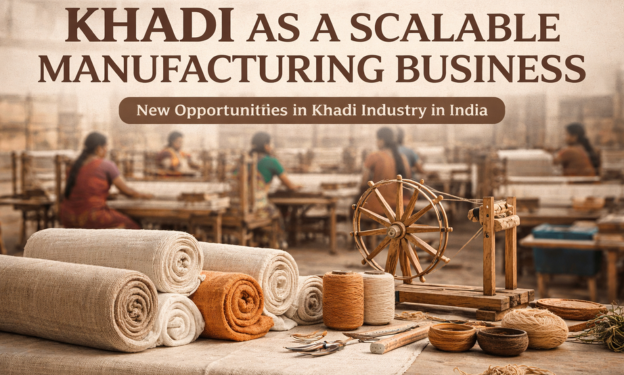
Khadi Manufacturing Business: Khadi had long been seen in a sentimental perspective, symbolic and patriotic, and country-like. This perception is now quite unequivocal. In the khadi industry in India, Khadi symbolizes something much bigger in terms of entrepreneurial importance: a policy-supported, structured, needs-based production space that has high scalability, can enhance profit margins, and increase the level of international applicability.
As the Kurukshetra Magazine, December Issue, points out, Khadi has silently progressed to a cottage-based activity into a modern production-based MSME industry, with institutional finance, digital marketplaces, design interventions, and export-based demand behind the latter. To first generation entrepreneurs and manufacturing investors, this shift is an infrequent chance to get into a culturally based sector in a place of commercialization inflection.
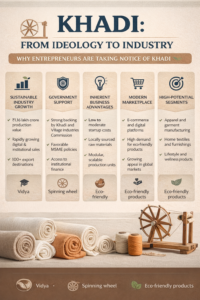
From Ideology to Industry: Why Khadi Is Now an Entrepreneurial Asset
The only thing that alters the Khadi narrative is data. There have been continued positive trends in production value, sales realization, artisan productivity and institutional turnover. Institutions of Khadi do not exist in a vacuum anymore; they are becoming a part of organized retail, government purchasing systems, export systems, and e-commerce systems.
The Government of India, through its Khadi and Village Industries Commission, has decisively taken a step to change the economics of the sector, thus, shifting it out of an emphasis on subsidy-dependent models toward market-sensitive modes of manufacturing. It is no longer focusing on the generation of employment, but on the value addition, throughput efficiency, product differentiation, and brand positioning.
Khadi is an excellent choice to those entrepreneurs who consider business ideas based on feasibility logic as it provides:
- Low-moderate startup capital.
- Agration that is decentralized and has a scale.
- Great institutional demand.
- Rising export traction
- Intrinsic sustainability strength.
Market Growth Snapshot: What the Numbers Reveal About Khadi Industry In India
The table below is a summary of key performance indicators used to determine the current level and direction of the Khadi sector as shown by official sector data as presented in Kurukshetra-
| Indicator | Current Status |
| Khadi production value | ₹1.16 lakh crore+ |
| Annual sales turnover | ₹1.45 lakh crore+ |
| Registered artisans | Over 49 lakh |
| Share of women workforce | Approx. 80% |
| Export destinations | 100+ countries |
| Employment growth trend | Consistently rising |
| Digital sales contribution | Rapidly expanding |
These statistics are significant as they prove one thing unquestionably, Khadi is no more a fringe activity, it is a commercially pertinent manufacturing industry.
Read Our Book: Project report
Business Selection Logic: Why Khadi Works for New Entrepreneurs
As a feasibility consultant, Khadi is a high-potential industry since it addresses various startup issues at the same time.
First raw material availability is stable and largely domestic reducing import dependency risks. Second production processes spinning and finishing can be modularised allowing entrepreneurs to start small and scale in phases. Third, working capital cycles are improving due to institutional procurement and organised retail partnerships.
To begin with, the availability of raw materials is not volatile and most is locally based minimizing the risk of relying on imports. Second, spinning, weaving, dyeing, garmenting, and finishing production processes can be modularised, where an entrepreneur can begin small and grow in stages. Third, the institutional procurement, digital payment, and structured retail collaboration contribute to enhancing working capital cycles.
Above all, Khadi products are placed at the crossroads of the three concepts: sustainability, authenticity, and ethical consumption, which are redefining the local and global demand trends.
Import–Export Dynamics: A Hidden Growth Lever
The potential of Khadi to be exported is one of the least recognised aspects of it. The global fashion and lifestyle trends are actively weaning themselves out of using synthetic fabrics and manufacturing processes that are carbon intensive. Products that are hand-spun and handwoven, and products that are made of natural fibres would automatically fit into the international ESG procurement systems.
Khadi exports have become apparel, home textiles, accessories, and lifestyle products. This gives a two-fold opportunity to Indian entrepreneurs:
- Import substitution, by replacing blended or synthetic fabrics in domestic institutional demand
- Export-led growth, especially in ethical fashion, slow fashion, and sustainable living categories
Such entrepreneurs that organize their business in terms of export compliance, quality standards and design based product lines can enter the premium overseas market without necessarily competing on price.
Learnings from Indian Industrial Leaders: Transferable Lessons
The examples of the traditional khadi industry in India that have been transformed into scaled businesses by a number of Indian business leaders are very remarkable.
- Ratan Tata (Tata Group) stressed ethical sourcing, long-term brand trust, and value-based manufacturing, which are the principles which are directly relevant to Khadi-led businesses.
- The model of digital public infrastructure by Nandan Nilekani suggests the scaling of even decentralized systems due to platforms and transparency, which is already being applied to Khadi with the help of digital commerce and traceability.
- An example of how backward integration and brand positioning can change the commodity products to premium categories was observed with Kumar Mangalam Birla (Aditya Birla Group), but that is exactly what is happening to Khadi.
The universal dictum to new entrepreneurs is obvious: scale is not merely a matter of machines; but a matter of systems, of trusts and of market fit.
Read Also: Khadi Business Ideas in India
High-Potential Khadi-Based Manufacturing Opportunities
Khadi Apparel and Garment Manufacturing Units
Business persons will be able to start stitching and finishing units connected with certified Khadi cloth vendors. These units can serve institutional purchasers, retail chains, and export houses with their modern sizing, fashion and forward cuts, and quality which is not compromised. Profitability enhances substantially with the inclusion of branding and direct-to-consumer channels.
Khadi Home Textiles and Furnishing Products
Curtains, furniture, bedding, table clothes and handmade decorations using Khadi are increasingly gaining popularity in hotels and quality residential buyers. This segment has better margins than apparel and enables planning production in batch.
Natural Dyeing and Processing Units
The major bottleneck in the area of sustainable textiles is eco-friendly dyeing. Khadi manufacturers can operate under environmental credentials by entrepreneurs investing in compliant scalable natural dyeing units to serve multiple producers.
Khadi Based Lifestyle and Wellness Products
In addition to textiles Khadi ecosystems are favorable in soaps and wellness products. The products have a good branding potential and repeat consumer demand.
Digital Aggregation and Brand Platforms
Aggregation, private labeling, and online sale infrastructure startups of Khadi, do not significantly require investment in the assets, and can grow at a fast pace, are ecosystem comprising.
Risk Awareness: What Entrepreneurs Must Plan For
There is no area that is free of challenges. Khadi businessmen need to take the initiative to control:
- Consistency in quality between decentralized production.
- Relevance in design and responsiveness in the market.
- Working capital on scale-up stages.
- Adherence to certification and institutional standards
These are risks that can be handled, however, this requires a systematic approach, expert analysis of feasibility, and gradual investment policies.
The Role of Feasibility Thinking in Khadi Ventures
Here is where professional project evaluation is important. In Niir Project Consultancy Services (NPCS), we liaise with entrepreneurs and help to convert opportunity into bankable reality. Our Market Survey cum Detailed Techno-Economic Feasibility Reports are not only an analysis of the idea, but also the value chain of it, i.e. manufacturing processes, demand evaluation, capacity planning, machinery choice, sourcing of raw materials, and overall financial analysis.
In the case of Khadi based projects, this methodology will help in ensuring that tradition is backed up by business discipline of modernity so that entrepreneurs can grow on a sustainable and profitable basis.
More Like This- India Acrylates & Intermediates Market: Trends, Growth & Analysis (2026)
FAQ
Is Khadi manufacturing viable for first time entrepreneurs?
Yes. The barriers to entry are relatively low compared to other industrial sectors and institutional support has high impact in minimizing risks during the initial stages..
What investment range is typical for a Khadi unit?
Projects may be initiated on a modest basis, dependent on scale and mix of products, and progress in stages, using internal accruals.
Can Khadi businesses scale beyond local markets?
Absolutely. It has already been demonstrated that national and global scaling are achievable through digital platforms and export channels.
How long does it take to achieve profitability?
Planned units can also achieve operational breakeven within a reasonable time frame, particularly with regard to institutional sales incorporated.
Is Khadi demand sustainable long term?
The structural drivers of demand, which include sustainability, ethical consumption, and production in the country are not cyclical.
Final Perspective
Khadi is no longer the question of nostalgia but of orderly chance. To the entrepreneur who is both willing and able to integrate cultural understanding with professional feasibility planning, Khadi presents an opportunity that is quite uncommon including low entry barriers, high scalability opportunities, and long-term mainstream. At a time when sustainability and self-reliance is redefining the priorities of industry, Khadi is not at the periphery- but squarely in the middle of the next manufacturing chapter in India.
Find the Best Idea for Yourself With our Startup Selector Tool


