


Low competition manufacturing business ideas in India
India’s manufacturing landscape is undergoing a quiet revolution. First-time entrepreneurs tend to choose low-margin products which include paper cups and disposable plates, but actual business possibilities exist through what experts term invisible B2B products which include essential industrial components and technical materials that businesses require for daily operations but which consumers cannot identify. The three business segments together provide their customers through recurring purchases while maintaining lower operational costs and better operational performance.
The Indian government’s drive for self-sufficiency together with international supply chain transformations and new regulatory requirements and increasing domestic market needs have created an exceptional opportunity for micro small and medium enterprises which operate as manufacturers. This article explores the most profitable manufacturing opportunities, step-by-step strategies, investment requirements, and government support mechanisms to help aspiring entrepreneurs make informed decisions.(low competition manufacturing)
Table of Contents
ToggleWhy Now is the Perfect Time to Start Manufacturing in India
Entrepreneurs will find themselves in a special opportunity period because of the following two elements:
1. Production-Linked Incentive (PLI) Schemes
PLI schemes reward actual production rather than mere investment. The Guaranteed demand for goods which businesses require as Tier-2 or Tier-3 suppliers to larger companies will enable MSMEs to build their operations without taking on significant initial expenses.
2. Global Supply Chain Shifts (China+1 Strategy)
Indian suppliers are needed by multinational corporations to provide essential parts which include electric vehicle components and electronic-grade chemicals and defence systems. This opens doors for small players who can meet quality standards.
3. Regulatory Mandates
The Zero Liquid Discharge regulations and BIS fire safety standards and compulsory geotextile usage in infrastructure projects create specific product demand which businesses must fulfil.
4. Rising Domestic Demand
The expansion of India’s industrial sector together with urban development and renewable energy growth creates a rising need for specialty chemicals and EV components and defence-grade equipment.
Entrepreneurs who implement the right strategy will find themselves facing a limited opportunity period which special conditions create.
High-Margin Manufacturing Opportunities Across Sectors
The most valuable products of a business exist within its complete product range. The knowledge of MSMEs enables them to build strong business defences which exceed their financial resources.(low competition manufacturing)
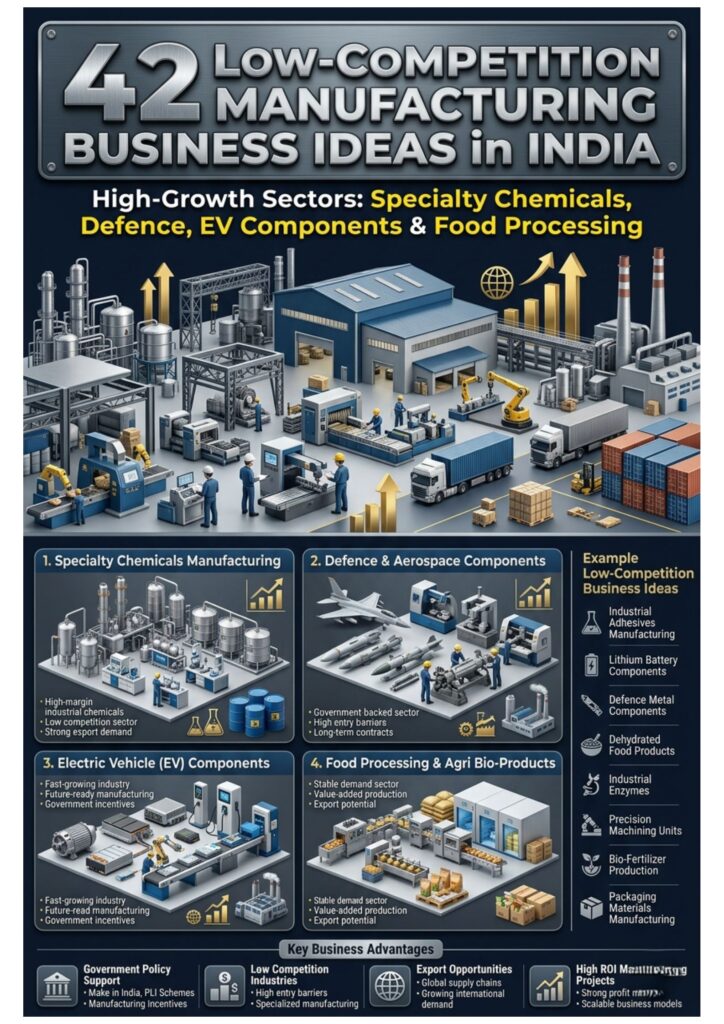
1. Specialty Chemicals
Specialty chemicals function as profitable high-margin products which industries use for their operations in electronics and pharmaceutical and metal finishing sectors. The following compounds serve as examples:
- Electronic-grade ultrapure solvents – Margins: 40–55%
- Boiler & cooling water chemicals – Margins: 35–50%
- Electroplating brighteners & additives – Margins: 35–50%
The chemicals in this box generate profits because their development needs specialized knowledge which needs to be learned through time instead of using expensive industrial machines. This business model creates continuous customer need for these chemicals which leads to stable revenue streams.
2. Defence & Aerospace Components
The defence and aerospace sectors of India experience rapid growth. Companies that manufacture aerospace-grade fasteners and MIL-spec connectors and precision machined parts achieve profit margins between 35 and 60 percent.
The SRIJAN portal enables users to access over 36,000 defence components which have received government backing for Indian defence procurement needs.
3. EV Components
The electric vehicle (EV) market is experiencing rapid growth which has increased the need for various parts including the following components:
- Motor laminations
- Battery Management System (BMS) hardware
- Hall-effect sensors
Investment range: ₹1.5–5 crore
Margins: 30–50%
Growth driver: Domestic EV adoption, government subsidies, and PLI schemes.
4. Food Processing & Agri Bio-Products
India functions as a worldwide center for exporting spices and fruits and pulses. Processing which requires deep understanding leads to valuable business prospects because it provides high potential value:
- Pectin extraction – Used in jams and confectioneries
- Pea protein isolates – Growing plant-based protein market
- Spice oleoresins – Export-oriented, high-margin
Investment range: ₹10–30 crore
Margins: 20–45%
Natural food ingredients are currently experiencing high market demand across the United States and European Union and Middle Eastern regions.
5. Other Knowledge-Intensive Niches
- Textile auxiliaries and specialty fabrics
- Chelated micronutrients and bio-pesticides for agriculture
- Activated carbon and filtration media for environmental and industrial use
Capital requirement: Under ₹2 crore to ₹30 crore depending on scale
Margins: 30–60%
The specialized knowledge of these niches allows businesses to achieve better results than typical commodity products because they receive consistent customer orders.
Read More: Project Reports & Profiles
Government Schemes Supporting MSME Manufacturing
The Indian government has introduced specialized financial assistance programs which now make it easier for entrepreneurs to establish new ventures across the country:
1. PLI Schemes
- The regulation applies to electronic equipment and battery storage systems and medical devices and technical textiles.
- The organization uses production-based incentives which extend beyond investment-based funding.
2. PMEGP & MUDRA
- The program provides financial assistance through subsidies and grants people access to interest-free loans which support their small manufacturing operations.
- The program helps entrepreneurs who have small amounts of money to start their businesses.
3. Udyam Registration
- The government provides MSMEs with access to tax advantages and special funding programs and government contract opportunities.
4. CGTMSE
- The program provides credit protection to small enterprises which helps financial institutions decrease their lending risks.
The companies NIIR Project Consultancy Services (NPCS) offer professional advisory services which support organizations in creating Detailed Techno-Economic Feasibility Reports (DPR) that enable them to make profitable investment decision.(low competition manufacturing)
Read More: Startup Selector
42 Opportunities at a Glance
# | Opportunity | Investment | Margins | Competition | Sector |
1 | Electronic-grade ultrapure solvents | ₹3–8 Cr | 35–55% | Very low | Chemicals |
2 | Electroplating brighteners | ₹2–5 Cr | 35–55% | Low | Chemicals |
3 | Water treatment dosing chemicals | ₹1–3 Cr | 35–50% | Low-med | Chemicals |
4 | Foundry metallurgical chemicals | ₹1.5–5 Cr | 30–50% | Low | Chemicals |
5 | Specialty carbon black | ₹5–12 Cr | 25–40% | Low | Chemicals |
6 | Precipitated silica (RHA) | ₹3–15 Cr | 20–35% | Low | Chemicals/Green |
7 | Pectin extraction | ₹5–15 Cr | 35–45% | Low | Food ingredients |
8 | Food-grade emulsifiers | ₹50L–5 Cr | 20–35% | Low-med | Food ingredients |
9 | Natural food colorants | ₹30L–8 Cr | 25–40% | Medium | Food ingredients |
10 | Pea protein isolate | ₹50L–15 Cr | 20–35% | Low | Food ingredients |
11 | Spice oleoresins | ₹50L–15 Cr | 25–40% | Low-med | Food ingredients |
12 | Industrial enzymes | ₹50L–15 Cr | 25–45% | Medium | Food/industrial |
13 | Chelated micronutrients | ₹50L–2 Cr | 30–45% | Low | Agri inputs |
14 | Seaweed bio-stimulants | ₹25L–5 Cr | 25–40% | Low-med | Agri inputs |
15 | Trichoderma bio-pesticides | ₹10L–5 Cr | 30–50% | Low | Agri inputs |
16 | Aerospace alloy fasteners | ₹2–8 Cr | 30–50% | Low | Defence |
17 | MIL-spec connectors | ₹3–10 Cr | 35–60% | Very low | Defence |
18 | Rubber-metal anti-vibration | ₹1–4 Cr | 25–40% | Low | Defence |
19 | Hydraulic manifold blocks | ₹2–6 Cr | 25–40% | Low | Defence |
20 | EV motor laminations | ₹1.5–5 Cr | 20–30% | Low | EV supply chain |
21 | Thermal management hardware | ₹50L–3 Cr | 25–35% | Low-med | EV supply chain |
22 | HV wiring components | ₹1–5 Cr | 20–35% | Low-med | EV supply chain |
23 | BMS hardware/sensors | ₹50L–3 Cr | 25–45% | Low-med | EV supply chain |
24 | VCI packaging | ₹1.5–5 Cr | 25–40% | Low | Ind. packaging |
25 | Pharma-grade desiccants | ₹50L–3 Cr | 30–45% | Low-med | Ind. packaging |
26 | Geotextiles/geosynthetics | ₹8–20 Cr | 20–35% | Low-med | Infrastructure |
27 | Specialty grouts/coatings | ₹1–5 Cr | 30–50% | Low-med | Infrastructure |
28 | Recycled PET acoustics | ₹1–4 Cr | 25–40% | Low | Infrastructure |
29 | Diagnostic kit cassettes | ₹50L–2 Cr | 25–35% | Low-med | Med devices |
30 | Medical silicone parts | ₹1.5–5 Cr | 30–45% | Very low | Med devices |
31 | Advanced wound care | ₹2–8 Cr | 25–40% | Low | Med devices |
32 | Fusible interlining | ₹75L–3 Cr | 18–30% | Medium | Textiles |
33 | Retro-reflective materials | ₹1–4 Cr | 25–40% | Low | Textiles |
34 | Specialty elastic tapes | ₹75L–3 Cr | 30–45% | Low | Textiles |
35 | Textile finishing chemicals | ₹25L–5 Cr | 30–50% | Low | Textiles |
36 | Biochar | ₹30L–2 Cr | 30–50% | Low | Clean tech |
37 | Coconut shell activated carbon | ₹1–5 Cr | 25–40% | Medium | Clean tech |
38 | Effluent treatment chemicals | ₹50L–3 Cr | 20–35% | Low-med | Environment |
39 | HEPA filter media | ₹50L–25 Cr | 25–45% | Low | Filtration |
40 | RFID laundry tags | ₹1–4 Cr | 30–50% | Very low | Tech/textile |
41 | EAS anti-theft labels | ₹1.5–5 Cr | 25–40% | Low | Retail tech |
42 | Engineered polymer compounds | ₹50L–5 Cr | 25–40% | Low-med | Plastics |
Steps to Start a Manufacturing Business in India
- Choose a Sector Based on Knowledge
Focus on areas where you have expertise or access to raw materials.
- Validate the Idea with a DPR
Includes market research, capacity planning, financial projections, and risk analysis.
- Leverage Government Schemes
Apply for PLI, PMEGP, MUDRA loans, and Udyam registration.
- Start Lean & Scale
Pilot-scale units allow testing and early customer acquisition before full-scale investment.
Case Studies: Companies like Constro Chem and Biocon demonstrate how knowledge-driven scaling and high-quality execution lead to long-term success.
Investment Considerations
Investment Range | Sample Products | Margins |
Under ₹2 Cr | Bio-pesticides, chelated micronutrients, biochar, textile auxiliaries | 30–50% |
₹2–10 Cr | Electroplating brighteners, VCI packaging, aerospace fasteners, medical silicone | 30–60% |
₹10–30 Cr | Geotextiles, HEPA filter media, pea protein isolates, pectin extraction | 20–45% |
Key insight: Knowledge-intensive fields always provide better investment returns than standard market commodities because of their superior performance.
Conclusion
India’s manufacturing industry provides permanent business opportunities which generate high profits for entrepreneurs who demonstrate quick decision-making abilities. The key to success lies in:
- Choosing knowledge-driven niches
- Validating demand through DPRs
- Leveraging government schemes effectively
- Scaling responsibly
Successful experts need to work in special niche markets which experience little competition because it provides them access to exceptional possibilities. By combining technical know-how, strategic investment, and government support, MSMEs can create sustainable wealth while contributing to India’s manufacturing growth story.
Frequently Asked Questions (FAQ)
Q1: Which sectors offer the highest margins for MSMEs?
The market produces special products which include defence materials and aerospace components and specialty chemicals and environmentally friendly technology products. Knowledge-intensive fields deliver companies their highest profitability.
Q2: Do I need a DPR before starting?
Yes. DPRs evaluate financial viability, capacity planning, and risks. NPCS offers professional DPR services across hundreds of sectors.
Q3: Can MSMEs export products from India?
Absolutely. Products like spice oleoresins, natural food colorants, and activated carbon have global demand. Certifications and export schemes ease entry.
Q4: How do PLI schemes help smaller manufacturers?
Tier-2 MSMEs gain indirect advantages because they provide products to PLI beneficiaries, which results in guaranteed sales without needing to apply for direct business connections.


