


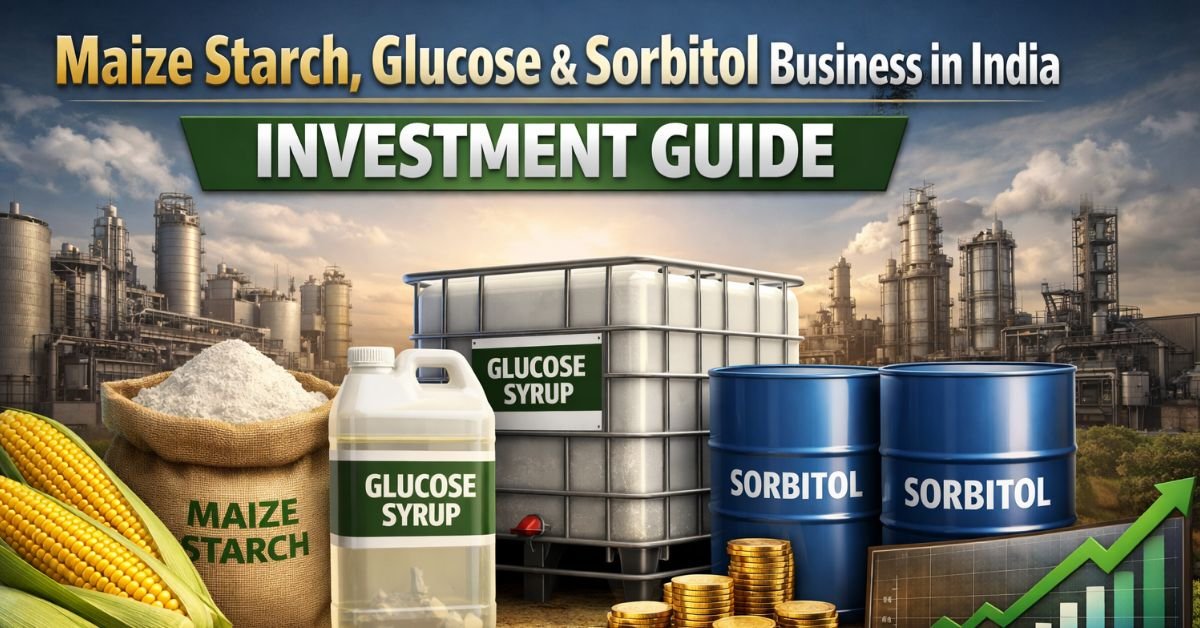
Maize Derivatives Business India
India’s agro-processing business is primed for a transformational phase of growth, with the derivatives of maize becoming one of the most lucrative investment opportunities. Once confined to trading in grains, the maize industry has become a complex of chemical and food ingredient production. Products like maize starch, liquid glucose and sorbitol are driving industrial demand which has provided investors and MSMEs with an opportunity to break into a market with opportunities for good profitability.
The present market conditions show optimal potential for entering this industry because abundant maize exists along with rising domestic demand and government support and there exists a shortage of high-value products. This blog discusses why 2025-26 is the right time to enter maize derivative ventures in India and a roadmap for investors.
India's Maize Derivatives Market: Strong demand, Supply shortfall
India produces about 2.6 million tonnes and the country consumes about 2.0 million tonnes of maize starch every year (2024). Despite this, the actual option is to develop value-added derivatives such as liquid glucose and sorbitol, which still suffer from supply shortages.
Key Market Trends are a highlight of the growth potential:
- Starch and Derivatives Market USD 3.7 billion (2026) USD 5.25 billion by 2031
- Compound Annual Growth Rate (CAGR) – 7.25%
- Sorbitol demand: 185 kilo tonnes (2024) – Projected sorbitol demand in 2033: 225 kilo tonnes
- Processed food sector growth (12%+ CAGR)
The demand for maize derivatives clearly exceeds current domestic production creating a strategic opportunity for new entrants.(Maize Derivatives Business India)
Supply-Demand Gap: Strategic Investment Opportunity
India still depends on imports for specialty maize derivatives, especially for the pharmaceutical and quality food markets. In 2023 maize derivative imports amounted to USD 4.7 million, even though there was sufficient maize production domestically.
- Sorbitol has 15-20% shortages at the domestic market.
- Specs for liquid glucose imports: – High-D.E. (dextrose equivalent) requirements in beverages and confectionery.
- Regional industrial clusters tend to have greater demand because of logistical and proximity advantages.
This opens up a lucrative niche for plants of the MSME scale, especially the cluster-based production.(Maize Derivatives Business India)
Modern Maize Value Chain: From Grain to High Value Products
Maize processing has gone from a simple trading mechanism to a complete chemical and food ingredient ecosystem, including:
- Wet milling: Produces 62 – 65% starch from maize
- Enzymatic hydrolysis: Starch to liquid glucose (DE 42-85)
- Hydrogenation: Gives rise to sorbitol
Additionally, co-products such as corn gluten meal, corn oil and corn steep liquor generate additional revenue streams, enhancing plant economics and protecting operations from volatile raw material prices.(Maize Derivatives Business India)
Industries Propelling Demand for Maize Derivatives
Maize derivatives are used in various industrial sectors which guarantees a stable and increasing demand:
- Starch: Paper, textiles, thickeners for foods
- Biscuits, confectionery, soft drinks, pharma fermentation – Liquid glucose
- Sorbitol: Toothpaste, synthesis of vitamin C, sugar-free food, cosmetics
This diversity helps to minimize the dependence of any single industry, so that new plants are used at high rates.(Maize Derivatives Business India)
Economical Viability for Integrated MSME Plants
For small and medium enterprises, a 100 TPD integrated plant for starch, glucose and sorbitol production is very feasible. Properly designed units can realize:
- Capital expenditure (CapEx): INR 80-120 crore (subsidies may bring this down)
- Cash-positive operations: 60% or so utilization
- Internal Rate of Return (IRR): 24–28%
- EBITDA margins: 25%+
- Payback period: 4–5 years
Integrated plants also provide for scalable modular production, which would enable investors to scale up beyond Year 3 and even export some of the sorbitol for better margins.(Maize Derivatives Business India)
Trade Trends Reveal Opportunities
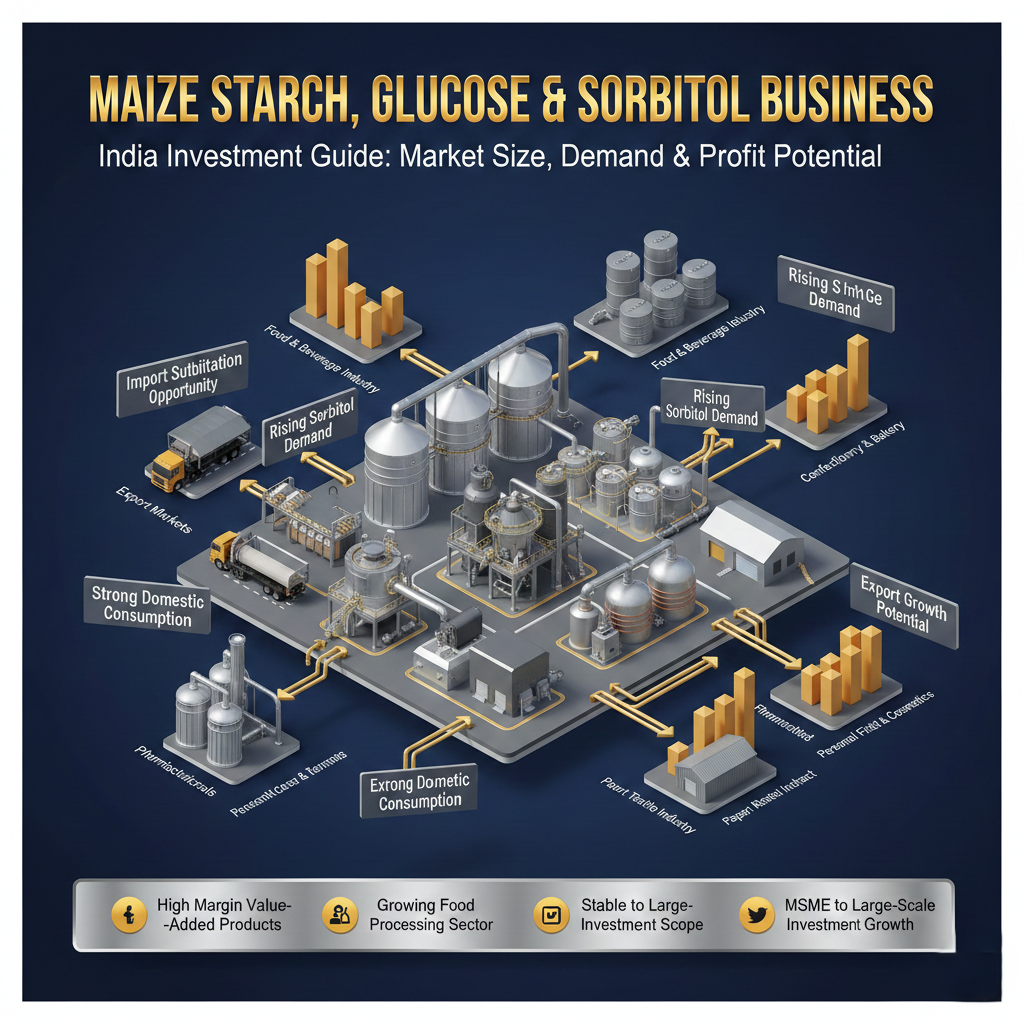
India continues to import maize starch and glucose, while sorbitol exports have 10-15% premiums in the world. The establishment of a strategically situated plant provides investors who use it to replace imports and export 15-20% of their sorbitol production with two different advantages:
- Import substitution: Decreasing dependence on imports
- Export arbitrage: Taking advantage of higher global margins
The business combination results in decreased operational risks while increasing revenue potential.(Maize Derivatives Business India)
Government Support Minimizes Entry Barriers
The Government of India supports maize processing through its various schemes which include the initiatives run by the Ministry of Food Processing Industries (MoFPI).(Maize Derivatives Business India)
- PM-FME (Pradhan Mantri Formalization of Micro Food Enterprises): Credit linked capital subsidy – 35%
- PLISFPI (Performance-Linked Incentive Scheme for Food Processing Industries) 4 – 6% incentive on incremental sale
- ODOP (One District One Product): Targeted support for one district for maize production
- Technical support: Support from national institutes in the form of process blueprints
These initiatives can reduce the upfront costs by 25 – 35% making maize derivative manufacturing highly feasible for first-time entrepreneurs.(Maize Derivatives Business India)
Existing Players - Validate the Market
Companies such as Gulshan Polyols Ltd., Sukhjit Starch & Chemicals Ltd. and Riddhi Siddhi Corn Processing Pvt. Ltd. are involved in large integrated operations. Whereas these players are operating at 85-90% capacity, regional and specialty demand is not frequently met – opening up opportunities for MSME entrants in cluster-based manufacturing.(Maize Derivatives Business India)
Roadmap for Investors
Investors can adopt an organized way of entry into the maize derivative business:
- Catchment Analysis: Identify regional clusters of high industrial demand
- Project Planning: Prepare DPRs, Financing, apply for subsidies
- Plant Construction: Establish turnkey wet milling, hydrolysis and hydrogenation plants
- Market Integration: MOUs for glucose supply to food companies; Tie ups for sorbitol export
By having the option of diversifying revenue among starch, glucose, and sorbitol, investors reduce risks from fluctuations in maize prices and demand.(Maize Derivatives Business India)
Why 2025–26 Is the Ideal Time to Enter
A number of reasons make this time ideal for investment:
- Record maize output in India
- Derivatives: – Strong and growing demand for derivatives
- Persistent import dependence – creates gap for domestic producers
- Government incentives to reduce financial risk
Investors getting into now are able to achieve sustainable 25%+ returns, first mover advantages in underserved markets and export opportunities.(Maize Derivatives Business India)
Conclusion
The maize derivatives market in India presents investors with a unique opportunity which creates profitable investment prospects. The combination of sufficient raw material supply and increasing industrial demand and government support enables MSMEs and first-generation entrepreneurs to build integrated plants which will produce starch and liquid glucose and sorbitol.
Investors who enter the market during 2025-26 period will receive substantial ROI while they become the first companies to enter underdeveloped areas. Maize derivative production in India can achieve sustainable success which brings excellent financial rewards through proper planning and technical assistance and strategic marketing implementation.(Maize Derivatives Business India)
Frequently Asked Questions (FAQ)
Q1: Is maize starch manufacturing a profitable business in India?
Yes, integrated maize derivate plants are usually delivering 24-28% IRR with good cash flows.
Q2: How much investment is required?
MSME-scale plants demand INR 80-120 crore but subsidies are available to bring down the effective cost tremendously.
Q3: Which product is the most profitable?
Sorbitol, particularly pharma-grade or export-oriented, is called highest margin.
Q4: Are Government subsidies available?
Yes, and with its proper documentation, MoFPI schemes such as PM-FME can reduce capex by as much as 35%.
Q5: Is this for first time entrepreneurs?
Absolutely, especially with the guidance of professionals in DPR and a cluster approach.


