



Maize Wet Milling Business
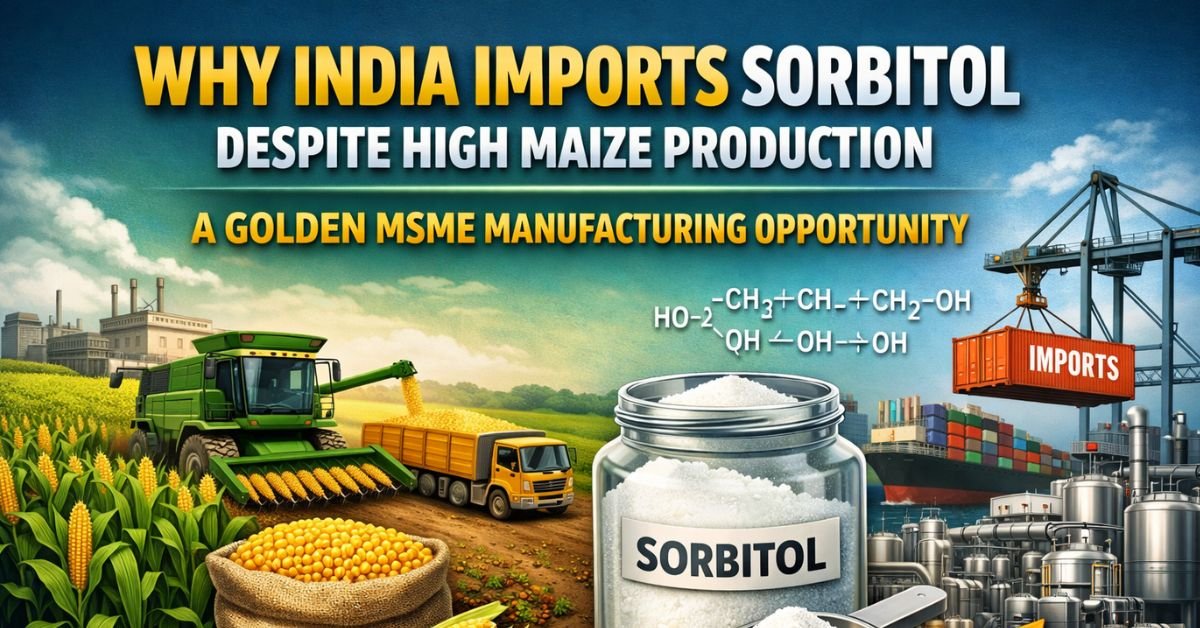
India’s strength in agriculture is well known but one of the best industrial opportunities in the country is underutilised – converting maize into high-value biochemical derivatives. While India is one of the leading countries in production of maize, the country has a structural demand-supply gap of starch, glucose, dextrose and sorbitol derivatives. This gap represents a great investment opportunity for MSME entrepreneurs looking to establish profitable agro processing ventures with a strong domestic demand, import substitution potential, and government policy support.
This market insight – SEO optimized covers the reasons why maize derivatives manufacturing is emerging as one of the best MSME business opportunities in India till 2032.
Strength of Maize Production in India vs Industrial Processing Facts
India produces more than 36-38 million metric tonnes of maize every year and this is supported by an increase in the area under maize cultivation, as well as an increase in the use of hybrid seed. However, under 25 percent of total maize production is industrially processed to starch and glucose derivatives. The majority is used by the poultry feed industry or traded as a raw material, which means that potential value is lost.
This imbalance points to a classic structural inefficiency:
strong agricultural supply + weak industrial infrastructure (secondary processing) = weak industrial demand.
As downstream industries grow further, this gap is predicted to widen further, if new processing capacity is not added – particularly at the MSME level.(Maize Wet Milling Business)
Increasing Industrial Demand for Maize-Based Derivatives
Maize derivatives are the sine qua non of functional inputs in several high-growth industries:
- Pharmaceuticals
- Native starch – tablet binder, disintegrant
- Liquid glucose Medical syrups
- Dextrose monohydrate – IV fluids, fermentation media
- Sorbitol – excipient, sweetener, stabilizer
- Food & Beverage Processing
- Feeds & meals: – cake, biscuits, ice creams
- Ready-to-drink beverages and nutrition products
- Personal Care & Cosmetics
- Sorbitol used in toothpaste, creams, gels as a humectant
- Textiles & Paper
- Starch based adhesives, warp sizing
- Strengthening of paperboard
India’s processed food industry alone is expected to experience growth of more than 8% CAGR till 2030 and of those alone the demand for starch and glucose-based intermediates will skyrocket.(Maize Wet Milling Business)
Import Dependence: A Missing Market Opportunity
Despite adequate supply of maize, India is importing pharmaceutical grade sorbitol and specialty glucose syrups mostly from Southeast Asia. The reasons are structural rather than agricultural:
- Limited domestic capacity for wet milling and refining
- Insufficient number of plants that meet pharma and food grade purity standards
- Regional imbalance of production and consumption clusters
Pharmaceutical hubs in Gujarat, Telangana and Himachal Pradesh still rely on imports of derivatives, driving up costs and exposing them to supply disruption worldwide.
For MSMEs, this import reliance represents immediate and local demand waiting to be filled.(Maize Wet Milling Business)
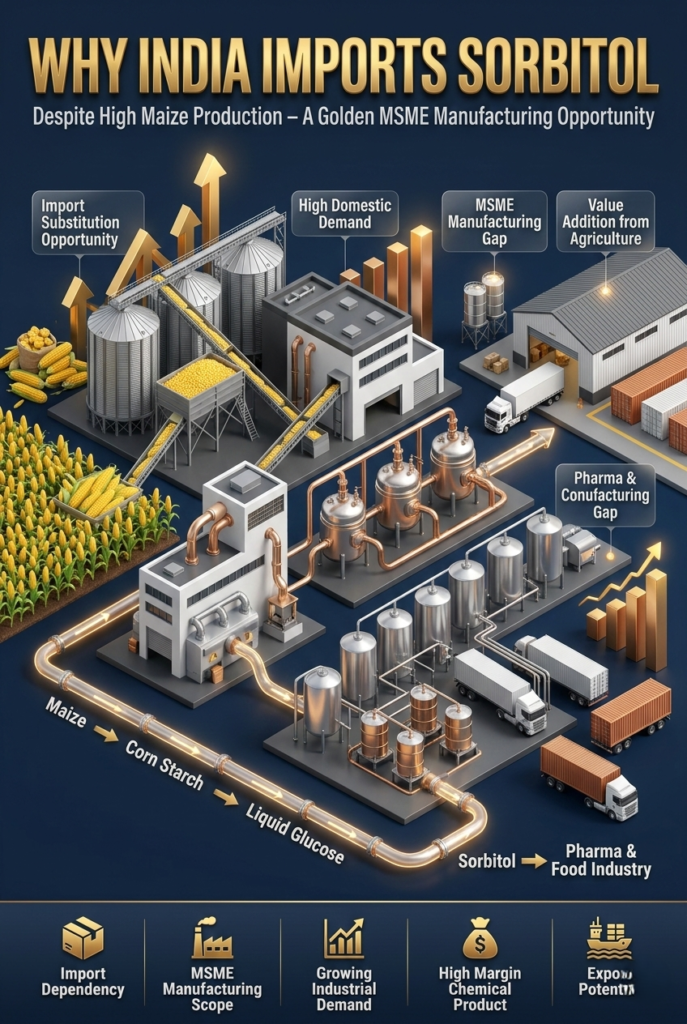
Maize Wet Milling: A Multi-Product Revenue Model
Maize wet milling is not business of one product – it is a portfolio manufacturing model to enhance profitability and risk diversification.
Core Process Overview
- 1. Steeping: Maize kernels softened in water with SO2
- Grinding & Separation: Starch, germ, fibre, gluten isolated
- Enzymatic Hydrolysis: Starch: liquid glucose
- Crystallization: Glucose: dextrose-monohydrate
- Hydrogenation: Glucose: sorbitol solution
Product Basket
- Native maize starch
- Liquid glucose
- Dextrose monohydrate
- Sorbitol solution
High-Value By-Products
- Maize germ oil (edible oil market)
- Gluten feed & fibre (animal feed industry)
This integrated output structure is very good for the stability of plant’s IRR and cash flows.(Maize Wet Milling Business)
Why MSME-Scale Units Make Business Sense
Some of the large players in the market are Gujarat Ambuja Exports Ltd., Sukhjit Starch & Chemicals Ltd., Riddhi Siddhi Gluco Biols Ltd., and Roquette India Pvt. Ltd. and dominate the supply of bulk.(Maize Wet Milling Business)
However, their plants are concentrated in small geographies, resulting in:
- Increased freight costs to buyers
- Regional supply shortages
- Longer procurement cycles
MSME Advantage
- Proximity to pharma & food clusters
- Lower logistics costs
- Faster customisation and deliveries
- High B2B contract manufacturing potential
Decentralized wet milling units can effectively meet these regional shortfalls.(Maize Wet Milling Business)
Government Incentives Help Boost Project Viability
The Indian government actively promotes the agro-processing through financial and policy support:
Central Schemes
- Pradhan Mantri Kisan Sampada Yojana
- PM-FME Scheme
- Argo Processing Cluster Infrastructure Scheme
State-Level Benefits
- Capital subsidies
- Interest reimbursement
- Electricity Duty exemptions
These incentives have considerably lowered project payback periods to make maize derivatives manufacturing attractive to first-generation entrepreneurs.(Maize Wet Milling Business)
Market Outlook Till 2032
India’s maize Derivatives market is set for sustained growth owing to:
- Rising consumption of processed foods
- Pharmaceutical manufacturing growth
- Industries include: – Personal care industry expansion
- Fermentation-based chemical demand
- Import substitution products in sorbitol & specialty glucose
By 2032, India will need significant new wet milling capacity, especially closer to consumption centres as opposed to solely the raw material centres.(Maize Wet Milling Business)
Why Maize Derivatives Manufacturing is a High ROI MSME Opportunity
Key Investment Strengths
- Abundant domestic raw material
- Multi-product revenue streams
- Strong downstream demand
- Government incentives
- Import replacement advantage
Entrepreneurs who invest in wet milling plants optimized regionally early will have the advantage of a long-term market positioning and stable B2B demand.(Maize Wet Milling Business)
Final Insight
India’s maize derivatives industry is a rare mix of agricultural plenty, industrial paucity and policy favouritism. For MSME entrepreneurs who are looking for manufacturing opportunities that scale and are future-ready, maize wet milling presents one of the best investment cases in India’s agro-industrial arena.(Maize Wet Milling Business)
Early entrants targeting quality, regional supply and pharma-grade compliance are the best placed to meet this growing demand until 2032 and beyond.(Maize Wet Milling Business)
Frequently Asked Questions (FAQ)
Q1. Is maize derivation manufacturing appropriate for MSMEs?
Yes. Modular wet milling plants can be designed at MSME scale with phased capacity expansion and diversified product output.
Q2. Which maize derivative is in the most demand?
At present, liquid glucose and sorbitol have the greatest demand with the food, pharma and personal care sectors growing.
Q3. Why is there still a sorbitol import in India?
Due to limited domestic refining capacity, which was not able to fulfill pharmaceutical-grade specifications – not because of maize shortage.
Q4. Where is the best place to establish a maize wet milling plant?
Near pharma clusters or food processing zones, to ensure close to end-users and lower logistics costs.
Q5. Are there government subsidies for such projects?
Yes. Central and state schemes give capital subsidy, support of interest, and infrastructure.
Q6. How profitable is maize wet milling unit?
Profitability is enhanced by by-product monetization, multi-derivative output and stable B2B contracts.


