


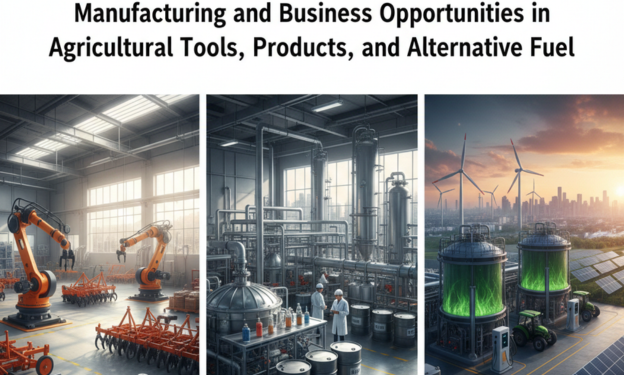
The Manufacturing and Business Opportunities environment in India is on a decisive decade. The growth of domestic demand, supply chain resets, energy transition objectives, and policy-driven industrialization are coming together to generate significant opportunities outside the conventional industries. The metallurgical materials, engineering plastics, and silicon-based products are among them that have the potential to be scaled, replace imports and remain relevant in the long term.
This paper evaluates three autonomous, high potential manufacturing opportunities with unique demand drivers and investment logic through the prism of real-life industrial planning and commercial viability.
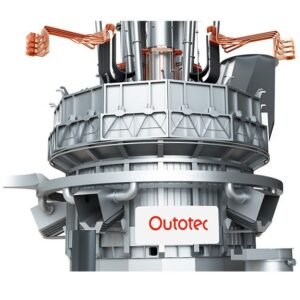
Metallurgical Grade Silicon Production by Arc Furnace
Product Overview and Industrial Relevance
One of the fundamental industrial materials is the Metallurgical Grade Silicon (MG-Si); silicon with 98-99 percent. It is the starting point of aluminium alloys, silicones, photovoltaic grade silicon and advanced chemicals. As opposed to niche specialty materials, MG-Si is a volume commodity whereby off-take by the metal manufacturers and downstream processors are steady.
High purity silicon is imported into India at a high rate especially by China and Brazil so any domestic production is a strategic one.
Manufacturing and Production Insights
Carbothermic reduction of pure quartz in submerged electric arc furnaces at temperatures above 1,900 o C yields MG-Si. The technology is energy intensive and is technologically stable and well understood.
The common plant arrangement comprises raw material preparation, furnace work, tapping and casting, crushing, sizing and packaging. The economics of operations depend more on the availability of power and the efficiency of the furnace than on labour or land costs.
Key Raw Materials and Processing Considerations
The main inputs are high grade quartz, low-ash coal or coke and wood chips as a reducing agent. The electricity most commonly used is in the 11-13 Mwh/tonne range, thus captive power or long-term industrial tariffs become a competitive strength factor.
Demand Drivers and End-Use Industries
The core customer base comprises producers of aluminium alloy, silicone manufacturers and solar-grade silicon refiners. As the aluminium market is experiencing an upward trend of more than 7 percent every year with a steady increase in the number of solar installations, MG-Si demand is stable on an upward trend.
Market Size, Growth Outlook, and Profitability
The silicon demand in India is projected to be more than 250,000 tonnes per year with a growth of 6 8%. Properly managed arc furnace units have an EBITDA margin of 1825 percent in periods of low power prices.
Indicative Cost Structure (per tonne)
| Cost Component | Share (%) |
| Power | 38 |
| Quartz | 22 |
| Reductants | 16 |
| Labour & Maintenance | 12 |
| Overheads | 12 |
Text-Based Cost Pie Chart
Power ████████████████████ 38%
Quartz ████████████ 22%
Reductants ████████ 16%
Labour ██████ 12%
Overheads ██████ 12%
Acrylonitrile Butadiene Styrene (ABS)
Product Overview and Real-World Applications
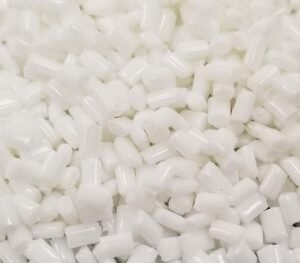
ABS is a high-performing engineering thermoplastic that has impact resistance, surface finish and dimensional stability. It is common in automotive and electrical housing, appliances, medical, and consumer electronics.
However, in comparison to commodity plastics, ABS does not compete only with prices but also with consistency and formulation control.
Manufacturing and Production Insights
ABS is made through emulsion or bulk polymerization through blending of acrylonitrile, butadiene, and styrene in moderate proportions. It requires accurate control of reactions, experience in compounds and quality testing facilities.
Mid-scale ABS plants enjoy the advantage of having modular expansion with flexible grade production, thus responsive to market trends.
Key Raw Materials and Processing Considerations
The three building blocks are petrochemical derivatives, and their prices vary with crude oil. It is necessary to have secured supply contracts and inventory planning. Cooling systems, utilities, and emissions management are important as far as compliance and efficiency are concerned.
Demand Drivers and End-Use Industries
The demand for ABS is directly driven by growth in automotive production, consumer durability and electronics assembly. On its own, India is growing its appliance manufacturing at 9-10 percent per year with the growing popularity of engineered plastics compared to metals.
Market Size, Growth Outlook, and Profitability
The market in India in relation to ABS is also over 400,000 tonnes per year with a growth rate of almost 8 per cent. The potential of import substitution is high since more than 40 per cent of the demand is served with imports.
Demand Comparison by Sector (Text Chart)
Automotive ████████████████ 32%
Electronics ████████████ 26%
Appliances █████████ 22%
Others ██████ 20%
Plant integrated plants have operating margins of between 15-22 and higher returns on specialty grades.
Silicon Crystals
Product Overview and Applications
Semiconductors, solar cells and precision electronics are the backbones of silicon crystals. In contrast to metallurgical silicon, crystal-grade silicon must be of extremely high purity and of crystalline structure, normally in the form of monocrystalline or multicrystalline ingots.
Manufacturing and Production Insights
Czochralski and float-zone processes control production. It is done by melting refined silicon and latent crystals are produced by delicately drawing under controlled thermal gradients. Capital intensity and process discipline are by far much greater than those of bulk materials.
Raw Materials and Processing Considerations
Some of the key inputs include ultra-pure polysilicon, dopants, inert gases, and precision equipment. The profitability is dictated by cleanroom standards, defect control and yield optimization.
Demand Drivers and End-Use Industries
The semiconductor mission of India, push in manufacturing solar cells and localization of electronics, is in demand. The supply of domestic wafers is becoming a strategic requirement.
Market Size, Growth Outlook, and Profitability
Although it is still in its infancy in the country, the demand of silicon crystals is increasing at a rate of more than 12 percent a year. Entry barriers are also inappropriate, and long-term returns are very high, especially in the case of players that belong to electronics ecosystems.
Read Project Detail: FARM TOOLS AND IMPLEMENT -KUDALI, FAWRA, GAITI & BELCHA MANUFACTURING (AGRICULTURAL IMPLEMENTS)
Growth Outlook Comparison (5-Year CAGR)
| Product | CAGR (%) |
| MG Silicon | 7 |
| ABS | 8 |
| Silicon Crystals | 12 |
Learning from Indian Industrial Success Models
The examples of several Indian industrial leaders show that disciplined capital allocation and downstream integration are the key to a long-lasting business. Aarti Industries, which is a company that is being led by Chandrakant Gogri, has scaled up through niche chemical intermediates as opposed to commodity volumes. They based their choice on the logic of mastering the process and customer stickiness, which is also applicable to ABS or silicon derivatives.
Equally, the Sanmar Group with N. Sankar as head learned to stabilize the operations of petrochemicals through backward integration and long-term contracts. To the first generation manufacturers, the syllogism is obvious: generate control, specialise early, and expand at a slow pace.
Role of Niir Project Consultancy Services (NPCS)
Entrepreneurs also tend to undermine the complexity of industrial planning. Niir Project Consultancy Services is very important and forms the preparation of Market Survey cum Detailed Techno-Economic Feasibility Reports. Such reports involve manufacturing processes, source of raw materials, layout planning of the plants, capital investment, operating costs, and financial projections.
NPCS is used to provide an objective evaluation of the technical viability, commercial viability, and scalability of a proposed industry under Indian conditions, thereby minimizing the cost of experimentation when executing it.
Policy and Institutional Support Environment
The institutions that contribute to the Indian manufacturing push are the Ministry of New and Renewable Energy which is the centre of alternative fuels, solar materials and energy saving manufacturing ecosystems.
Frequently Asked Questions (FAQ)
Is the cost of power the greatest risk of silicon manufacturing?
Yes. The volatility of power pricing has a direct effect on margins. This risk is mitigated in long-term power contracts or captive generation.
Are MSMEs viable in the ABS manufacturing?
Mid-scale ABS compounding and specialty grades are available to the MSMEs with technical partners and good quality control.
What is the time interval in stabilization of silicon crystal operations?
Usually in the range of 2436 months, taking into account the optimization of yields and the qualification cycles of customers.
What is the quickest product to break-even?
ABS is normally expected to break-even sooner, with reduced capex and domestic demand.
Is there high potential to export?
Yes, especially in the case of silicon derivatives and specialty polymers, when quality is known to be constant.
Conclusion: Strategic Takeaways for Entrepreneurs
This can be seen as the opportunities not being speculative trends but rather structural needs of the industrial future of India. Metallurgical silicon is scale and stable, ABS is flexible and high market diversity, and silicon crystals are high-entry and high-reward manufacturing.
Achieving success will not be based on the pursuit of incentives but rather on discipline in execution, realistic ability assessment and long-term alignment of customers. These industries provide long term avenues to industrial development to those entrepreneurs who are not afraid to invest in the depth of the process, as opposed to its shortcuts.


