



Introduction: Manufacturing business ideas in India
India is on the fast track to becoming a global manufacturing hub. Government initiatives like Production-Linked Incentive (PLI) schemes, Make in India and Atmanirbhar Bharat have helped to boost production and invest in new facilities. As a result, not only are factories becoming more common, but exports are rising and industrial employment opportunities are also on the rise throughout the nation.
Despite this growth, one big hurdle is continuing to slow progress – the shortage of skilled workers in manufacturing. The shortage of skilled technicians machine operators and maintenance staff creates problems for many companies. The shortage will increase during the next ten years, which will create both challenges for businesses and chances for new business ventures.
The rising demand creates advantages for businesses that provide workforce solutions and training services and staffing solutions. The manufacturing talent gap is not just a problem; it’s a powerful business opportunity for those with an understanding of the market.
Why Manufacturing Talent Gap Is Growing In India
The shortage of skilled workers is the result of long-term changes to the structure of the economy. Manufacturing industries are growing at a rate faster than the workforce can be trained to do the job. At the same time, technology is becoming more advanced requiring higher levels of skill.
Several important factors are contributing to the talent gap:
- Retirement of experienced workers, from traditional industries
- Massive adoption of automation and modern machinery
- Expansion of factories & production capacity
- Limited availability of industry-specific training programs
- Increasing demand for certified & skilled labour
These factors are driving a continuing demand for skilled workers across a number of industries.
Understanding the Build, Buy & Borrow Workforce Strategy
Manufacturing companies approach workforce issues with a straightforward, but effective framework called the Build, Buy, and Borrow strategy. This model helps entrepreneurs discover business opportunities that will generate them profits.
Build: Developing Skilled Talent
The “Build” strategy focuses on internal development of workers and skills. Companies invest in formal training programs to ensure their workers meet production standards and safety standards.
Entrepreneurs work with this strategic plan through their service offerings:
- Industrial training programs
- Skill development centres
- Apprenticeship training services
- Technical certification courses
- Training solutions for the corporate sector
Trained workers create long-term value because they boost productivity and decrease operational errors.
Read More: Business Plans / Project Profiles
Buy: Hiring Skilled Workers
The “Buy” strategy is to hire experienced workers straight from the job market. The search for manufacturing specialists becomes difficult especially when technical roles need to be filled.
Manufacturing companies require recruitment and staffing services to help them find employees who have expertise in manufacturing positions. Companies often look to external agencies to identify qualified candidates in a timely and efficient manner.
Borrow: Contracting Services and Workforce Flexibility
The “Borrow” model is focused on the temporary workforce. Factories encounter staffing shortages during peak production periods and when new projects are initiated.
Contract staffing companies provide businesses with flexible labor solutions while handling all their administrative responsibilities. These services enable manufacturers to scale up without long-term hiring commitments.
Read More: Project Reports & Profiles
High Growth Business Opportunities in Manufacturing Workforce Sector
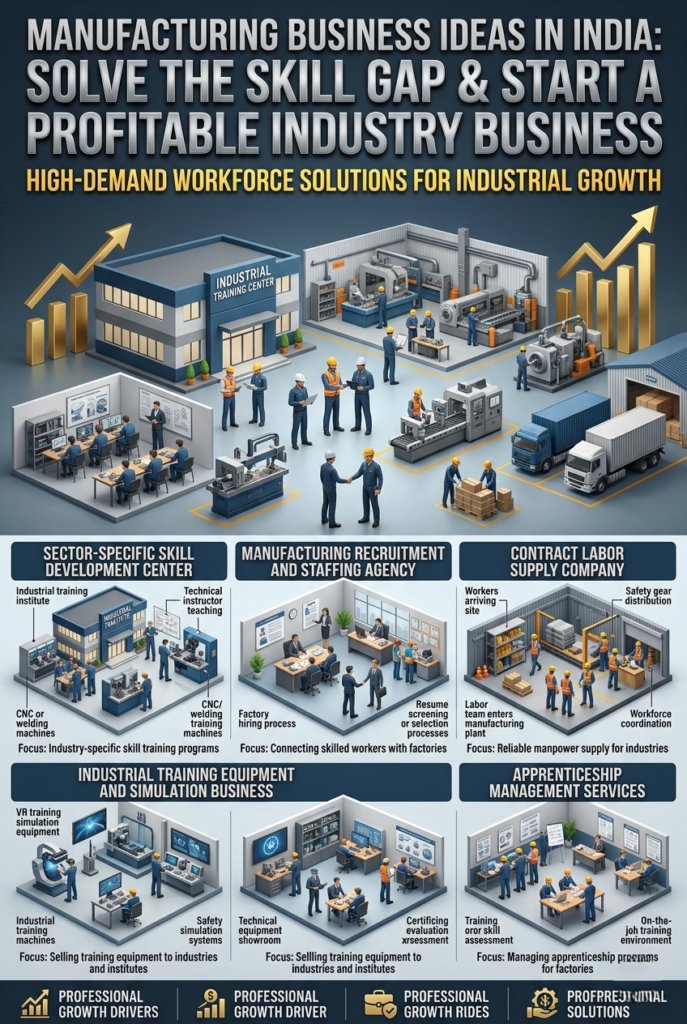
The manufacturing talent gap has opened up many business opportunities with great demand and stable revenue potential. These businesses do not require big investment for starting the business and can be grown gradually.
1. Sector Specific Skill Development Center
A special training center on manufacturing skills is also one of the best business opportunities in this field. Instead of general education, these centers impart practical training as per the needs of the industry.
Common areas of training are:
- CNC machine operation
- Welding and fabrication
- Electrical maintenance
- Industrial safety training
- Quality inspection and testing
Such centers tend to have a high placement rate as employers are more inclined to hire candidates from centers that offer hands-on training.
Read More: Startup Selector
2. Manufacturing Recruitment And Staffing Agency
Manufacturing recruitment agencies currently experience strong demand from employers. Factories choose to outsource hiring because it provides time savings and improves candidate selection.
The staffing agencies typically manage these types of job assignments:
- Machine operators
- Production supervisors
- Maintenance technicians
- Quality control inspectors
- Industrial engineers
Staffing agencies develop recurring revenue streams through their client networks, which generate placement and workforce contract income.
3. Contract Labor Supply Company
Contract labor supply companies: Contract labor supply companies provide temporary workers to manufacturing units. These businesses are responsible for managing the workforce and ensuring compliance with labor regulations.
Their responsibilities typically include:
- Worker recruitment and deployment
- Payroll processing, wage management
- Attendance tracking and reporting
- Insurance and safety conformity
- Legal documentation and record maintenance
This business model is attractive in that it does not require a relatively low infrastructure investment.
4. Industrial Training Equipment And Simulation Business
Training equipment is important in developing skills. Factories and Institutes for training require practical tools to help educate workers on how to operate machines safely and efficiently.
Examples of products included in this segment are:
- Welding simulators
- Electrical training panels
- Machine operation models
- Safety training kits
- Industrial maintenance tools
Entrepreneurs in this area can provide equipment for the domestic and international market.
5. Apprenticeship Management Services
Many small and medium-sized enterprises are interested in taking on apprentices, but find government procedures complicated. A service company can make it easier by handling registration, documentation and compliance requirements.
This business model works well as it creates recurring monthly revenue and long-term client relationships.
Government Support to Skill Development Businesses
The Indian government is a great supporter of businesses that have a role in job creation and skill development. Entrepreneurs in this sector can access multiple programs that provide financial assistance and operational resources.
Some of the most important government initiatives are:
- Pradhan Mantri Kaushal Vikas Yojna (PMKVY)
- National Apprenticeship Promotion Scheme (NAPS).
- Startup India Registration
- MSME Subsidy Schemes
- Skill India Mission
The programs will assist businesses with their initial expenses while helping them achieve long-term operational success.
Why the Manufacturing Workforce Sector Is Long Term Stable
The demand for skilled workers to work in manufacturing is expected to increase steadily for many years. Industrial growth, infrastructure development and exports will continue to bring an increase in workforce demands.
This sector has a number of advantages for entrepreneurs:
- Continuous need for skilled labor
- Strong government support
- Low risk of market decline
- Opportunities in the urban and rural areas
- High potential for business expansion
Because manufacturing is crucial to economic development, workforce-related businesses are likely to be relevant for decades.
Steps to Get Your Manufacturing Workforce Business Started
Starting a business in this sector requires careful planning and an understanding of the industry needs in the local area. Entrepreneurs must first study the industrial areas around them and find out which skills are deficient.
The basic procedure generally includes:
- Choosing a business model
- Conducting market research
- Registering the business legally
- Building partnerships with factories
- Hiring of qualified staff or trainers
- Undertaking marketing and outreach activities
Following these steps is helpful to decrease risk and increase long-term success.
Conclusion: How to Convert The Talent Gap Into A Business Opportunity
India’s manufacturing sector experiences rapid growth, yet skilled labor shortages present a major obstacle. This gap is an ideal opportunity for entrepreneurs to establish businesses that can aid the growth of the industry while providing a steady income.
Companies offering training, staffing, and workforce solutions will be pivotal to the future of manufacturing. With huge government support and an ever-increasing demand for skilled labor, this is one of the most promising business opportunities in India.
Entrepreneurs who take the initiative and invest in quality services can create successful and scalable businesses within this burgeoning industry.
Frequently Asked Questions (FAQ)
Q1. what’s the minimum investment needed to start a training center for manufacturing?
The small training center needs an investment range which typically requires between Rs 30 lakhs and Rs 60 lakhs. The larger institutes with advanced equipment charge fees which depend on their infrastructure and course offerings that range from Rs 1.5 crores to 4 crores.
Q2. Is manufacturing staffing a profitable business?
Yes, it is possible for the manufacturing staffing business to turn a profit in six to nine months if the company can establish good rapport with several clients as well as maintaining quality of services.
Q3. Can this business be initiated in small cities?
Yes, small cities and industrial towns are often very good, as operating costs are lower and there is a high demand for a skilled worker.
Q4. And how long does it take for this business to grow?
Most businesses in this sector become even in the first year. Significant growth is generally seen within twelve to twenty-four months with steady demand and client relationships.


