


Introduction: Manufacturing Business Ideas
The Indian manufacturing industry is experiencing rapid growth due to increased domestic demand and government support for micro and small enterprises and expanding international markets. Initiatives like Make in India and various MSME schemes are motivating entrepreneurs to set up manufacturing businesses that can develop the industrial ecosystem of the country.
The MSME sector plays a very important role in terms of contribution to GDP, employment generation as well as exports in India. For new entrepreneurs, it is important to select the appropriate manufacturing sector for long-term profitability and scalability.
An investment range of Rs. 1.25 – Rs. The ideal capital requirement for establishing a small to mid-sized manufacturing facility amounts to 1.5 Crore. This level of capital enables entrepreneurs to install modern machinery, uphold quality standards and create efficient systems for production that can compete in both the domestic and global market.
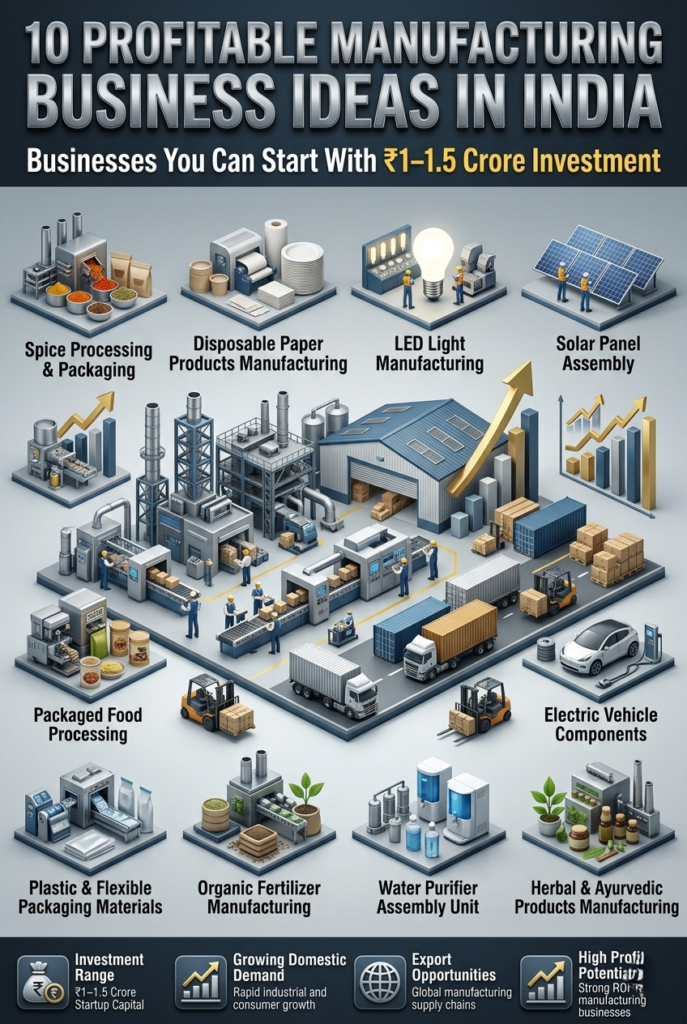
The manufacturing industries currently experience strong growth because of existing market demand and supply deficiencies together with shifting customer buying habits. The following business ideas are promising business opportunities for entrepreneurs who wish to enter the manufacturing business.
Table of Contents
ToggleRead More: Handbook on Spices, Seasonings and Condiments Processing, Extraction with Kitchen Spices Manufacturing
1. Premium Spice Processing and Packaging
India holds the position of being the world largest producer and exporter of spices. Products like turmeric, chili, coriander and blended masalas have wide application in domestic and international markets. However, a large percentage of spices is still being exported in raw condition, which means that there is huge growth potential for the value-added processing segment.
Modern consumers prefer packaged and branded spices as they guarantee hygiene, uniform flavour and increased shelf life. As a result, the demand for processed spices is still growing in supermarkets, restaurants, and the export market.
A mid-scale spice processing unit can be created with some investment of about Rs. 1.3 crores. The fundamental production system establishes basic requirements for implementation:
- Cleaning and roasting machinery
- Grinding and pulverizing machines
- Blending systems for mixtures of spices
- Automatic packaging and labelling machines
Entrepreneurs have the ability to distribute their products through three different sales channels which include retail distributors and online marketplaces and export markets.
2. Precision Fasteners and Engineering Components Manufacturing
The engineering and automotive industries have heavy duties in the requirement of precision components like bolts, nuts, and threaded fasteners. As India’s infrastructure and automobile sectors are growing, there is a steady increase in the demand for good quality engineering components.
Many big companies outsource the production of such components to MSME manufactures. This provides a great opportunity for entrepreneurs who can offer products that are of high quality.
A manufacturing unit in this sector usually needs to have CNC machines, threading machines, as well as quality testing machines. Companies in the construction industry, automobile manufacturing and industrial machinery often buy these components in bulk, ensuring a steady demand.
3. Flexible Packaging Manufacturers
Flexible packaging is one of the fastest growing packaging segments. It is widely used in foods processing, pharmaceuticals, cosmetics, and packaging of consumer products.
Products like laminated pouches, sachets and multi-layer packaging films are in high demand as they offer protection to products and increase shelf life. Many small and medium food manufacturers rely on packaging suppliers to design their tailored packaging for their products.
A flexible packaging unit can be set up with an investment of around 1.4 crore. The production process normally entails:
- Lamination of plastic films
- Pouch making and sealing
- Welding operations Slitting and cutting operations
- Printing & branding of packaging materials
Since almost all products need to be packaged, this is a long-term stable sector.
4. Ready-to-Eat and Ready-to-Cook Food Manufacture
Changing lifestyles and urbanization have boosted the demand for easy-to-eat food options. Consumers are requesting meals that are easy to prepare but also provide traditional taste and quality.
Ready-to-eat and ready-to-cook food products like instant curries, packaged dal, soups and frozen snacks have thus gained tremendous popularity in India.
A mid-scale manufacturing facility can be established with pieces of equipment such as retort processing machines, packaging units and refrigeration systems. Businesses in this sector can provide products to supermarkets, online grocery platforms, catering companies and institutional buyers.
5. Water Treatment Chemical Manufacturing
The requirement for water treatment has become essential for industrial facilities and residential buildings and municipal government operations. Organizations are building water treatment systems because environmental regulations have become more rigid.
Water treatment chemicals serve the purpose of purification which leads to enhanced water quality results. The typical product lineup consists of:
- Coagulants – used for removal of suspended particles
- Flocculants – to help settle impurities
- Polymer blends for industrial treatment systems
A blending and packaging facility requires only a basic financial commitment to establish operations. The regular chemical usage by industries creates a business model which secures both repeat customer contact and extended supply agreement business.
6. Non-Woven Fabric and PPE Production
Non-woven fabrics are extensively applied to healthcare and hygiene products such as medical masks, surgical gowns, protective covers and filtration materials. Demand for these products has been on a high since some years, because of increasing healthcare awareness.
A small manufacturing facility may take the non-woven fabric and convert it into end products for hospitals, labs and industrial users. This type of business can be kept relatively small in terms of its workforce while still being capable of producing high volumes of disposable protective products.
Hospitals and government healthcare departments are frequently buying products from PPE manufacturers, which provides steady demand for the manufacturers.
7. Manufacturing of leather Goods
On the world market, India is one of the largest producers of leather and leather products. The country exports a wide range of items including handbags, belts, wallets and fashion accessories.
The market continues to accept new manufacturers who develop modern products although the industry already has established strong market presence. Premium leather accessories are particularly popular among urban consumers and also among international buyers.
The leather goods manufacturing facility requires equipment which includes cutting machines and stitching machines and finishing machines and packaging machines. Entrepreneurs who build their business around product quality and brand identity can distribute their products through retail stores and online platforms and export markets.
Read More: Project Reports & Profiles
8. Modular Component Manufacturing of Furniture
Urban housing and commercial infrastructure projects have generated a good demand for modular furniture. Offices, Apartments, Co-living Spaces: Modular furniture is used in such places as it is space-efficient and easy to install.
Furniture manufacturers often farm out the production of precision-cut panels and components to specialized manufacturers. A manufacturing unit which has CNC’s and panel cutting machines can manufacture components used in wardrobe, kitchen cabinets and office furniture.
By supplying the interior designers, furniture brands, and construction companies, such businesses can create a steady demand.
9. Manufacture of Organic Fertilizer and Bio-Stimulants
Organic farming practices continue to increase in popularity among farmers who work in India’s agricultural industry which is essential to the country’s economy development. Organic fertilizers and plant growth stimulants have become popular among farmers because these products help to improve soil health and increase crop yields.
The production process of organic fertilizers requires combining natural raw materials with micronutrients to produce formulations that provide essential nutrients to plants. A small scale of production, which includes mixing tanks and drying equipment and product packaging equipment, can fulfil the increasing needs of agricultural markets.
Fertilizer dealers and agricultural cooperatives serve as distribution channels which enable businesses to access farmers located in multiple regions.
10. Eco Friendly packing manufacturing
Businesses need to develop sustainable packaging solutions because environmental issues and government regulations demand such solutions. The market now uses bamboo straws and biodegradable containers and jute bags to replace single-use plastic products.
Eco-friendly packaging has become a major trend in the hospitality sector because restaurants hotels and cafes use it to minimize their environmental effects.
A manufacturing unit of this sector may include machines to cut, form and shape natural materials. Businesses can sell these products to restaurants, retail stores, and export markets where there is a constantly growing demand for sustainable products.
Conclusion
India is an open pot full of business opportunities for an entrepreneur to get into manufacturing industry. With an investment of 1.25 – 1.5 crores it is possible to set up a modern production facility, which is able to provide quality products to the domestic and international markets.
Sectors such as spice processing, packaging manufacturing, engineering components, organic fertilizer and eco-friendly products are experiencing high growth in demand. Entrepreneurs that focus on quality, innovation and efficient supply chain can build successful manufacturing businesses with long term potential.
Frequently Asked Questions (FAQs)
What is the manufacturing business that can be started with 1.5 Crore rupee in India?
A number of businesses can be started in this range of investment, which include spice processing, flexible packaging manufacturing, precision fasteners manufacturing and manufacturing of modular furniture components.
How profitable are medium scale manufacturing business?
Profitability is determined by the efficiency of production processes, the needs of the market, and the distribution networks. Many manufacturing businesses are generating a steady profit in three to five years.
Are manufacturing businesses required to have licenses in India?
Yes, most of the manufacturing units require registrations like GST registration, pollution control approval, industries like food processing require FSSAI, etc.
Have MSME manufacturing units the ability to export products?
Yes, there are a number of small and medium units of manufacturing which export products to all over the world. With the appropriate quality certifications and export documentation, entrepreneurs have the opportunity to enter the global market.
Does the government Favor Manufacturing startups?
The Indian government provides various MSME schemes like financial support, subsidies, technology support and export promotions schemes for manufacturing entrepreneurship.


