


The manufacturing cycles do not change due to slogans, but change when there is a change in three factors- policy intent, supply-chain economics, and buyer behavior. That’s exactly what India’s Union Budget 2026–27 signals for a set of high-value industrial segments that were earlier considered “too strategic” or “too capital-heavy” for new entrepreneurs: electronics components, the semiconductor ecosystem, rare earth permanent magnets, container manufacturing business ideas and dedicated chemical parks.
What makes this moment commercially interesting is not just the announcement of sector schemes, but the supporting reform layer around customs facilitation, bonded-zone manufacturing enablement, and import–export process easing. In plain feasibility language: the Budget is trying to reduce friction costs that typically kill first-generation manufacturing projects—uncertain lead times, compliance complexity, and costly equipment imports—while simultaneously creating domestic demand pull through strategic sector prioritisation.
For founders and MSME planners, the bigger opportunity is not “enter manufacturing.” The real opportunity is to enter the right slice of manufacturing—where margin logic is sound, scalability is visible, and risk is manageable with disciplined project design.
Why “Why Now” Matters More Than “What to Manufacture”
Before we talk products, it’s important to understand the timing. The Budget’s narrative is built around sustained growth, fiscal discipline, reduced import dependencies, and a strong thrust on domestic manufacturing capacity. Alongside that, it explicitly highlights strategic and frontier sector manufacturing initiatives such as an Electronics Components Manufacturing Scheme, India Semiconductor Mission (ISM) 2.0, a Scheme for Rare Earth Permanent Magnets (research, mining, processing, and manufacturing), a Scheme for Container Manufacturing, and three dedicated chemical parks to enhance domestic production.
That is a classic ecosystem signal. When policy supports the full chain—from input processing to finished components—private capital becomes less hesitant, anchor buyers become more willing to onboard new suppliers, and supply-chain localisation becomes a boardroom-level priority. This is how “new entrant” industries become feasible.
The Incentive Layer Entrepreneurs Should Actually Pay Attention To
Many entrepreneurs read incentives as a subsidy checklist. Serious promoters read them as a cost-of-capital and time-to-market reducer. The Budget includes a set of measures that, when combined, can materially change project viability:
- A five-year income tax exemption for non-residents providing capital goods, equipment, or tooling to a toll manufacturer in a bonded zone—this improves the attractiveness of global supply partnerships for Indian manufacturing setups.
- Safe harbour provision for non-residents for component warehousing in bonded warehouses—critical for electronics and precision parts where inventory planning is sensitive.
- Deferred duty payment window to trusted manufacturers, and risk-system recognition for regular importers with longstanding supply chains—this reduces working capital lock-up and clearance uncertainty.
- Export cargo using electronic sealing to be cleared from factory to ship—improves export reliability and reduces logistics friction.
- A special one-time measure allowing eligible SEZ units to sell into the domestic tariff area at concessional duty rates—useful for capacity balancing and early cash flow stabilisation.
- Targeted customs duty exemptions on specified parts for manufacturing segments (such as certain appliances and aircraft components), which reflects a broader direction: reduce input costs for priority manufacturing.
These are not “headline incentives.” They are the operational levers that determine whether your plant ramps up smoothly or bleeds money for a year.
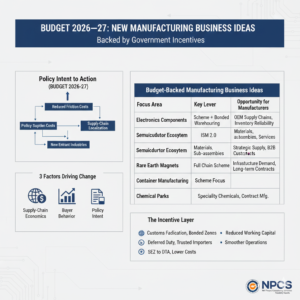
Table: Budget-Backed Manufacturing business ideas
| Focus Area | Budget-backed lever | What it unlocks for a new manufacturer | Practical “why now” |
| Electronics components | Electronics Components Manufacturing Scheme + bonded warehousing safe harbour | Faster integration into OEM supply chains; inventory reliability | Local sourcing push + import friction reduction |
| Semiconductor ecosystem | India Semiconductor Mission (ISM) 2.0 | Demand for materials, sub-assemblies, tooling, and services | Semiconductor value chain needs thousands of suppliers |
| Rare earth magnets | Scheme for Rare Earth Permanent Magnets (research to manufacturing) | Strategic supply-chain entry with sticky B2B customers | Global supply disruption is forcing localisation |
| Container manufacturing | Scheme for Container Manufacturing | Infrastructure-driven demand; long-term procurement visibility | Logistics and trade expansion increases container needs |
| Chemical parks | Three dedicated chemical parks | Plug-and-play industrial infrastructure + clustering advantage | Domestic production capability is being prioritised |
1) Electronics Components: Manufacture What OEMs Can’t Source Reliably
Electronics is no longer just about assembly. The money is increasingly in components, sub-assemblies, and precision parts—the items that control reliability, warranty rates, and supply continuity. The Budget’s electronics components push is best read as an invitation to build a deep supplier base: connectors, PCBs and sub-assemblies, power modules, enclosures, thermal management parts, cable harnesses, and precision plastics.
From a profitability lens, electronics components reward enterprises that control three variables: rejection rates, cycle time, and repeat orders. If your process capability is strong, customers don’t switch suppliers casually—especially when qualification cycles are long. The bonded warehouse safe-harbour direction matters here because components are often imported initially and localised progressively; reducing warehousing and duty friction directly improves working capital efficiency.
Founder logic: don’t chase “everything electronics.” Choose one segment where you can win on quality and delivery, then scale horizontally into adjacent components.
2) Semiconductor Ecosystem: The MSME Opportunity Is Not the Fab—It’s the Surrounding Universe
Most first-generation entrepreneurs get intimidated by semiconductor manufacturing because they picture fabrication plants. That’s not where MSMEs enter. MSMEs enter through the surrounding ecosystem: precision machining, cleanroom consumables, specialty gases and chemical handling systems, packaging materials, test sockets, thermal interface materials, tool-room fixtures, ESD-safe components, and controlled-environment logistics.
ISM 2.0 is a demand-creation engine for this supplier universe. In feasibility terms, this ecosystem has two attractive characteristics: high switching costs (once qualified) and long procurement horizons (buyers plan capacity years ahead). The risk is compliance discipline—documentation, traceability, and consistent quality are not optional.
Founder logic: build a “qualification-first” plan. Your first win is not revenue; it is approval. After approval, revenue becomes repeatable.
3) Rare Earth Permanent Magnets- A Strategic Manufacturing Bet with Multiple Entry Points
Rare earth magnets have moved from a hidden component to a strategic input for EVs and defence systems. Global supply concentration has made buyers anxious which changes the supplier landscape- assurance-of-supply becomes as valuable as price.
The Budget’s rare earth magnet scheme spans research, mining, processing, and manufacturing, signalling an end-to-end capability build. For new entrepreneurs, the entry points are not limited to mining. There are viable models in alloy/powder processing, sintered magnet manufacturing, machining and coating, and component-level magnet assemblies for motors and actuators.
Profitability pattern- margins improve dramatically when you move from commodity materials to specification-controlled products. The defensibility rises further when you supply assemblies rather than just magnets.
4) Container Manufacturing: The Infrastructure-Linked Manufacturing Play
Container manufacturing is often misunderstood as a “metal box” business. In reality, it’s a standards-driven, procurement-heavy, infrastructure-linked product line where long-term demand can be visible if you align with logistics corridors, ports, and large fleet operators.
A scheme focus on container manufacturing indicates an intent to build domestic capacity and reduce import reliance. For MSMEs, the opportunity can be approached in tiers: full container manufacturing for strong-capital players, and component supply for others—corner castings, doors and locking gear, flooring systems, coatings, and repair/refurb services.
Founder logic: build a model around predictable contracts and quality compliance. This is less a retail business and more a B2B procurement discipline business.
Read Also: Steel Shipping Containers Manufacturing in India
5) Chemical Parks: The Quiet Accelerator for Speciality Manufacturing
Dedicated chemical parks are not just real estate announcements. They are a manufacturing risk reducer because they typically improve access to common infrastructure—utilities, effluent handling ecosystem, logistics, and a clustering effect that lowers operating friction.
The Budget’s emphasis on three dedicated chemical parks connects to a larger intent: enhance domestic production in chemicals while strengthening industrial competitiveness. For entrepreneurs, the high-potential plays are in specialty intermediates, performance chemicals, formulations, and contract manufacturing where customers pay for reliability and compliance.
Profitability pattern: specialities outperform commodities when you control specification and secure stable offtake arrangements.
Read Our Books: The Complete Technology Book on Chemical Industries
Lessons from India’s Industrial Leaders: The Decision Logic That Scales
Baba Kalyani- Promoter of Bharat Forge created an international corporation through the skill of achieving sophisticated manufacturing and constant upgrading ability. The lesson to the new manufacturers: find the segment at which increasing complexity is your moat, not your burden.
Mukesh Ambani- Promoter of Reliance Industries climbed up by backward integration and dominating over essential inputs. MSMEs do not require mega-scale, but they ought to emulate the idea: make the suppliers more dependent on them by means of collaborations and gradual associations.
N.R. Narayana Murthy- Co founder of Infosys proved that the governance and transparency lower the cost of capital. In the business of manufacturing, that means clean financial systems, discipline in compliance and audit preparedness, particularly when you need institutional finance or strategic partners.
Where NPCS Fits Naturally in This New Manufacturing Wave
The largest failure mode in these segments is not ambition- it is bad feasibility discipline, the demand is overestimated, the compliance cost is underestimated, inappropriate product mix, and unrealistic ramp-up assumptions. That is where formal project appraisal comes in handy.
Niir Project Consultancy Services (NPCS) is a professional consultancy firm offering services with respect to preparing Market Survey cum Detailed Techno-Economic Feasibility Reports (DPRs) that are intended to be used in establishing new industries or businesses. Our reports contain elaborate manufacturing processes, market research and market analysis, process flowcharts, product mix and capacity planning, machine and material information and total project financials, including profitability analysis. We aim to assist entrepreneurs in considering the feasibility and long term scalability prior to making an investment.
FAQ
What is the best industry in which a first-generation entrepreneur can work?
Electronics sub-assemblies and components may be the most agreeable place to start with the MSME, and where magnets and speciality chemicals may be effective, where you have excellent technical partners and compliance discipline.
Which of these large themes should I select to manufacture?
Begin with buyer pain: what are OEMs finding difficult to source reliably? Then confirm demand through offtake conversations and qualification schedules.
Will I require export markets in the very beginning?
Not necessarily. Early operations can be stabilised through a strong domestic customer base. Exports get favorable when quality systems are developed and the risk of rejection is managed.
What do these industries have as the highest hidden costs?
Failure to meet quality and delay in ramping up. Rejections, rework and slow approvals have a way of destroying the early cash flows more than interests.
What is the real effect of incentives on the viability of projects?
They decrease the friction-import duty load, warehousing risk, lock-up working capital, export process delays, all members of your ramp-up will be easier and more productive use of your capital.


