



Operation Greens 2.0: Every year, India cultivates a large number of fruits and vegetables. Harvesting these crops poses particular challenges and, without developing advanced systems, a large percentage will be wasted. The significant loss of income impacts farmers’ livelihoods and Hopper Losses.
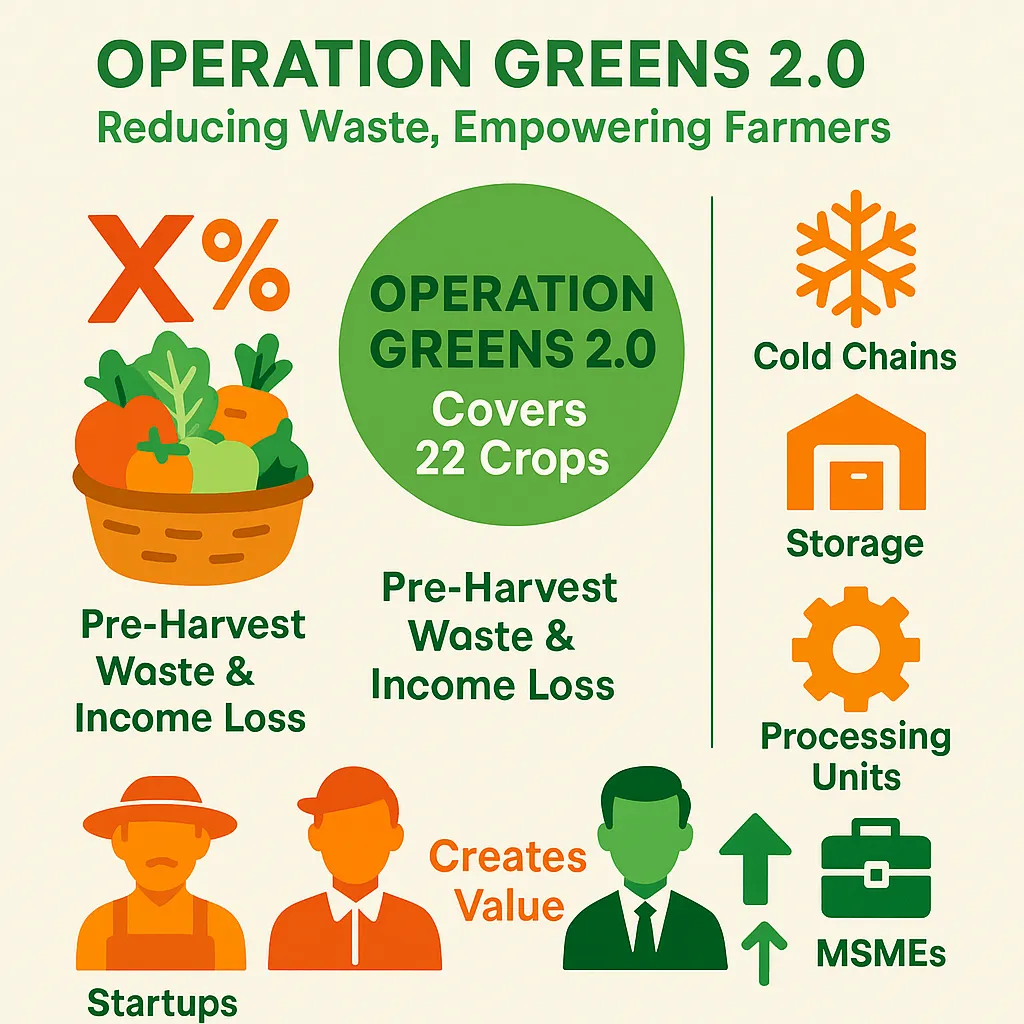
Operation Greens 2.0 sets out to address these challenges. The program cultivates crops to develop perishables into profitable value chains. The program covers twenty-two crops and provides financial support to create cold chains, storage, and processing units. Perishable crops create immense value for start-ups and MSMEs.
Read Our Project Report: Click Here
What Defines Greens 2.0?
Operation Greens 1.0 was focused on deriving value for only tomatoes, onions, and potatoes. Version 2.0 covers 22 perishables. The Ministry of Food Processing Industries provides a 50% and above subsidy to build cold storages, ripening chambers, and primary processing centers. These benefits offer the potential to new enterprises to expand and grow more rapidly(Operation Greens 2.0).
The Perishables of the Scheme
Apples, bananas, mangoes, oranges, onions, tomatoes, potatoes, and the perishables cauliflowers and leafy greens. During harvest, transport, and storage, a large portion of these perishables and vegetables are wasted. The schemes set objectives to create a more stable value chain to enhance farmer earnings and for the processors to realize a margin for profit.
Read More: Fruits & Vegetables Powder Manufacturing Business
Value Chain Development: A New Area for New Businesses
Operation Greens 2.0 seeks to promote the development of value chains within the country focusing on integrated cold chains, pack houses, processing facilities, and farm to market transport. Start-ups can provide logistics tech, digital solutions, quality control, and processing. There is potential for development of a long term business for within this value chain.
Increased FPOs Support-Operation Greens 2.0
Farmer Producer Organizations are meant to assist low scale farmers in the collective marketing of their produce. Within the schemes there is capacity building and financial support to these members. Start-ups have the potential to partner with these FPOs to provide and set traceability standards and control for crop quality. This collaboration will lower costs while improving efficiencies.
Post Harvest Infrastructure Support
The facilities within the scheme provide a 50% subsidy on cold chains, storage facilities, ripening chambers, and primary processing centers. This is a great way to lower the initial capital outlay for these MSMEs(Operation Greens 2.0). There is a potential focus for entrepreneurs to target the more niche areas such as berries, leafy vegetables and other high value fruits. This is vital for the establishment of a premium supply chain that ensures increased profit margins.
Mapping India’s Import–Export Space
India exported USD 46.43 billion of agri-food products in 2023–24 of which over 23 percent was contributed by processed food. Processed foods also touched USD 5.34 billion in imports. Startups can supply high quality processed foods and also export mango pulp, frozen vegetables, spices, and dehydrated fruits.
Key Startup Opportunities Under Operation Greens 2.0
Cold Chain as a Service
Startups can offer subscription based cold storage and transport which can assist FPOs and small processors to store small batches at a lower cost.
Mobile Processing Units
Mobile units assist farmers in grading, sorting, and packing crops at the farm gate which reduces losses and increases the produce value.
Ready-to-Eat Products-Operation Greens 2.0
Surplus crops can be processed into frozen mixes, purees, dehydrated snacks, and instant meal packs, along with which processing cost can be subsidized.
Export Units for High-Value Crops
There is a high demand for products like mango pulp, frozen slices of berries, and spice extracts which are in high-value crops. Export oriented units can gain better margins.
Digital Market Linkage Platforms-Operation Greens 2.0
Startups can offer FPOs and cold chain actors digital platforms to assist in market linkage with retailers which can improve price discovery and minimize wastage.
Read More: A Complete Guide to Starting a Food Business with Government Support
What NPCS Does for Entrepreneurs
NPCS does operational & scale economic feasibility studies. These studies analyze Market Survey, Process Flow, Inputs (Raw materials, Machine), and Finances. It helps the economic risk and profitability assessment prior to starting the business for the founders.
Success Caselets in MSME Sector
- In Maharashtra, a cold chain start-up has a subscription model and is managing 500 tons a month.
- In Uttar Pradesh, a women’s unit processes tomatoes into purees and pastes.
- In South India, a unit collaborates with NIFTEM to supply dehydrated vegetables to the Middle Eastern countries.
- These cases reflect the potential of small businesses if fostered properly.
Important Gov. Sites
- Ministry of Food Processing Industries (MoFPI)
- Nivesh Bandhu Investor Portal
- PMFME Scheme Portal
- PLI Scheme Portal for Food Processing
These sites provide information on the policies, incentives, and the projects that are in place.
Read More: Food Processing Startup Financing in India
Action Plan For The Start-Up Founders
- Identify commodities that have high wastage and high volatility in prices.
- Collaborate with FPOs to create a supply and traceability for it.
- Make use of the subsidies for setup of cold chain and processing.
- Diversify into value-added or RTE products.
- NPCS assistance is recommended for feasibility and financial forecasting.
Read Our Book: Click Here
How NPCs Work For You
At NPCS, they help you step-by-step when you want to get started with a Project under Operation Greens 2.0. NPCS handles scheming minutiae with regard to feasibility on market demand, raw materials, machinery, and total cost of the project. NPCS also helps with respect to which subsidies are available, paperwork and others of a technical nature. This helps you to lower expenses, organize the appropriate capacity, and develop a fundamental value chain with FPOs. You also receive help in planning for exports, standards for the product, and strategies for growth over time.
Find the Best Idea for Yourself With our Startup Selector Tool
Conclusion-Operation Greens 2.0
In the agribusiness industry in India, Operation Greens 2.0 is a huge opportunity. The scheme minimizes waste, assists our farmers, and enables our new businesses to create value chains that are economically rewarding. The industry is open to new ideas for processed food. With large subsidies and strong market demand for processed food, the industry is open to new ideas(Operation Greens 2.0).
Those entrepreneurs willing to take the next steps will be rewarded with the ability to adapt rapidly to changes in demand and be able to reach the global market. They will have the ability to meet the demand of other countries rapidly although they will have to be prepared to meet the demand of their own country.
FAQS-Operation Greens 2.0
1.How can NPCS help me to start a project Undertaking Operation Greens 2.0?
A.NPCS assists you in obtaining the appropriate paperwork and technical requirements. This helps you reduce risk, plan the right capacity, and build a strong value chain with FPOs.
2.Does NPCS prepare DPRs for cold chain and processing units?
A.Yes. NPCS prepares complete DPRs with piecemeal machining and financing.
3.Can NPCS help me understand subsidies under the scheme?
A.NPCS walks you through the rules, eligibility, and documents needed to apply for subsidies.
4.How does NPCS support work with FPOs?
A.NPCS assists you with the designing of sourcing strategies, and the quality systems, and supply chains with FPOs.
5.Can NPCS guide me on export opportunities?
A.Certainly. NPCS aids you in determining the export market and the sustained units needed for the accessible global demand.


