


PCPIR chemical manufacturing India
For entrepreneurs and MSMEs who are looking to enter the Indian chemical and petrochemical manufacturing sector, location selection is often the single determining factor for long term profitability. While the machinery, technology and formulation of the product may take the limelight, good investors know that margins in chemical manufacturing are determined far more by feedstock access, logistics efficiency, environmental compliance costs and infrastructure reliability.
This is where Petroleum, Chemical and Petrochemical Investment Regions (PCPIRs) become an obvious competitive edge. Unlike traditional industrial estates, PCPIRs are intended as integrated industrial ecosystems, where chemical manufacturers can not only operate in a connected value chain but also as integrated units.
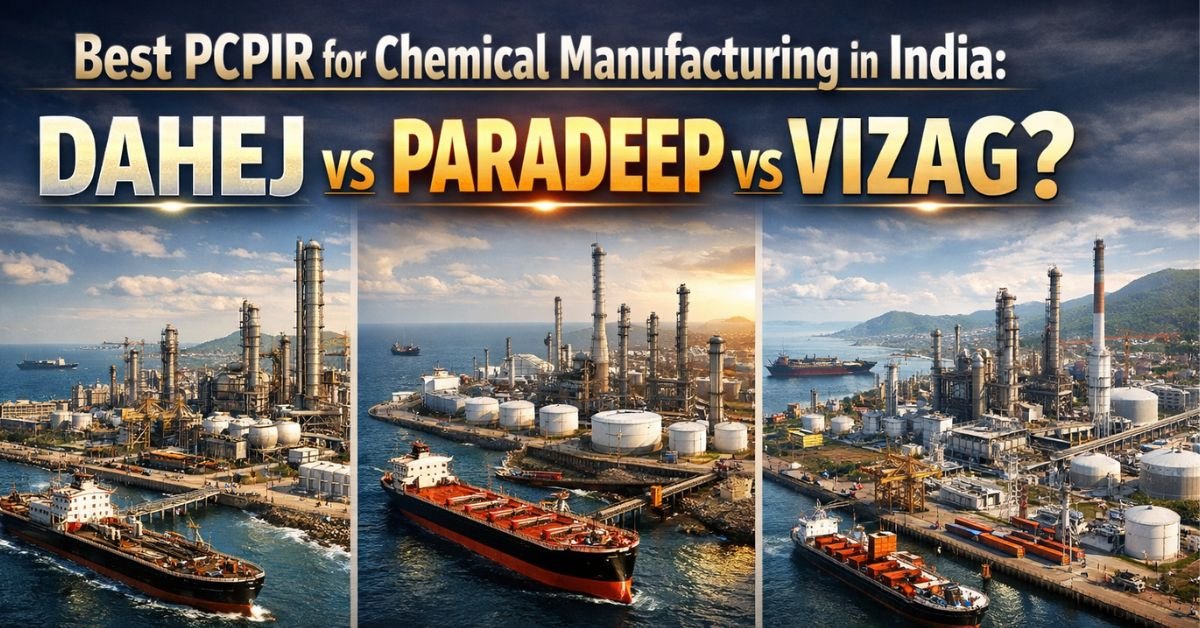
Of all the approved PCPIRs in India, Dahej PCPIR, Paradeep PCPIR and Vizag-Kakinada PCPIR have come out to be the most commercially attractive zones for chemical startups and MSMEs and mid-sized chemical manufacturers.
Table of Contents
ToggleRead More: Detailed Project Profiles On Chemical Industries (Vol II) (2nd Revised Edition)
What Is Structurally Different about PCPIRs From Industrial Parks?
According to India’s Department of Chemicals and Petrochemicals, PCPIRs are large, cluster-based regions, usually spread over 250 square kilometres or more, planned to support the entire lifecycle of petrochemical and chemical manufacturing.
Unlike broken up industrial parks, PCPIRs integrate:
- Upstream Petrochemical Feedstock Sources (Refineries and Crackers)
- Downstream chemical, polymer and specialty units
- Deep-draft ports, rail and national highway
- Common utilities, CETPs and hazardous waste management systems
This integrated structure minimises both execution risk and operating costs, especially for first generation chemical entrepreneurs who may not have legacy supplier networks.(PCPIR chemical manufacturing India)
Comparative Strength Of Top PCPIRs Of India
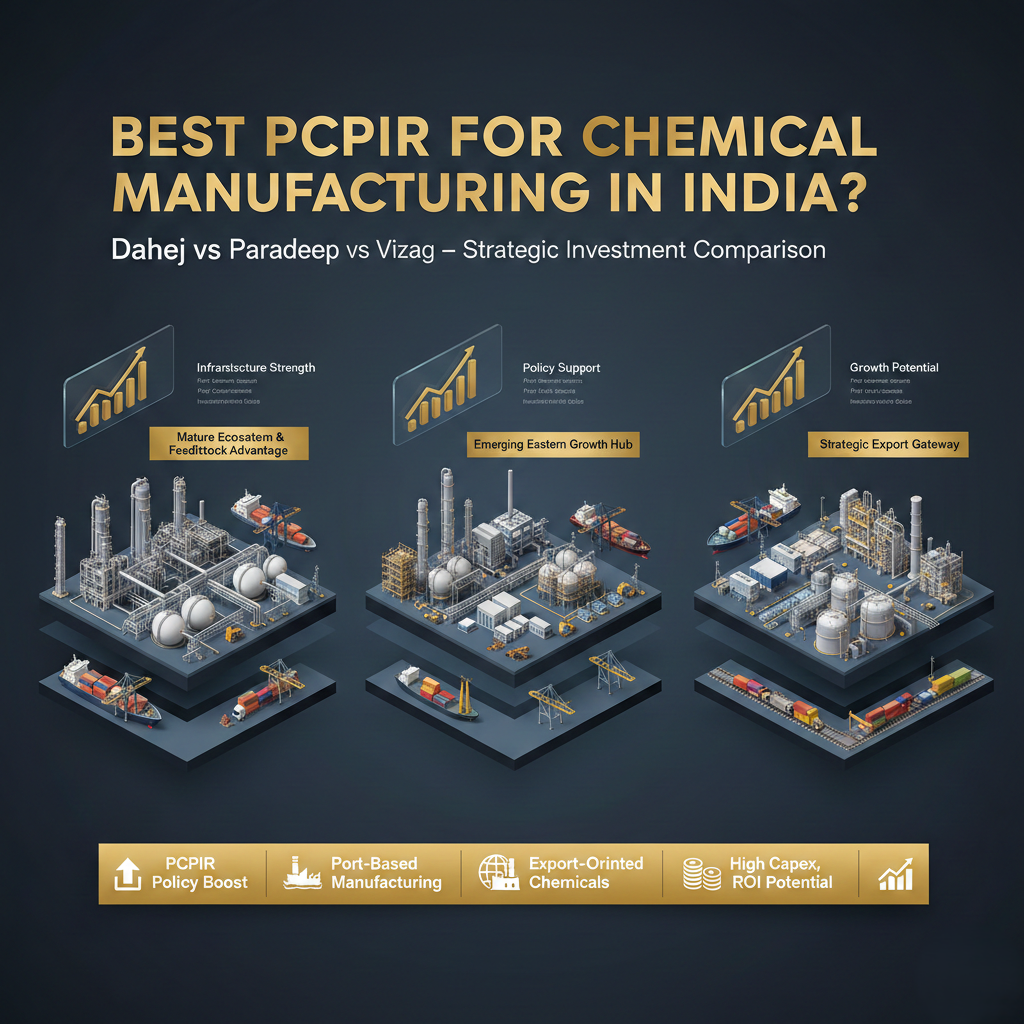
From the point of view of an investor, Dahej, Vizag-Kakinada and Paradeep have different strategic advantages.
- Dahej PCPIR is a measure of ecosystem maturity and minimum start up friction
- Vizag–Kakinada PCPIR offers balanced growth with export scalability
- Paradeep PCPIR offering First Mover Advantages with Lowest Competitive Intensity
It is critical to understand these differences to know which region to choose based on project size, product category, and risk appetite.(PCPIR chemical manufacturing India)
Read More: Modern Technology of Industrial Chemicals
Dahej PCPIR: The Most Established Chemical Manufacturing Hub in India
Dahej PCPIR has become the most developed petrochemical and chemical manufacturing ecosystem in India. Anchored by the large upstream players like ONGC Petro additions Limited (OPaL), the region is blessed with a steady availability of the feedstock for polyethylene and polypropylene.(PCPIR chemical manufacturing India)
The structural advantage of Dahej results from two factors which include direct access to primary resources and its comprehensive supportive network:
- Existing logistics operators and raw material distributors
- Experienced EPC Contractors and Maintenance Service Providers
- Fully functional CETPs and utility corridors
- Availability of skilled technical and managerial manpower
The chemical startups experience two benefits which include faster project completion times and decreased operational risks and easier time to meet compliance requirements. As a result, Dahej is often the lowest risk of entry chemical manufacturers for first-time manufacturers in India.(PCPIR chemical manufacturing India)
Vizag-Kakinada PCPIR: A Balanced Growth and Export Corridor
The Vizag – Kakinada PCPIR is at a strategic middle position between maturity and opportunity. Supported by multiple ports and located close to pharmaceutical product, agrochemical, and specialty chemical clusters, this corridor is ideally suited to chemical intermediates, solvents, and specialty products.(PCPIR chemical manufacturing India)
Compared to Dahej, the level of competitive saturation is lower and infrastructure readiness is continuing to improve. Entrepreneurs who want to build export-focused chemical enterprises that can grow to mid-sized operations should consider Vizag-Kakinada as a location which offers them acceptable levels of risk and reward potential.
The region is particularly good for manufacturers with the Southeast Asian and East Asian export markets in mind because of the eastern seaboard connectivity.(PCPIR chemical manufacturing India)
Read More: Project Reports & Profiles
Paradeep PCPIR: High Potential First Mover Zone
Paradeep PCPIR is anchored by Indian Oil Corporation refinery complex giving good long-term feedstock fundamentals. While down stream development is still in the early stages, total capital investment commitments are already among the highest in India’s PCPIR’s.
Paradeep’s most important advantages include:
- Reduced land acquisition and entry costs
- Reduced competitive density
- Direct linkage to refinery based feedstock streams
For startups that have the appetite to take a medium to long term view, there is a lot of upside potential in Paradeep as the downstream ecosystem matures over the next decade.(PCPIR chemical manufacturing India)
Why PCPIR Based Manufacturing Units are High Return On Investment
One of the greatest cost challenges in the chemical manufacturing industry is feedstock logistics. Outside of PCPIRs, moving olefins, aromatics or polymer intermediates from state to state can add 8-15 percent to raw material prices.
PCPIRs reduce this inefficiency by locating downstream units near refineries and cracker complexes. In addition, all three PCPIRs are in line with deep-draft ports, which facilitate export-oriented manufacturing.(PCPIR chemical manufacturing India)
Another crucial benefit is common environmental infrastructure. PCPIR level CETPs and waste management systems allow startups to:
- Reduce initial environment capital expenditure
- Simplify regulatory compliance
- Achieve higher capacity utilization from the first day
Together, these factors result in much shorter payback periods and better margins in the long-term.(PCPIR chemical manufacturing India)
High ROI Manufacturing Opportunities in Chemical Startups
PCPIRs are particularly well suited for downstream, value-added manufacturing, as opposed to capital-intensive primary petrochemicals.
Major opportunity segments include:
- Polymer Compound and Masterbatch production, especially Dahej
- Chemical intermediates and industrial solvents which are suitable for Dahej and Vizag
- Plastic processing and packaging materials, an msme friendly segment inspired by growth leaders such as Time Techno Plast Ltd
- Refinery linked downstream products in Paradeep, including performance plastics, specialty lubricants and synthetic rubber components
These segments benefit directly from the proximity to feedstock suppliers and PCPIR-level infrastructure.(PCPIR chemical manufacturing India)
Feasibility Planning Importance in PCPIR Investments
The PCPIRs deliver structural benefits to organizations, yet their success and feasibility assessment require accurate assessment through proper planning procedures. Errors in capacity selection, product mix or operating cost assumptions can hurt margins in even the most favorable locations.
Professional feasibility studies should entail:
- Market demanded pricing analysis
- Manufacturing process and technological choice
- Machinery sizing & utility estimation
- Detailed financial projection and break-even analysis
Such planning helps to ensure that the entrepreneurs make the most of the advantages of PCPIR and do not just rely on the location benefits.(PCPIR chemical manufacturing India)
Conclusion
Dahej, Vizag – Kakinada, and Paradeep PCPIRs are an India’s an industrial ecosystem that is the richest in terms of profitability with chemical startups that cater to different investment strategies and risk profiles.
- Dahej provides ecosystem maturity & execution certainty
- Vizag-Kakinada delivers balanced growth with export scalability
- Paradeep- offers first mover advantage and long-term upside
To the chemical entrepreneurs who deploy their product strategy in resonance with the correct PCPIR and back it up with a strong feasibility planning, the regions represent superior ROI, speed and sustainable competitive advantage in the rapidly growing Indian chemical manufacturing landscape.(PCPIR chemical manufacturing India)
Frequently Asked Questions (FAQ)
Which PCPIR is best for first-time chemical entrepreneurs?
Dahej is the lowest risk of execution due to ecosystem maturity, while Paradeep offers higher upside for early entrants over longer terms.
Do PCPIRs help reduce environmental compliance costs?
Yes, access to shared CETPs and waste management facilities significantly lowers initial environmental investment.
Are MSME-scale projects viable in PCPIRs?
Downstream polymer processing, packaging products, and solvent blending units are suitable to be MSMEs.
Can PCPIR-based units target export markets?
Strong port connectivity across the three regions can thus ensure exports at minimum costs.
What is the biggest ROI advantage of PCPIR-based manufacturing?
Integrated feedstock sourcing and shared infrastructure improve margins and shorten payback cycles.


