


Petrochemical Import Substitution
India’s chemical industry is growing at an impressive rate, with output having passed the mark of 15 lakh crore and an annual growth rate of over 11%, according to the ministry of chemicals and fertilizers. Despite this growth, India still imports high performance petrochemical products. For MSME startups, it is a definite business opportunity. Import substitution is not just a policy slogan – it is a market signal waiting to be captured.
While India produces significant volumes of base polymers, olefins and aromatics, dependence on imports remains as buyers are more focused on grade, consistency and documentation rather than volume. This opens up niches for the success of disciplined, quality-focussed MSMEs.
Table of Contents
ToggleRead More: Handbook On Chemical Industries (Alcohol Based)
Why India Continues To Import Petrochemical Products
India’s domestic production is strong in base chemicals, but most buyers are not looking for “volume”-they are looking for specific grades and reliable performance. Industries such as automotive, electronics, textiles, and controlled industries cannot afford to compromise on batch to batch uniformity, levels of impurities, or even the processing behavior.(Petrochemical Import Substitution)
Even when domestic alternatives are available, they tend to fail to meet analytical documentation, performance reliability or regulatory compliance. As a result buyers are willing to pay a premium for imported materials that save downtime, reduce rework and ensure quality compliance.
For MSMEs the most important lesson to take away is that import substitution is not about competing on scale but about reliability and consistency. Small, well-run production units can pocket large margins by filling in gaps that large-scale domestic producers ignore.(Petrochemical Import Substitution)
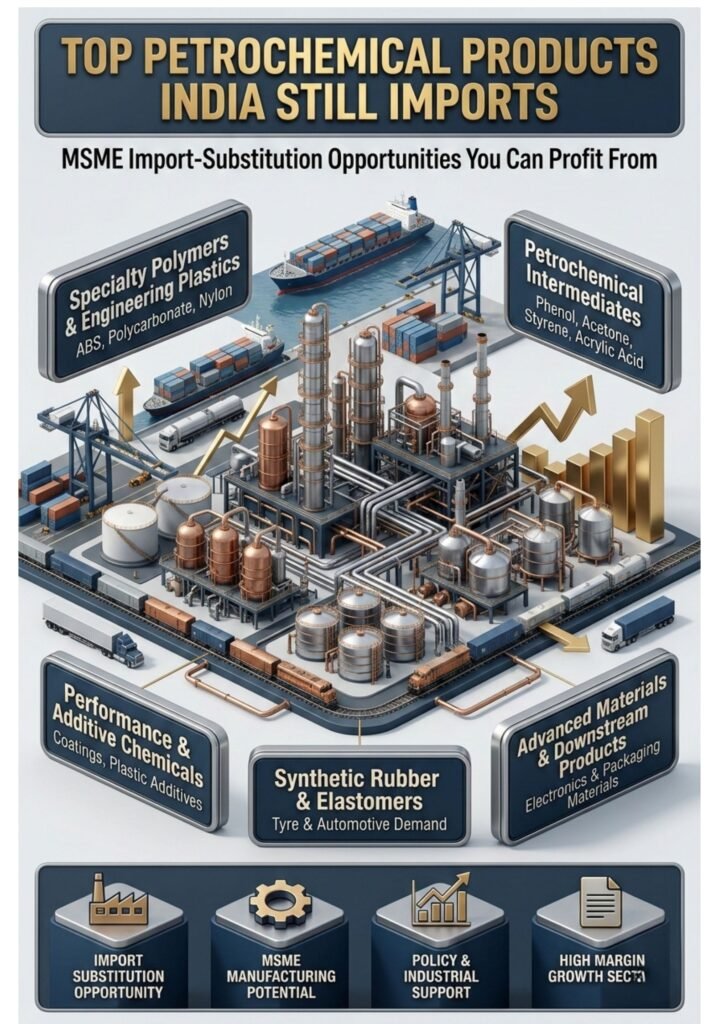
High Potential Import Substitution Opportunities for MSMEs
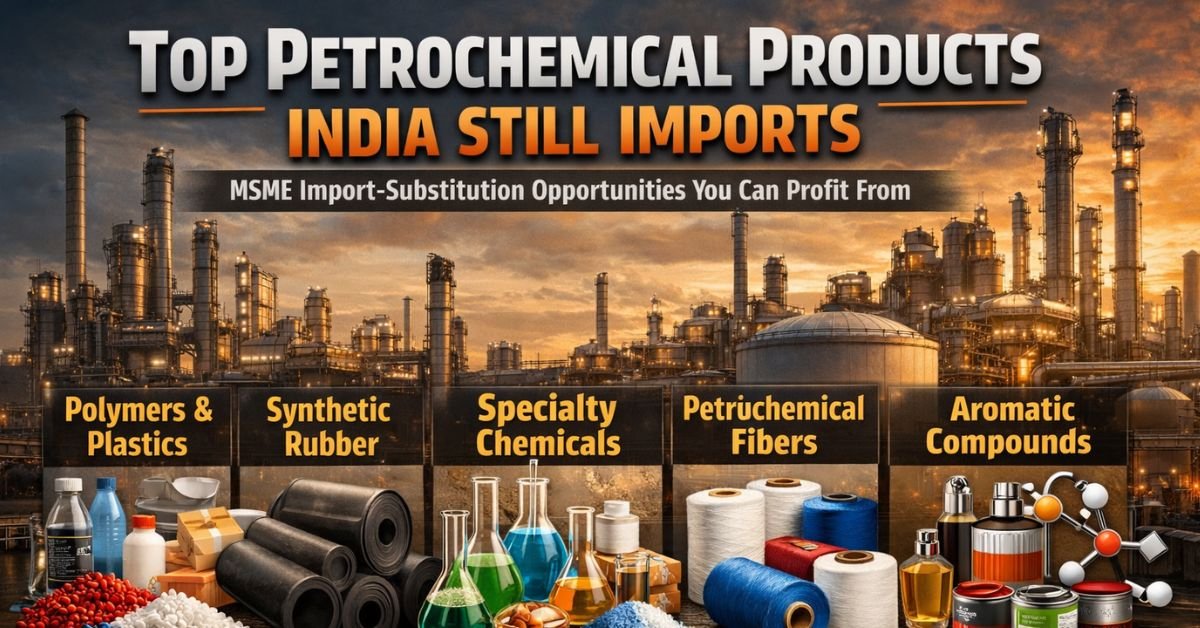
There are still several downstream and specialty segments that are highly import dependent. These areas are perfect for MSMEs as they are value and performance-focused, and not so much on raw material volume.(Petrochemical Import Substitution)
1. Performance Polymer Compounds and Masterbatches
- Examples: Impact modified polymers, flame retardant grades, glass-filled polymers, UV stabilized masterbatch
- Why it works – Buyers pay for traceability of batches and consistency of performance. MSMEs have good lab discipline and process control can easily replace imports.
Read More: Modern Technology of Industrial Chemicals
2. Engineering Plastics Conversion
- Applications Automotive parts, Appliance housings, Industrial fittings
- Opportunity: These products demand for accuracy of dimension, reliability of materials, accurate documentation. Startups can differentiate through consistency and quick turnaround.(Petrochemical Import Substitution)
3. Synthetic Rubber Compounds and Adhesives
- Applications: Automotive parts, industrial seals, regulated industry adhesives.
- Margin driver: Quality of formulation, process control and consistency are more important than volume.
4. Textile Chemicals
- Products: Coatings, binders and auxiliaries for export-oriented textile units.
- The reason for successful operation exists because consistent chemical usage prevents fabric defects which lead to export rejections thus making local chemical supply methods dependable.
5. Specialty Surfactants and Detergent Intermediate
- Applications: The product contains two components which adapt to hard water conditions and contains low odor detergents and maintains controlled foaming agents.
- Advantage: The process generates permanent income streams through repeated customer purchases which happen after customers verify product reliability.
6. Aromatics Downstream Products
- Examples: The industry requires purity-sensitive derivatives which serve as coating materials and electronic components and specialty chemical solutions.
- Critical success factor: Companies need to establish analytical processes together with quality assurance systems to achieve successful replacement of imported products.(Petrochemical Import Substitution)
Read More: Project Reports & Profiles
How MSMEs can Succeed in Import Substitution
The most profitable import substitution ventures are not the most valuable markets – they are segments where the buyer has performance gaps. The market established a strong market entry method which MSMEs can use:
- Target Missing-Grade Products
The process requires organizations to identify products which need import protection because quality gaps exist. Focus on niche applications as opposed to bulk materials.(Petrochemical Import Substitution)
- Invest in In House Testing and Labs
The organization applies its advanced analytical skills to ensure product quality control throughout different production batches while complying with regulations and establishing customer trust.
- Locate Close to Petrochemical Clusters
The strategic locations of Dahej in Gujarat and Visakhapatnam-Kakinada in Andhra Pradesh and Paradeep in Odisha provide businesses with access to feedstock resources and skilled workers and cost-effective transportation.
- Concentrate on Reliability, Not Price
Consumers pay higher delivery fees because they expect their packages to arrive at scheduled times with verified product quality and available technical assistance.
- Take Advantage of Process Discipline and Documentation
The market uses ISO standards together with test certificates and traceable records to create a competitive advantage for MSMEs which face heavy competition from imported products.(Petrochemical Import Substitution)
Lessons Learned from India's Industrial Leaders
Large Indian industrialists have lessons for MSMEs:
- Mukesh Ambani: Focus on value-added steps rather than just raw materials.
- Kumar Mangalam Birla: Sustainable development needs organizations to follow their set rules while they pursue their extended strategic goals.
- Gautam Adani: Business operations can gain a competitive edge through their defense of both infrastructure and logistics systems.
- Karsanbhai Patel: Companies achieve market success through their ability to maintain consistent operations while distributing products efficiently and understanding customer needs.
MSMEs can implement essential business principles through their niche operations which depend on quality and reliability.(Petrochemical Import Substitution)
Conclusion
For MSME startups in India, import substitution in the area of petrochemicals is a real business opportunity. Success is not in on chasing massive volumes but in solving the grade gaps, ensuring reliability and providing documented quality.(Petrochemical Import Substitution)
Key strategies for MSMEs:
- Have a niche, high margin product focus
- Build up strong in-house testing capabilities
- Strategically place them close to petrochemical clusters
- Leverage process discipline and documentation
- Carefully plan working capital to maintain uninterrupted supply
By doing so, MSMEs can turn the import dependency of India into a profitable, scalable manufacturing business, serving the critical domestic demand at a premium margin.(Petrochemical Import Substitution)
Frequently Asked Questions on Petrochemical Import Substitution
Q1: Which petrochemical products have the best import substitution potential?
A: Performance polymer compounds, masterbatches, engineering plastics, synthetic rubber compounds, textile chemical inputs, specialty surfactants and high purity aromatics.
Q2: Why does India still import when there is a tremendous domestic capacity?
A: Buyers are more focused on grade, consistency and documentation. Downtime and quality failures are more expensive than imported materials.
Q3: What is the greatest risk for MSME startups?
A: Assuming automatic switching by buyers. Switching does not occur without consistent proof of reliable supply.
Q4: Is downstream conversion better than raw materials manufacturing?
A: Yes. Conversion is less capital intensive, customer approval time is less, and differentiation is easier.
Q5: How do the industrial clusters benefit MSMEs?
A: The company provides access to essential materials and a skilled workforce and assistance with transportation and industrial ecosystem benefits which reduce hidden expenses and streamline business operations.


