


Polymer manufacturing business
India’s synthetic fibre and polymer manufacturing industry has quietly developed into one of the most reliable industrial opportunity fields for startups and MSMEs. This value chain is different compared to trend-driven sectors because it is core industries such as textiles, packaging, automobiles, infrastructure, electronics, and agriculture.
The existing momentum is strongly aligned with government policy. The Ministry of Chemistry & Fertilizers through the Department of Chemicals & Petrochemicals has clearly indicated that the chemical sector strategy of India is now aimed at domestic value addition, minimisation of import dependence, enhanced quality standards and cluster-based manufacturing.
For entrepreneurs this shift means that opportunity is no longer restricted to large upstream plants. It is in downstream manufacturing, conversion and specialization where MSMEs can effectively compete.(Polymer manufacturing business)
Table of Contents
ToggleRead More: The Complete Technology Book on Polymers with Processing & Applications
Why This Value Chain is Good for New Entrepreneurs
From the point of view of feasibility, the field of synthetic fibre and polymers has advantages that few manufacturing segments can boast.
To begin with, demand is stable in structure. Synthetic fibres and polymers are used on a daily basis in a variety of industries, so offtake is consistent even during economic slowdowns.
Second, you become more profitable as you move downstream. While upstream polymer production is capital-intensive and their margins sensitive, downstream conversion enables the pricing based on performance, quality and application suitability.
Third, entry is flexible. Entrepreneurs can have small capacities to start with and scale up.
Key entry routes include:
- PET recycling and manufacturing pellets
- Polypropylene compounding
- Polyester filament yarn texturizing & twisting
- Engineering plastic moulded components
- PVC pipes, profiles and sheets
This modularity of scalability means that there is much less risk for first-generation founders.(Polymer manufacturing business)
Read More: Polymers and Plastics Technology Handbook
What Production Data Says About Real Opportunities
Government production data indicates where ecosystems are already robust and reliable.
In synthetic fibres, Polyester Filament Yarn is the most popular in terms of production volumes, hence there is an enormous downstream industry to texture, dye, and process specialty yarns. Polyester Staple Fibre continues to serve textiles and nonwovens. Nylon industrial yarn and tyre cord although smaller in volume represent high value industrial applications where long term contracts are more significant than spot pricing. Spandex filament yarn is a premium segment having a good import substitution potential.
For entrepreneurs, the message is clear – where the base production is large, downstream MSME opportunities are naturally multiplied.(Polymer manufacturing business)
Polymer Production and Relevance for MSME
Among polymers, a few materials stand out because of their conversion potential.(Polymer manufacturing business)
Polypropylene has the largest downstream ecosystem in India and provides for industries ranging from automotive to appliance, packaging to consumer goods. PVC is still closely associated with the construction, infrastructure, irrigation, and electrical insulation sectors, which creates a stable and predictable business. Polystyrene fulfils appliances, packaging, and insulation, and PET chips serve as the link between packaging and fibre markets.
For MSMEs, polymers such as PP and PET are attractive, as they create repeat orders for industry as opposed to one-time sales that tend to be volatile.(Polymer manufacturing business)
PCPIRs: Why Location Is a Cost Advantage
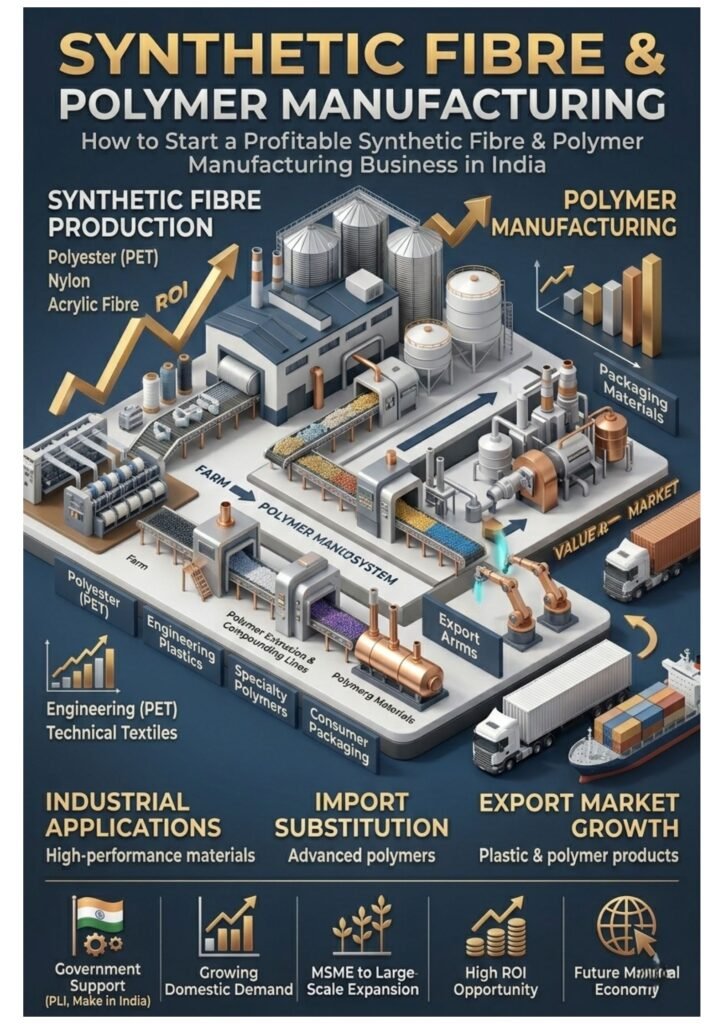
One of the most underestimated factors that determines the success in polymer manufacturing is location. India’s Petroleum, Chemical and Petrochemical Investment Regions (PCPIRs) are intended to develop integrated industrial ecosystems as opposed to isolated factories.(Polymer manufacturing business)
Operating inside or within PCPIR range provides:
- Stable access to raw materials
- Reduced logistics and transport costs:
- Shared effluent treatment and utilities
- Improved regulatory clearances
For the chemical and polymer projects, the strength of the entire ecosystem frequently trumped the advantages of individual plants.(Polymer manufacturing business)
High Feasibility Manufacturing Projects for MSMEs
PET Recycling and Pellet Manufacturing has become a good opportunity because of sustainability regulations and demand for packaging. MSME’s can focus on washing, flake processing, pelletizing, filtration improvements and intrinsic viscosity improvements. Value addition becomes dramatic with movement from flakes to pellets and on to food-grade or textile-grade applications.(Polymer manufacturing business)
Polyester Filament Yarn Conversion is a classic MSME segment. While the large plants function as manufacturing base yarn, the market rewards:
- Texturized yarn
- Specialty denier variants
- Functional and dope dyed yarns
Capacity expansion is modular, so it can be scaled on control.
Nylon Industrial Yarn and Tyre Cord Manufacturing is technically demanding but very stable once the customer approvals are achieved. It is suited for those entrepreneurs who have good technical and quality backgrounds.
Polypropylene Compounding can be said to be the most reliable polymer MSME project. OEMs do not purchase raw PP; they need customized compounds such as impact, glass filled, flame retardant or UV stabilized. This segment is the silent driving force behind import substitution.
Engineering Plastic Components Nylon 6 ABS SAN enables MSME participation in High Margin Precision Manufacturing for Automotive, Electrical and Appliance industries.
PVC Pipes and Profiles remain strong particularly for Tier-2 and Tier-3 markets. While not sexy, there are reliable cash flows to be had in PVC conversion.
Lessons from India's Top Polymer Industry Players
India’s polymer ecosystem has been formed under strategies of long-term thinking.(Polymer manufacturing business)
Mukesh Ambani built dominance by controlling feedstock and integrating downstream in Reliance Industries, thus illustrating the importance of security of supply.
Kumar Mangalam Birla showed the way of disciplined capacity expansion in Aditya Birla Group followed by focus before diversification.
Gautam Adani demonstrated how infrastructure and location strategy at Adani Group can be used to build long-term industrial edge.
Final Takeaway
The synthetic fibre and polymer value chain is not just an industry but a ladder of opportunities. The most successful entrepreneurs begin downstream, emphasize quality and feasibility and scale step by step. When approached with consultant-level planning instead of trend-driven thinking, this is one of the best scalable and realistic manufacturing opportunities for Indian MSMEs these days.(Polymer manufacturing business)
Frequently Asked Questions
Which polymer project is the safest for first time MSMEs?
Polypropylene compounding and downstream polymer conversion efforts tend to be safer because of lower capital intensities and wider markets.
Is synthetic fibre manufacture too capital intensive?
Base fibre plants are costly but texturizing, twisting and specialty processing of yarn are MSME-friendly.
What is the highest risk in polymers manufacturing?
Volatility in the price of raw materials and poor quality control systems.
How should founders decide between PET project, PP project, PVC and nylon projects?
The decision should be based on the local demand, availability of raw material, complexity of compliance and internal technical capability.
Can MSME’s Export Polymer Product?
Yes, if product grades are standardised, batches are consistent and international compliance norms are followed.


