


Potash and Phosphate Business in India
The fertilizer industry in India currently experiences its most essential growth phase. Despite being one of the largest agricultural economies in the world, the country still relies heavily on imported raw materials, such as potash and rock phosphate. This dependence opens both a supply risk and a huge business opportunity for domestic entrepreneurs.
In recent years, the Government of India has made important steps to de-depend upon imports, for example, by classifying fertilizer minerals such as phosphate and potash as critical resources. This shift has had a positive impact on policy support, the simplification of mining auctions, and the private sector to participate. For entrepreneurs looking at long-term industrial opportunities within the national priorities, potash and phosphate projects are starting to present very attractive options.
Unlike the many industries that rely on consumer trends, the demand for fertilizer is tied directly to agriculture, which means a consistent market demand. This makes the sector more stable and amenable to long term investment planning.
India's Fertilizer Mineral Market: Growth in Demands Faster Than Supply
India uses a huge amount of fertilizers annually to maintain the agricultural productivity. However domestic production of fertilizer minerals is limited especially potash. The country depends on fertilizer imports to meet its agricultural needs, which creates two major problems for the market. International price changes and supply interruptions both impact the market.
Phosphorite production is concentrated in a few areas, particularly Rajasthan, which over time has developed a good infrastructure for mining. The existing industrial clusters which have logistics and skilled workers available create business opportunities for new companies to establish their operations.
The demand-supply gap of fertilizer minerals is set to enlarge over the next few years owing to population growth and growing food demands. This trend confirms the business case for domestic production and processing projects.
Why Potash and Phosphate Projects are Becoming Attractive Investments
The fertilizer mineral industry is getting attention due to the structure but not the temporary conditions of the market. Agriculture will always need fertilizers and government programs ensure that farmers have access to these important inputs.
There are several important factors driving investment interest in this sector.
Major Growth Drivers
- Rising need for fertilizers in Agriculture
- Strong government backing of domestic production
- High import dependency creating substitution opportunities
- Stable long term demand from farming sector
- Expansion of mining infrastructure, fertilizer manufacturing infrastructure
These drivers create a favourable environment for entrepreneurs who want to build sustainable industrial businesses.
Another key factor is stability of the policy. In the past, investment in mining and chemical processing industries was discouraged by regulatory delays. Today, better governance and quicker approvals have boosted disclosure and predictability of project planning.
High Potential Business Opportunities in Potash & Phosphate
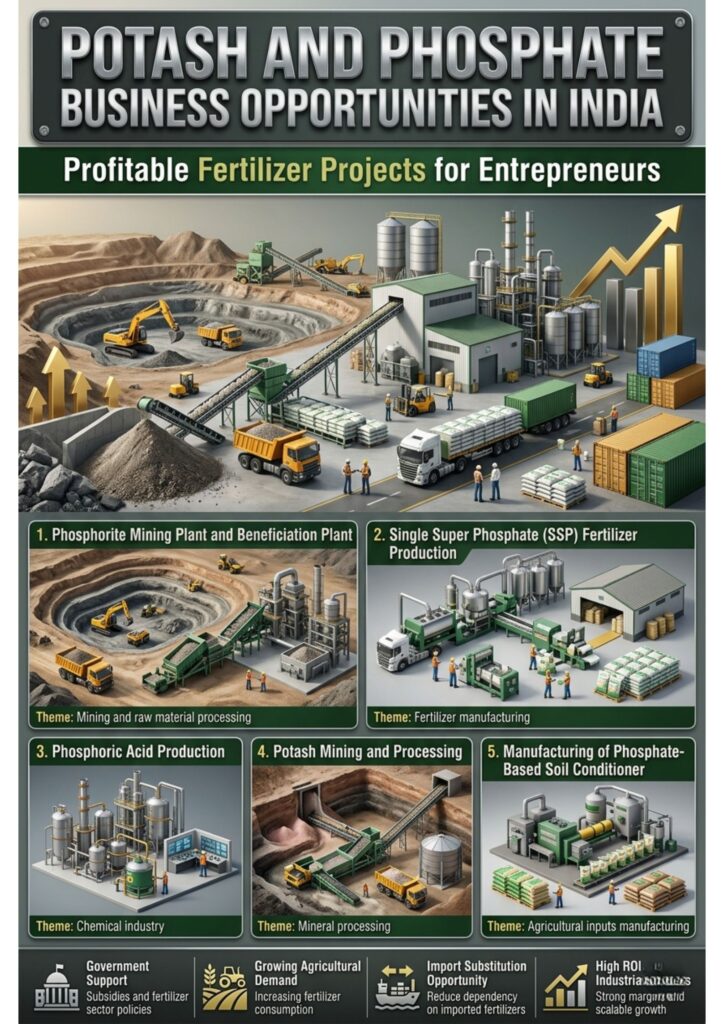
The potash and phosphate sector has a number of areas where investment can be made based on investment capacity and technical expertise. Entrepreneurs can opt for mining, manufacturing, processing or trading models.
1. Phosphorite Mining Plant and Beneficiation Plant
This is a business that involves phosphate ore mining and improvement of the quality of the ore by beneficiation. The process enhances the nutrient level of the mineral that can be used for producing fertilizer.
Mining projects need careful geological assessment and environmental planning but have the potential for long-term revenue generation once operations are underway.
2. Single Super Phosphate (SSP) Fertilizer Production
SSP fertilizer has high usage in agriculture in India, particularly for phosphorus-demanding crops. The technology needed to produce is relatively simple, and the market need is stable throughout rural areas.
Important Benefits of SSP Manufacturing
- Moderate investment requirement
- Established demands in agricultural markets
- Easier distribution through Fertilizer dealers
- Faster project implementation as compared to mining
This makes SSP plants one of the best jumping-off points for medium-scale investors.
Read More: Project Reports & Profiles
3. Phosphoric Acid Production
Phosphoric acid is a key supply to manufacture complex fertilizers like DAP and NPK. The production process requires chemical reactions and specialized equipment, thus capital requirements are higher but so is profit margin.
Industrial groups that have experience in the manufacturing of chemicals often have this as a strategic investment due to the fact that there is a huge demand for it both domestically and for export.
4. Potash Mining and Processing
India has developed a new business opportunity through potash mining because new mineral blocks are being auctioned for commercial use. The first investors who obtain mining rights will receive long-term supply contracts which establish their control over the market.
While the initial capital cost is high, there is also a possibility of high returns considering the high import dependency of potash in India.
5. The Manufacturing of Phosphate Based Soil Conditioner
Soil conditioners are becoming more popular as farmers look to improve soil health and crop productivity. These products improve nutrient availability and benefit sustainable agriculture practices.
This business model does not require as much capital as mining projects do, and it can achieve profitability in a shorter period of time, making it suitable for small and medium enterprise.
Read More: Startup Selector
Investment and Profitability Factors
Before initiating any industrial project, entrepreneurs have to carefully consider the financial feasibility. The potash and phosphate industry entails both capital expenditure and running costs and hence detailed planning is necessary.
Profitability is dependent on a number of factors, such as production efficiency, quality of raw materials and demand on the market place. Companies that integrate several stages of the supply chain often have improved financial performance.
Major Costs in Fertilizer Projects
- Machinery and plant equipment
- Land and infrastructure development
- Raw material procurement
- Labor and operational expenditures
- Transportation and logistics
- Cost of regulatory compliance
Managing these costs effectively is of prime importance to keep the profitability intact.
Working capital management is another important factor. Fertilizer production entails inventory storage and distribution costs, and therefore, businesses must practice good financial discipline to keep their operation running smoothly.
Regulatory Approvals Needed for Potash and Phosphate Projects
Industrial projects in the fertilizer industry must comply with government regulations that govern safety standards and environmental protection methods and product quality requirements. The process of approval requires both documentation and planning but recent process reforms have made it easier to obtain approval while reducing the time needed for approval.
Typical Approvals Needed
Lease contract or industrial license, including:
- Environmental clearance
- Approval from pollution control board
- Factory registration
- Certification of the quality of fertilizers
- Labor and safety compliance
Entrepreneurs who prepare documentation at the beginning will be able to decrease project delays significantly.
Future Prospects of Potash and Phosphate Business in India
The future success of potash and phosphate businesses will depend on the agricultural development rate in India. The increasing population requires us to produce additional food supplies to meet growing demand. The agricultural sector will require fertilizers because they help maintain soil fertility and support crop production.
Government initiatives directed towards reduction of import dependency will continue to aid the domestic production. Infrastructure development and technological advancements will further enhance the efficiency in mining and fertilizer manufacturing operations.
In the next decade, the fertilizer mineral industry of India is projected to be a major element of the Indian industrial and agricultural strategy. Entrepreneurs who capitalize on early investments and efficient operations may have a very substantial competitive advantage.
Conclusion
Potash and phosphate projects are one of the best industrial opportunities in India today. The combination of stable demand, favourable government policies and solid import substitution potential make this sector a favourable one to invest in for the long term.
Businesses that focus on efficient production methods and reliable supply chain systems and meet regulatory requirements will establish sustainable operations in this industry. T The fertilizer mineral sector has become a vital component for India’s economic growth instead of being perceived as a temporary trend.
FAQ
- Is potash and phosphate business profitable in India?
Yes, the business may be profitable because of stable demand for fertilizers, the support of the government, and opportunities for import substitution.
- What is the best entry level business in this sector?
Many entrepreneurs first begin their activities in fertilizer production, soil conditioners, or trading of raw materials because they need less investment than mining.
- Which is the best state for starting a Phosphate project in India?
Rajasthan is believed to be the most appropriate site as it has a large reserve of phosphorite and an established infrastructure for its mining.
- How much money does it take to set up an SSP fertilizer plant?
Investment is usually between Rs 5 crore and Rs 25 crore based on capacity and location.
- What is the demand for fertilizer in India in future?
Demand is likely to rise steadily owing to population growth, higher food needs and agricultural programs of the government.


