


Introduction: PP PE Manufacturing Business India
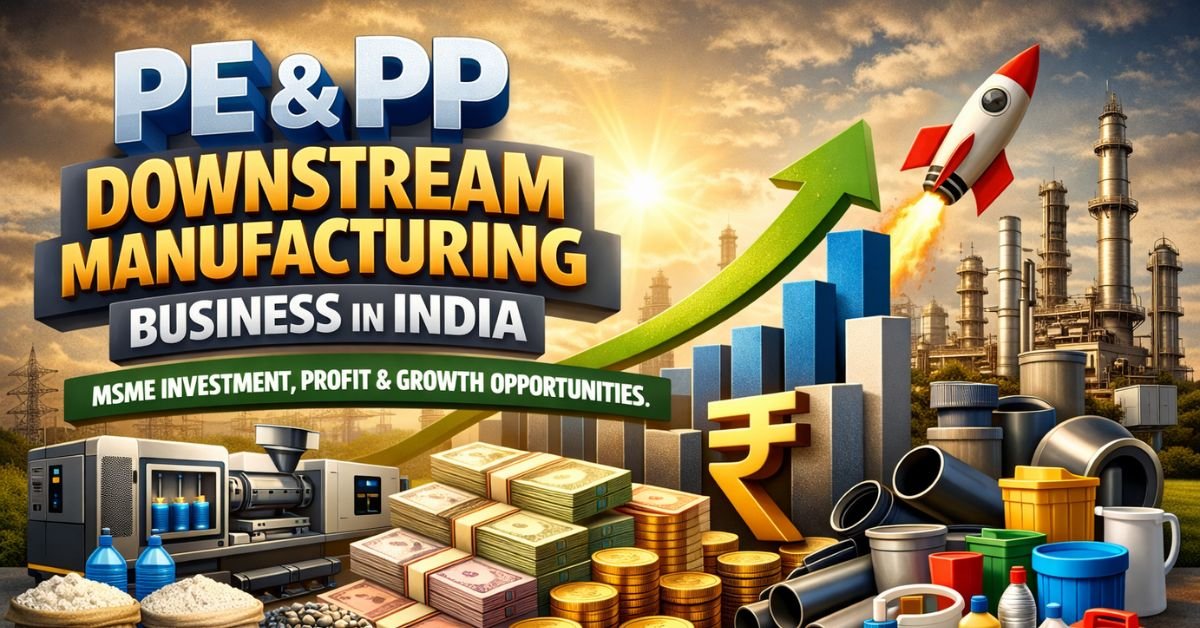
Polyethylene ( PE) and Polypropylene (PP) are the backbone of modern industrial and consumer economy in India. From packaging films to water tanks, to pipes, to automotive parts, to medical disposables, to agriculture applications, these two polyolefins are leading the consumption of plastics in all sectors.
While large upstream petrochemical capacities have been built in India, there remains a large demand-supply mismatch at the downstream and specialty grade level. This gap has paved a good and solid opportunity for Micro, Small and Medium Enterprises (MSMEs) involved in PE and PP processing.
With the policy initiatives like Atmanirbhar Bharat, Plastic Parks, MSME credit guarantee, PCPIR zones, downstream PE and PP manufacturing have emerged as one of the most attractive industrial segments for Indian entrepreneurs.(PP PE Manufacturing Business India)
Increasing Demand for Polyethylene and Polypropylene in India
India’s consumption of plastic per capita is still far lower than the world average but the overall demand has increased steadily in the past decade. Rapid urbanisation, infrastructure growth, growth in organised retail, e-commerce, healthcare and agriculture continue to boost consumption.
Polypropylene demand alone has increased by almost 50 percent in last eight years with the demand coming from packaging, automotive parts, household goods and woven applications. At the same time, there has been a sharp increase in the consumption of HDPE and LLDPE because of:
- Flexible and rigid packaging
- Water storage and piping systems
- Agricultural films and liners
- Industrial containers & logistics packaging
Despite having strong domestic production, India imports over five million tonnes of polymers, and this is mainly to meet demands for consistent quality and specialised grades. This import dependence is a reflection not of a lack of capacity but of a qualitative mismatch between the output upstream and the processing needs downstream – the very areas where MSMEs can provide added value.(PP PE Manufacturing Business India)
Key Players in India Polymer Ecosystem
India’s upstream polymer industry is dominated by a handful of major players who supply a large portion of PE and PP resins to downstream processors.
Reliance Industries Limited is the largest producer of polymers in the country with around 4.4 million tonnes per annum of polyethylene and polypropylene capacity in the Repol and Relene brands.
ONGC Petro additions Limited (OPaL) is a world scale integrated petrochemical complex at Dahej, comprising of a 1.1 MMTPA ethylene cracker and a 0.6 MMTPA propylene unit which has a robust downstream ecosystem in western India.
Other important suppliers are Indian Oil Corporation, Haldia Petrochemicals Limited and GAIL (India) Limited.
Even with these capacities, MSMEs often struggle to access specialty grades, flexible supply terms, or application-specific polymers – this provides opportunity for downstream processing, compounding and product manufacturing.(PP PE Manufacturing Business India)
Read More: Business Plans / Project Profiles
Why PE and PP Downstream Units Are Suitable for MSMEs
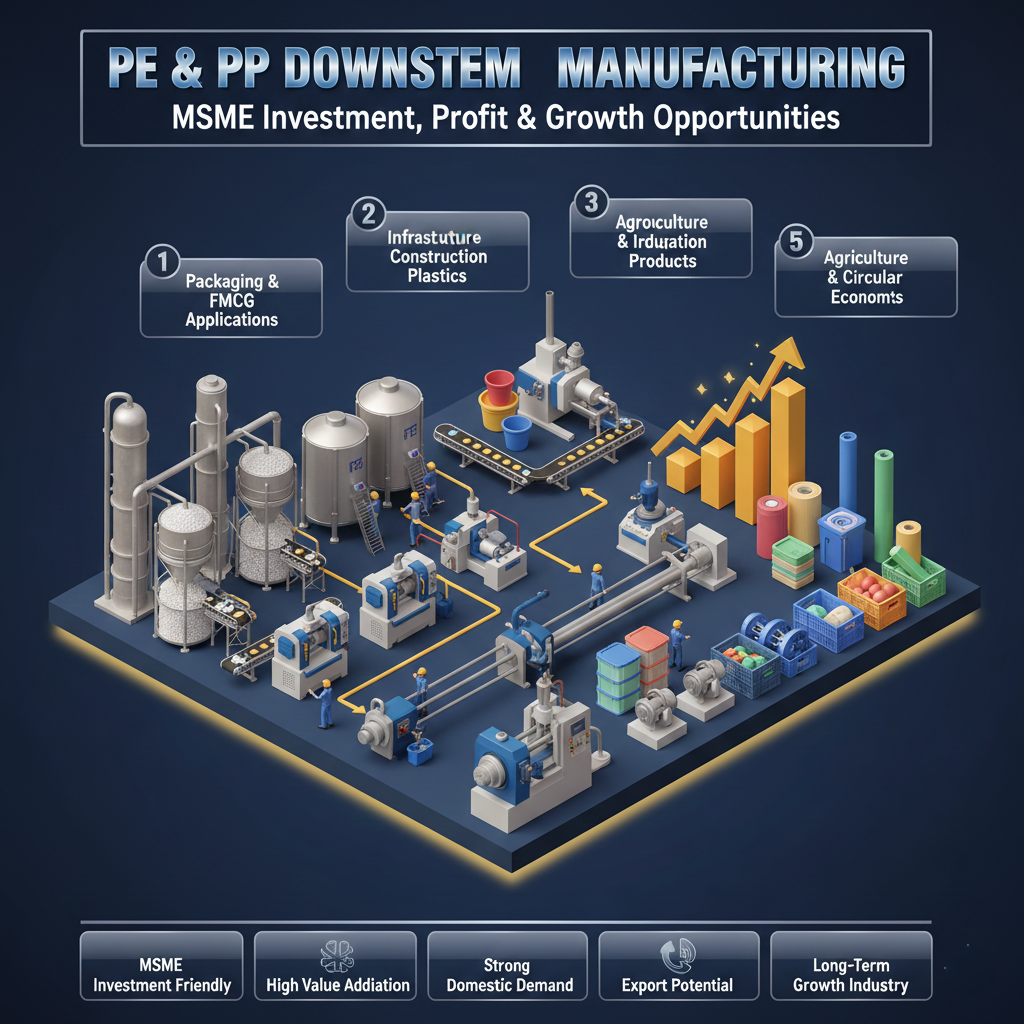
Downstream plastic processing is a rare combination of manageable capital investment, diversified demand and scalable growth. Unlike upstream petrochemicals, units of these can be established more quickly, expanded on a modular basis, and funded using MSME frameworks.
Key advantages include:
- Widespread application base with packaging, infrastructure, FMCG, healthcare, and agriculture
- Moderate costs of projects as compared to heavy industries
- Manpower Availability of domestic machinery and trained manpower
- Typical EBITDA margins of 15 to 20 percent
- Strong policy and financial support through MSME schemes and Plastic Parks
These features make PE and PP downstream units appropriate for both first-time entrepreneurs and existing plastic processors seeking to upgrade and/or diversify.(PP PE Manufacturing Business India)
Opportunity 1: Blow-Moulded Hdpe Water Tank Manufacturing
Blow moulded HDPE Water Tank is one of the most stable and resilient downstream plastic business in India. Demand is driven by:
- Construction and real estate housing
- Urban water supply schemes Rural water supply schemes
- Industrial and commercial storage requirements
- Replacement of ageing tanks
A medium scale unit will usually produce tanks from 500 litres to 10,000 litres using HDPE blow mould grades.(PP PE Manufacturing Business India)
Business strengths:
- Consistent year-round demand
- Strong regional branding potential
- Relatively simple technology
- EBITDA margins of 15–18 percent
Manufacturers have the potential to further increase profitability by introducing multi-layer tanks, UV-stabilised grades, antibacterial linings or customised industrial designs.(PP PE Manufacturing Business India)
Opportunity 2: LLDPE Stretch Film Manufacturing
Stretch film manufacture is one of the fastest growing applications of PE in India. The rapid growth of logistics, ware housing, exports and organized retail has sourced out tremendous demand for high performance stretch films.(PP PE Manufacturing Business India)
These films are made with LLDPE and metallocene LLDPE on cast film extrusion lines and are used for pallet wrapping and load stabilisation extensively.
Reasons why this segment is attractive:
- Higher levels of value addition compared to commodity films
- Strong quality based pricing power
- Growing demand across industries
- EBITDA margins of 18–20 percent with efficient operations
Incorporation of downgauging technology, use of recycled content, and addition of performance additives also fit into sustainability requirements and new regulations.(PP PE Manufacturing Business India)
Read More: Project Reports & Profiles
Investment and Financial Summary
A typical project of MSME-scale PE or PP downstream requires an investment of 10-15 crore rupees, including machinery, utilities, installation and working capital. Returns are therefore dependent on capacity utilisation, product mix and efficiency of operation, but well managed units typically have payback periods of 4-5 years.
Bank financing is easy to access under MSME lending programmes, particularly with the backing of a professional project report and CGTMSE guarantees.(PP PE Manufacturing Business India)
Role of Project Consultancy in the Success of MSME
Many projects in plastic processing fail, not because of weak demand, but because of poor planning and wrong assumptions. Professional project consultancies are important as they:
- Preparing detailed project reports (DPRs)
- Analysing market demand and competition
- Choosing of suitable polymer grades and technology
- Estimating Capital Costs and Operating Margins|
- Improving bank approval success and execution success
A structured and data-based approach takes away a lot of risk and improves sustainability in the long run.(PP PE Manufacturing Business India)
Policy Support & Industrial Ecosystem
The Indian government takes an active interest in promoting downstream plastic processing because of its employment and value addition potential. Key enablers include:
- Shared infrastructure Plastic Parks
- MSME loan schemes and interest subsidy
- CGTMSE credit guarantees
- Capital and power incentives on the state level
Petroleum, Chemicals and Petrochemicals Investment Regions (PCPIRs) like Dahej and Paradip guarantee long-term availability of feedstock and smooth logistics.(PP PE Manufacturing Business India)
Future Outlook of PE and PP Downstream Industry
India’s consumption of plastic is set to almost double by 2030. While recycling, sustainability, and material efficiency will change the way products are designed to a certain extent, PE and PP will continue to dominate because of their versatility and cost-effectiveness.
The demand-supply gap in specialised and application-specific grades is likely to remain and ensure that there will continue to be scope for downstream processors with a focus on quality, efficiency and niche markets.(PP PE Manufacturing Business India)
Conclusion
The PE and PP downstream sector presents one of the best opportunities for manufacturing for MSMEs in India. A growing domestic market, easier imports, and beneficiary government policies leds to a profitable and stable business environment.
Blow moulded water tanks and stretch film manufacture in particular, provide attractive margins with manageable investment and scalable growth. Entrepreneurs that enter this space with the right plan, technology choice and market orientation can create sustainable businesses in line with India’s long-term goals of manufacturing and self-reliance.(PP PE Manufacturing Business India)
Frequently Asked Questions (FAQ)
Is PE and PP downstream manufacturing profitable in India?
Yes. Most well-managed units achieve EBITDA margins of between 15 and 20 per cent.
What is the general investment needed?
MSME-scale projects typically require between Rs. 10-15 crore (both in terms of machinery and working capital).
Why does India import polymers though large domestic capacity?
Imports mainly cover the demand for specialised grades and consistent quality not sufficiently available domestically.
Which downstream segments are growing the fastest?
Stretch films, blow moulded water tanks, HDPE pipes, pharmaceutical packaging, automotive components.
Is there support from the government for plastic MSMEs?
Yes. Through Plastic Parks, MSME loan schemes, CGTMSE guarantee and state incentives.


