


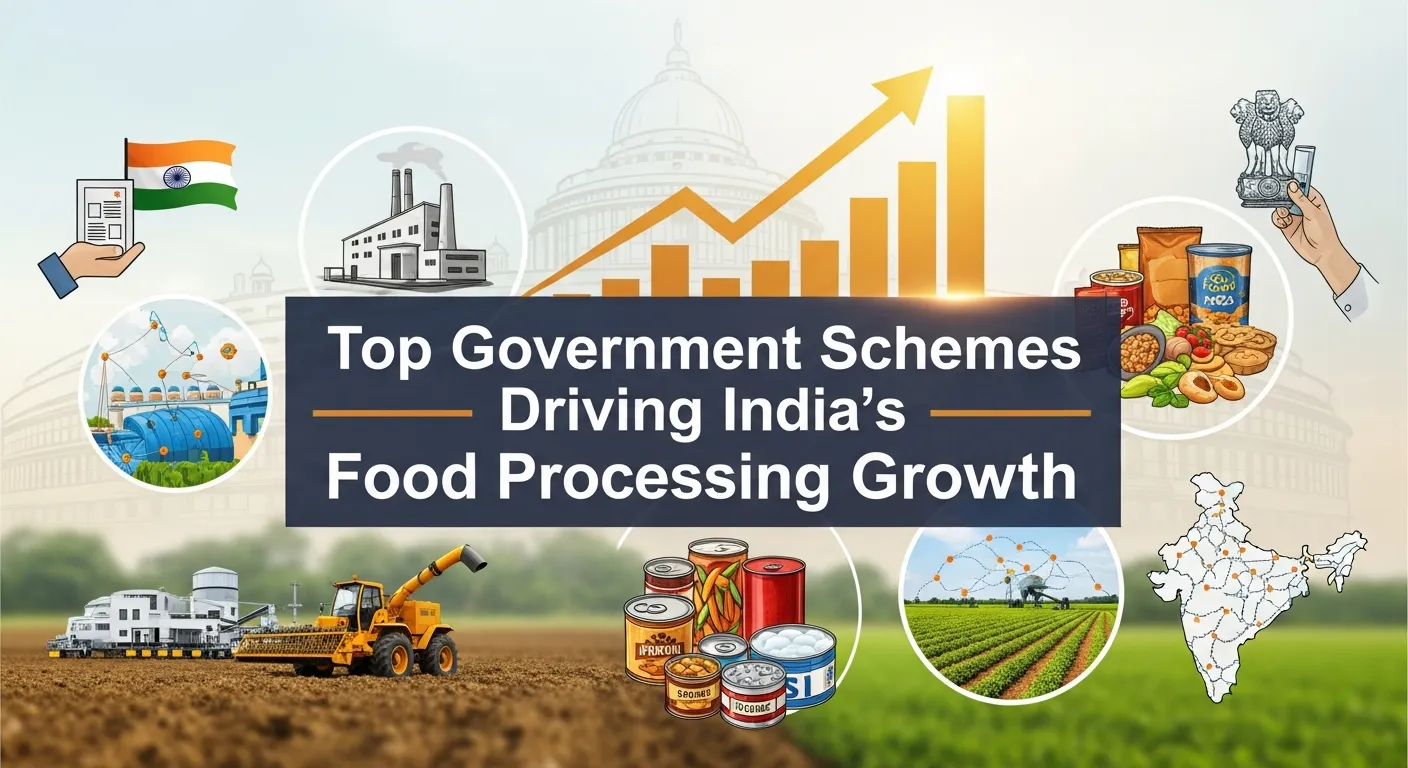
Pradhan Mantri Kisan Sampada Yojana: India has an abundant production of cereals, vegetables, pulses, fruits, and even milk; however, even with such incredible production, the nation is still shackled with high rates of post-harvest losses, low value-added production, and an imbalance in export activities. Based on the MoFPI Annual Report 2024–2025, food processing shows a positive contribution of 7.93 percent and 8.45 percent in the manufacturing GVA and agriculture GVA respectively, while the exports were USD 46.43 B in FY2023–2024.
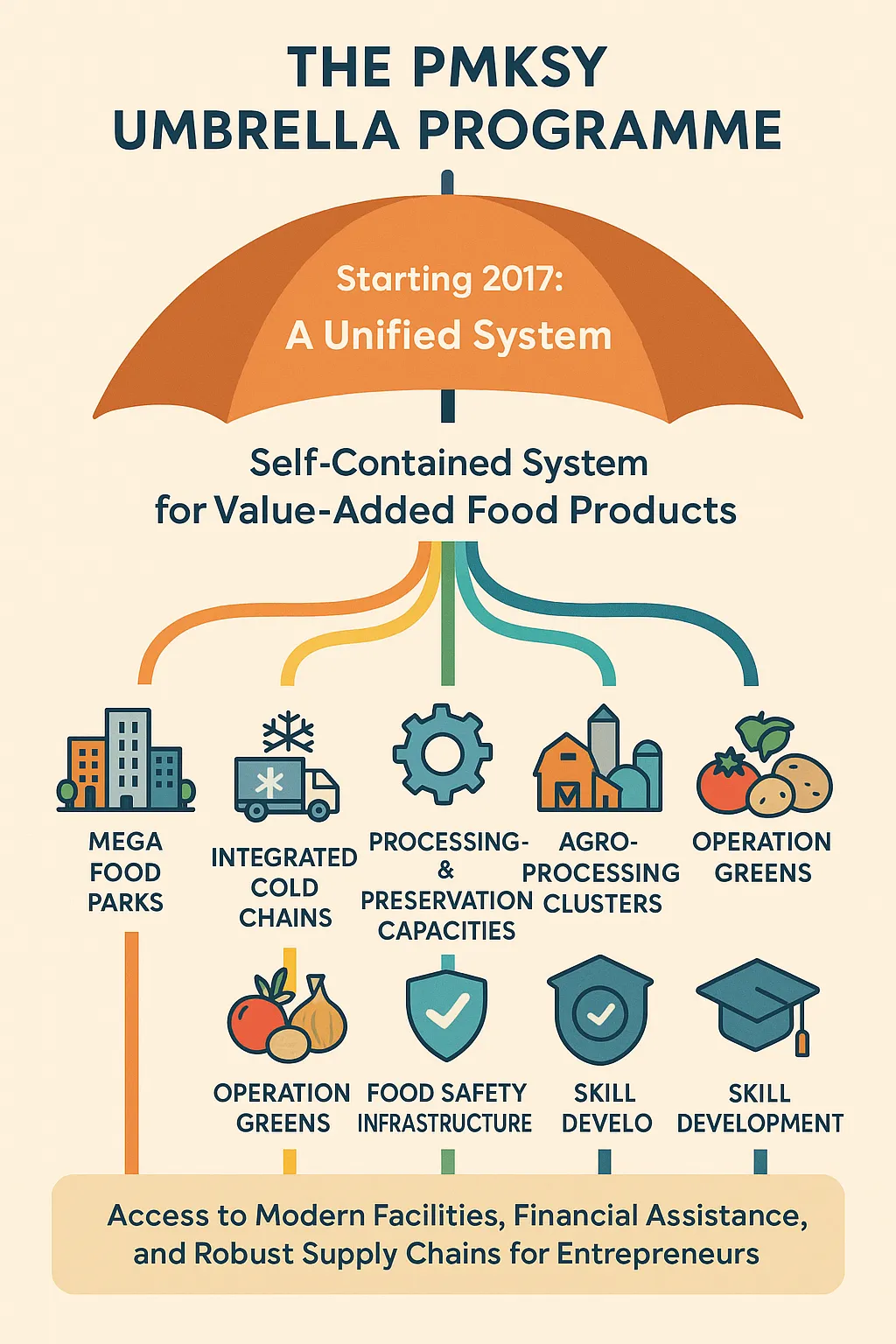
Yet, and as elucidated, the country has its strengths, even with these strengths, 20-25 percent of the produced vegetables and fruits every year are wasted, and as a result, the country incurs significant losses in its economy. This gap in the economy fueled the government to initiate the Pradhan Mantri Kisan Sampada Yojana (PMKSY). The scheme is an umbrella programme as it unifies schemes like the Mega Food Parks, Cold Chains, Agro-Processing Clusters, and Operational Greens(Pradhan Mantri Kisan Sampada Yojana).
The goals of PM Kisan are to construct modern infrastructures, debottleneck wastages, and assist farmers with making India the processing centre of the world. The scheme provides unbounded enterprising opportunities to start-ups to create scalable, profitable, and export-oriented businesses(Pradhan Mantri Kisan Sampada Yojana).
Read More: Top 10 Government Schemes for Food Processing Startups in India
India’s Food Processing Potential-Pradhan Mantri Kisan Sampada Yojana
India had an export value of food products of US $46.43 billion during FY 2023-24. Total imports were USD $31.7 billion within the same fiscal year. The industry employed 22.96 lakh in the registered units and 46.57 lakh in the unincorporated enterprises. On the food processing industry, the FDI in the food processing industry totaled 7.22 billion within the years of 2014 to 2024(Pradhan Mantri Kisan Sampada Yojana).
This portrays a clear contradiction. India imports a scientifically unproportionate amount of processed food given the amount of raw materials the food industry produces. PMKSY provides the opportunity to the entrepreneurs of this industry the access to domestic food processing units to reduce imports and increase exports.
PMKSY: The Umbrella Programme
Starting in 2017, PMKSY consolidates multiple schemes to provide self-contained system. This provides the raw materials needed to provide complete value added food products.
These include Mega Food Parks, Integrated Cold Chains, Food Processing Preservation Capacities, Agro-Processing Clusters, Operation Greens, Food Safety Infrastructure, Skill Development. These components provide the needed access to modern facilities, financial assistance, and robust supply chains needed to the entrepreneurs.
Mega Food Parks: Engines of Growth-Pradhan Mantri Kisan Sampada Yojana-Pradhan Mantri Kisan Sampada Yojana
Concept:
Mega food parks are large, food processing integrated hubs. These include cold chain facilities, storage, warehousing, testing labs, packaging and logistics facilities. These complete infrastructures remove the headache of setting up new industries and reduces the costs of added new facilities.
Read Our Book: Click Here
Progress
As of late 2023, 22 mega food parks have been sanctioned in various states, including Assam, Punjab, Maharashtra, and Tamil Nadu, where most of the primary parks are located. Each park enables the establishment of several multi-layered food processing and agro outlets, as well as the development of new job opportunities and exports.
Entrepreneurial Opportunities-Pradhan Mantri Kisan Sampada Yojana
Opportunities abound in the establishment of juice, ready-to-eat, dairy powder, seafood, and spice processing and beverage concentrate units. Infrastructure is provided at the parks and offered at shared costs which, coupled with the ease of vertical sevelopment and rapid scaling of new companies, facilitates the establishment of new enterprises.
Integrated Cold Chains
Improper storage and transport of perishables result in the annual loss of almost 25% of the vegetables and fruits produced in the country. Cold storage chains are crucial left to preserve the perishables and the food loss in the value chain. Cold storage chains facilitate the movement of perishables, unhindered, from farms to markets, and eventually, to export points(Pradhan Mantri Kisan Sampada Yojana).
Achievements
Under the PMKSY scheme, cold chain facilities have been established with several subsidies, from 35% in general areas to 75% in the north east and hilly states. The scheme has over 298 completed and operational cold chain projects.
Entrepreneurial Opportunities
There are substantial cold storage and transport service opportunities focusing on apples, mangoes, onions, potatoes, and dairy products which are in high demand as export value loss. The same is true for meat and fisheries export where cold chain solutions are for high-value perishables.
Read More: How to Set Up a Profitable Agro Processing Cluster
Agro Processing Clusters
Concept
Agro processing clusters slowly develop around raw materials as the facilities offered become operational. For each developing region, agro processing facilities, or new companies, follow the government’s One District One Product (ODOP) scheme. This has the potential to reduce logistics costs and increase the manufacturing output for the food processing industry in the region supported(Pradhan Mantri Kisan Sampada Yojana).
Demonstrations of cluster development leveraging local resource Mesa Pulses Plant in Uttar Pradesh, spice cluster in Kerala, and pineapple processing unit in Tripura.
Opportunities for Startups-Pradhan Mantri Kisan Sampada Yojana
Food processing businesses can be established based on the development of processing hubs of ODOP crops; development of geo-heritage based regional brands; and production of niche items like extracts of turmeric and cardamom oil(Pradhan Mantri Kisan Sampada Yojana).
Operation Greens: Perishables Stabilization
Objective
Initially targeted for Tomatoes, Onions, and Potatoes (TOP), Operation Greens now encompass all perishables.
Outcomes-Pradhan Mantri Kisan Sampada Yojana
It smothers price fluctuations, provides protective service to processing businesses, and provides safe cover for farmers during overproduction.
Opportunities for Startups
This scheme would be highly beneficial for those processing facilities that are into the production of tomato puree and tomato ketchup, onion flakes and onion powder, potato chips and potato starch, frozen French fries.
Read More: Government Schemes For Food Processing in India
Startups Goldmines: Import-Export Gaps
- India imports edible oil worth US$ 15 billion every year. Cocoa imports are US$ 513 million. Imports in Beverages and in vinegar exceed US$ 1.5 billion. Domestic manufacturing in all these is highly justifiable.
- PMKSY infrastructure enables entry of these startups to the market through the provision of subsidized facilities, and a strong supply chain.
- NABARD Financing Assistance-Pradhan Mantri Kisan Sampada Yojana
- NABARD extends concessional credit for processing of food in the country. This includes food processing facilities in Mega Food Parks, clusters, cold chain, and preservation units. In the Financial year 2023-2024, over ₹800 crore was disbursed.
- The potential risk to the project is lowered due to the lower cost of interest and lengthy financing SMEs are able to access.
Read Our Project Report: Click Here
MSME Success Stories: Learning from India\’s Food Pioneers
LT Foods, Amul, Paper Boat, Everest, and MDH are all companies that diversified and scaled in the food sector due to the processing, branding, and strong supply chains. These derive the lessons that Infrastructure and market access of the supply chains, even MSMEs, can achieve global scale.
NPCS: Guiding Entrepreneurs to Success
NPCS provides entrepreneurs with market survey and project report detailing the manufacturing process, machinery to be used, process flow diagrams, market, and target market, capacity in the market, and financials that are necessary for food processing units to be built profitable under pmksy for NPCS.
Find the Best Idea for Yourself With our Startup Selector Tool
Roadmap for Entrepreneurs Under PMKSY
Entrepreneurs can identify the best suitable product line and from then decide from Mega Food Parks, clusters and/or cold chains to choose from. After that, PMKSY subsidies can be applied for followed by NABARD loans. Compliance on FSSAI and ISO is mandatory. With strong branding and an export plan most, if not all, startups would be able to access global markets. NPCS provides all the necessary support on feasibility and strategies.
PMKSY Concludes: Growth Engine of Food Processing
The Food Processing industry in the country is undergoing rapid development. There is an opportunity for Startups in the industry as the PMKSY scheme provides the access to the needed infrastructure, reductions in wastage, and logistical support to increase exports. The government support and guidance from NPCS will allow entrepreneurs to establish a successful and competitive food processing business globally.
Frequently Asked Questions-Pradhan Mantri Kisan Sampada Yojana
1. What is the objective of PMKSY?
A.The objective of PMKSY is to modernize food processing and infrastructure, while also aiming to reduce losses after the harvest.
2. Which target audience can access the benefits of PMKSY?
A.The target audience PMKSY aims to support are Startups, MSMEs, FPOs, cooperatives and also food processing units that are already established.
3. What percentage of subsidies are offered in PMKSY?
A.The subsidies provided vary from 35 to 75 percent and specifically for the Cold chain projects.
4. How can new enterprises benefit from Mega Food Parks?
A.New enterprises can benefit significantly as Mega Food Parks are established and they help reduce the cost of setting up infrastructure and also in increasing the pace of production.
5. What support can entrepreneurs expect under PMKSY from NPCS?
A.Support provided by NPCS is the development of Feasibility reports, DPRs, Financial and Technical plans along with the design of new processing units.


