



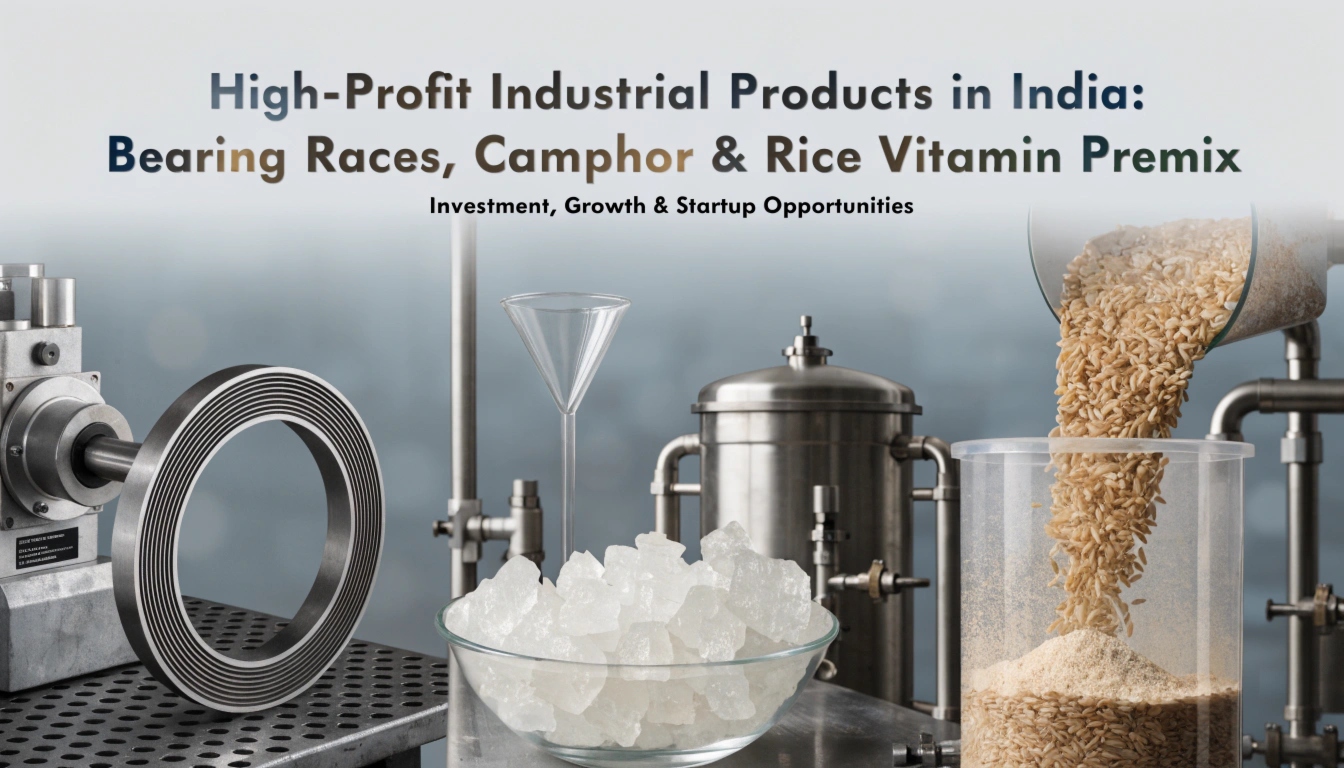
These large upheavals are underway in and of themselves in India’s industrial scenario at present. The combination of increased domestic demand and governmental support and the expansion of MSME enterprises creates optimal conditions for entrepreneurs who want to establish manufacturing businesses. The automotive industry and agricultural sector and healthcare market and consumer goods field drive particular sectors including industrial components and chemical derivatives and nutrition-focused products to achieve strong market growth.
Amongst the myriad of possibilities there are three manufacturing opportunities which are noteworthy for their consistent demand, ease of scalability, and reasonable capital requirement: bearing races (cup-cone race), camphor crystals and rice vitamin premix powder. These products range in industries – engineering, chemicals and food – but all have one thing in common – good domestic and export potential.
Table of Contents
ToggleRead More: Ball Bearing Manufacturing
Bearing Races: Precision Parts for Automotive & Industrial Growth
Bearing races are extremely important mechanical parts that allow balls or rollers in machinery to roll smoothly and with a low friction rate. They are essential in automotive wheel hubs, industrial machinery, agrarian equipment, railways and electric motors. High-quality bearing races are essential for operations that prioritize efficiency and reliability in their execution.
Manufacturing Highlights
The production of bearing races needs two key components which are exact metallurgical work and precise machining methods. The essential process involves three main phases:
- Steel forging or bar cutting
- CNC turning and shaping
- Heat treatment to achieve hardness
- Precision grinding for dimensional accuracy
- Defect elimination through quality inspection
Raw Materials: High carbon chromium steel
Critical Considerations: Metallurgical purity, Dimensional accuracy, Surface hardness
Market Demand
The Indian bearing market expands because of the increasing demand from both the automobile and industrial sectors:
- Automotive: 45% of demand, growth 7–8%
- Industrial machinery: 25% of demand, growth 6%
- Agriculture equipment 15% of demand, growth 8%
- Railways & infrastructure 15% of demand, Growth 7%
The Make in India program provides support to strengthen domestic supply chains. Profit margins are usually between 12% and 20%, depending upon precision and automation.
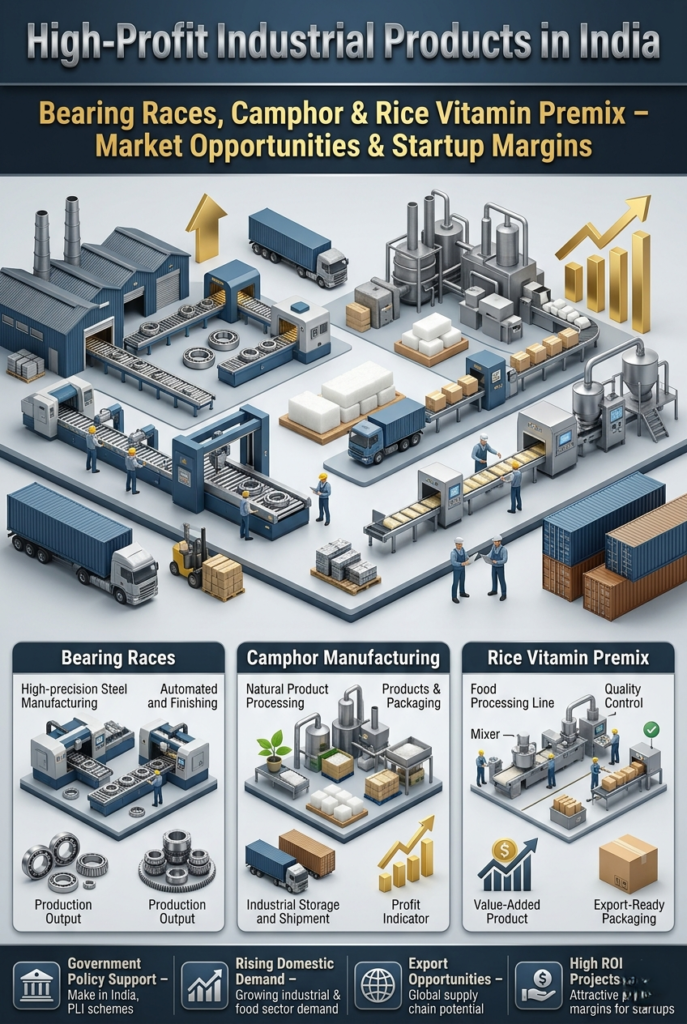
Camphor Crystals: Steady Demand from Cultural & Pharmaceutical
Camphor crystals have a huge demand in India because of religious rituals, traditional medicine and household use. Consistent consumption of camphor is done by temples, households and pharmaceutical companies, with a seasonal spike during festivals such as Diwali and Navratri.
Manufacturing Insights
Modern camphor production is done synthetically, from turpentine oil. The process involves:
- Distillation of Turpentine Oil
- Conversion to camphene
- Oxidation and crystallisation
- formation of tablets or cube using automated machines.
Raw Materials: Turpentine oil, acetic acid, chemical raw materials
Quality Checks: Check crystal formation, fragrance intensity, purity
Read More: Project Reports & Profiles
Market Overview
Camphor consumption in India is very stable:
- Religious use: 60%
- Pharmaceuticals: 20%
- Household & FMCG: 15%
- Industrial applications: 5%
Profit margins in retail packaging are between 18% and 25% and this makes camphor production an attractive option for MSMEs looking to enter the market quickly.
Rice Vitamin Premix Powder: Nutrition-Based Manufacturing
Rice vitamin premix powder is a formulation of essential micronutrients which is used for fortification of rice to tackle the widespread nutritional deficiencies. Fortified rice kernels are added to normal rice, which contains Iron, folic acid, vitamin B12, zinc and vitamin A.
Manufacturing Process
The focus of the production process is on precision blending and quality control:
- Vitamins and mineral bought that are pharmaceutical grade
- Ribbon blenders-make it uniformly mixed
- Quality testing ensures uniform nutrient distribution
- Packaging is done under controlled conditions
Raw Materials: Iron compounds, Vitamin premixed formulations, Stabilizers (food grade), Rice flour carriers
Market Demand
The demand of fortified rice is increasing on account of governmental nutrition programmes and food security programmes. Large buyers include:
- Government food distribution systems
- Nutrition programs and NGOs
- Food processing companies
Margins are between the range of 15% to 22% and the demand is policy-driven, which ensures stability for the manufacturers.
Read More: Startup Selector
Comparative Insights
While camphor provides for rapid entry given the simplicity of technology, rice premix provides for stable growth supported by policy. Bearing races are more capital intensive and require technical skill but can provide long term profitability for if precision and quality are maintained. Many entrepreneurs begin with chemical or food processing products before moving on to precision engineering.
Quick Comparison:
- Bearing Races Medium-high investment, 12-20% margins, industrial cyclical demand
- Low- to medium-investment. 18 – 25% Margins. Highly stable demand.
- Rice Vitamin Premix Medium investment 15-22% Margins Policy driven growth
Lessons from the Industrial Leaders of India
Successful entrepreneurs offer good lessons:
- Brijmohan Lall Munjal (Hero Group): Scaled a two-wheeler ecosystem – components manufacturing
- Venu Srinivasan (TVS Motor Company): Focused on precision and quality in automobile parts
- Dilip Shanghvi (Sun Pharmaceuticals): Narrow niche products with constant demand
Key takeaways include focus on niche products, quality, build supplier networks and scale slowly.
Conclusion
The manufacturing sector of India presents huge opportunities for entrepreneurs willing to invest in the market in a strategic manner. Bearing races, camphor crystals and rice vitamin premix powder show how a wide range of sectors from engineering and chemicals to food processing can provide profitable and scalable growth.
Success will be in the selection of products with reliable demand, quality and operating at a responsible scale. By learning from industrial leaders and taking advantage of the support from government-supported industries, MSMEs can develop robust businesses for the domestic and international markets. Sustained profitability and growth in business can come by way of manufacturing ~ there are several contributing factors if these objectives must be achieved by the traditional techniques even in a developing country such as India.
Frequently Asked Questions (FAQ)
- How much investment is required to get these units going?
Camphor involves low – medium investment, bearing races involve higher capital and rice premix lies in the mid-range.
- What product permits more rapid market entry?
Camphor crystal production is the fastest because of the simplified processing and because of the high demand.
- Are there export opportunities?
Yes. Bearing elements are in demand all over the world, fortified food elements are increasingly exported.
- What licenses are required?
The registration of industrial is obligatory. Food manufacturers follow national food safety standards; chemical producers follow industrial standards.
- How important is automation?
Automation helps products be consistent and efficient, particularly for precision parts such as bearing races.


