



India has become the fastest-growing startup environment in the world, and the country is ranked the third most in the world in the number of startups. The new venture has never been more rewarding with government programs such as Startup India, Make in India, Production Linked Incentives (PLI), and Atmanirbhar Bharat. To entrepreneurs, DPIIT recognition as part of Startup India is not merely a formality, but a strategic instrument to grow faster, acquire funding, and build credibility in a competitive business environment.
This article will give a detailed guideline on Startup India registration, its advantages, eligibility, high potential areas, and how entrepreneurs can use government initiatives to ensure maximum success.
Table of Contents
ToggleRead More: 42 Most Profitable Manufacturing Business Ideas in India Under ₹10 Crore Investment Guide
What Is Startup India and DPIIT Recognition?
Startup India is a Government of India flagship program that is run by the Department of Promotion of Industry and Internal Trade (DPIIT). It seeks to facilitate innovation, improvement of business ease, and entrepreneurship in the nation. Startups are businesses that are considered under this scheme and they have access to various government-supported incentives, capital sources, and regulatory assistance.
Eligibility Criteria
To qualify for DPIIT recognition, a business must:
- Be registered as either a Private Limited Company, LLP or Partnership.
- Less than 10 years since incorporation.
- Turnover less than INR 100 crore/annual.
- Target innovation, improved product/process or scalable business models that create jobs or wealth.
Startup India does not recognize simple trading or reselling business without innovation.
Read More: Our Books
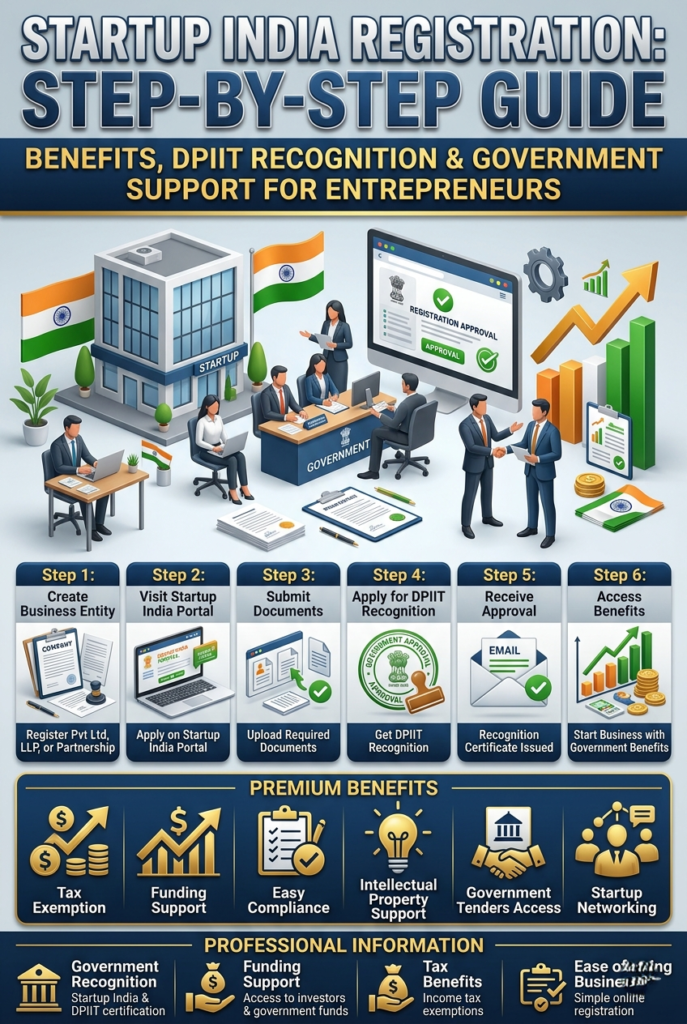
Key Benefits of Startup India Registration
Startups identified by the DPIIT have a number of benefits that are intended to facilitate early-stage development:
- Income Tax Holiday- Under Section 80-IAC, startups are entitled to three years of tax exemption.
- Angel Tax Exemption Investments made in startups do not incur tax on share premiums, and the process of raising funds is made easier.
- Self-Certification – Startups can self-certify compliance to nine labor laws and three environmental laws, which lessen the regulatory load.
- IP Support – Faster and cheaper registration of patents and trademarks helps protect new ideas.
- Funding Accessibility – SEBI-registered Alternative Investment Funds (AIFs) can be put into the Fund of Funds at SIDBI.
- Government Contracts – Relaxed the criteria to bid in government contract procurement.
- Easy Exit -The capacity to be wound up in 90 days of insolvency law provides flexibility in operations.
All of these advantages help to eliminate financial and operational friction and allow entrepreneurs to concentrate on growth and innovation.
Application Procedure of Startup India.
How to Apply for Startup India Registration
- Incorporate Your Business – Register as a Private Limited Company, LLP, or Partnership through the Ministry of Corporate Affairs (MCA) portal.
- Register an Account on Startup India – Login to Startup India portal and register an account with the help of PAN and incorporation certificate.
- Applications to DPIIT Recognition Application- Upload required documents:
- Certificate of Incorporation
- Brief description of innovation or business model
- One supporting document:
- Recommendation from a government-recognized incubator
- Registration of patent or trademark.
- Funding letter from a registered fund
Self-proclaimed information about innovation and scalability.
- Approval- The application is reviewed by an inter-ministerial board and approved startup is provided with a digital certificate that enables the benefits to be obtained immediately.
Read More: Business Plans / Project Profiles
Why Now Is the Right Time to Launch a Startup in India
The rising economy of India, rising number of consumers, and investment in infrastructure is providing an atmosphere that is conducive to new ventures. Structural benefits are provided by government policies that facilitate import substitution in electronics, speciality chemicals, processed foods, and defense components.
Lower costs, financial assistance, and export incentives such as RoDTEP can be utilized by the startups in industries that are under the PLI scheme, such as textiles, food processing, pharma, solar modules, and advanced chemistry cells.
Combined with the benefits of Start-up India, MSME programs, and simplified access to funding, starting a business is a matter of strategic advantage in the present day.
High-Potential Startup Opportunities in India
Entrepreneurs must target industries that have a high growth opportunity and are supported by the government:
- Specialty Chemicals- Pharma, agrochemicals, and textile are all highly demanded, which guarantees good margins.
- Processed Food & Agri-Value Addition – Capitalize on the Indian production of agriculture through the packaged and organic food as well as export-ready products.
- Prefabricated and Modular Construction – The programs of urbanization and affordable housing provide stable demand.
- Renewable Energy / EV Components – Battery, solar panels and EV motor assemblies are incentive and demand-driven in the market.
- Industrial Packaging – Corrugated box, drums and flexible packaging are in demand by E-commerce, FMCG, and pharma growth.
Read More: Project Reports & Profiles
Successful entrepreneurs are the people who have learned
India provides great examples of business leaders who made business empires out of nothing:
- Kiran Mazumdar-Shaw (Biocon): Began with small capital and capitalized on the raw material advantages of India.
- Acharya Balkrishna (Patanjali Ayurved): Specializes in consumer psychology in areas and Ayurvedic products to grow a diversified FMCG business.
- Baba Kalyani ( Bharat Forge): Transformed Indian traditional forging into an international technology-based engineering powerhouse via exports.
Key lesson: Find areas that India has cost or resource advantages, innovate and scale to domestic and international markets. Registration of Startup India gives the resources and credibility to do so.
Evaluating Feasibility with Professional Support
It is important to evaluate the viability and the scalability of your project before investing. Such services as Niir Project Consultancy Services (NPCS) offer Detailed Project Reports (DPRs), which include market research, production process, sourcing of raw materials, machine requirements, and financial projections.
Professional feasibility study minimizes risk, profits, and enhances chances of success in long-term.
Read More: Startup Selector
Important Government Resources on Entrepreneurs.
In order to exploit opportunities, entrepreneurs are expected to become familiar with:
- DPIIT: Startup India recognition and policy modification.
- Ministry of MSME: Udyam registration, credit guarantee and development schemes.
- Ministry of Commerce and Industry: Policy for promoting exports and foreign trade.
- Startup India Portal: Plan, sign up online, and find resource.
- SIDBI: a fund of funds, venture capital, and loans to small and medium-sized businesses.
Conclusion
The procedure to register for Startup India works as an official process but serves as a vital tool for business expansion. The combination of DPIIT recognition with government incentives and NPCS professional project evaluation enables entrepreneurs to achieve their business objectives through their startup ventures.
The startup ecosystem in India offers a dynamic business environment which maintains its growth while presenting numerous opportunities for business success. The combination of government support, market knowledge, and innovative solutions creates a successful formula which enables businesses to expand their operations towards both national and international markets.
Frequently Asked Questions (FAQs)
- Is Startup India registration mandatory?
The program is not compulsory for businesses to join but it provides businesses with tax advantages and intellectual property assistance. - Can existing businesses apply?
The organization can apply if its operations started less than ten years ago and its revenue remains under 100 crore Indian rupees while its products meet either innovation or scalability requirements. - Does DPIIT recognition guarantee funding?
The program enables organizations to access government funds but AIFs which are registered with SEBI reserve the authority to make funding decisions. - How long does registration take?
Online submission is instant; approvals usually take a few weeks depending on documentation. - Can manufacturing MSMEs register?
The program permits all manufacturing MSMEs to register for Startup India benefits which combine with MSME program advantages. - What documents are required?
The required documents include the certificate of incorporation and PAN and innovation description and supporting documents which include incubator letters and patents and funding letters and self-declaration.


