


Introduction: Startup lessons from Tata Group
The Tata Group is not merely a business giant, it is a world example of long-term, ethical and sustainable business actions. The group, which was founded by Jamsetji Tata, more than 150 years ago, has been able to survive the impact of colonial constraints, the licence raj, economic liberalisation, and market volatility around the globe, although it remains principled.
To first time founders, the story of Tata is not just inspirational but it provides actionable strategies. Although spread sheets, valuations and revenue projections are essential, people are important, and long term planning are the keys to creating a lasting business.
These are the seven eternal lessons at the Tata Group that every entrepreneur may use today.
1. Address a National Need, Not Ambition.
Jamsetji Tata established Tata Steel in order to solve a severe gap: India was nearly completely reliant on the imported steel. He was striving towards nation-building and not riches.
Lessons for founders:
- Find products with a true supply-demand mismatch rather than chasing the speculative trends.
- Consider other areas such as specialty chemicals, agro-inputs, and precision components, where India is yet to be self-reliant.
- Use government programmes such as PLI schemes and DPIIT schemes to mitigate financial risk.
Startups can create long-term relevant, stable and impactful businesses by commencing with a national need.
2. Build Infrastructure before Pursuing Revenue.
Tata was always long term. Jamshedpur was turned into a planned township, Bombay was electrified by Tata Power earlier than profit, and the takeover of Corus by Ratan Tata was a strategic move on the international front.
Takeaways for startups:
- It should focus on strong infrastructure, processes and compliance before concentrating on revenue.
- Omission of quality machinery, standard operating procedures (SOPs), or compliance with regulations adds to costs in the future.
- A Techno-Economic Feasibility Report (TEFR) such as those of Niir Project Consultancy Services (NPCS) will make sure that operations are ready and compliant.
Scalability and sustainable growth are preconditions of long-term infrastructure investment.
Read More: Business Plans / Project Profiles
3. Strategic Hedging of Diversification.
The Tata Group operates in the fields of IT and automobile, chemicals, FMCG, energy, and hospitality. All the diversification acts as a safeguard towards the declines of particular sectors.
For startups:
- Diversification does not imply the release of various products at once, but rather is a plan to expand in the future by adjacency.
Examples:
- A starch plant can subsequently be used to produce glucose syrup or sorbitol using maize as the starting material.
- Organic fertilizers or biomass briquettes can also be generated by a compressed biogas (CBG) plant.
The trick is the creation of flexible infrastructure that enables the expansion into related products to enhance the efficiency of capital and to mitigate the risk.
4. Ethics as a Competitive Advantage.
Ethics is not a mere decision of morality to the Tata Group; it is a competitive asset. Openness, adherence, and honesty bring the best talent, good funding, and governmental tenders.
Founders can be advised to:
- Make adherence to labor legislation, regulations, and tax one of the investments, rather than an expense.
- Short-term gains are better avoided by taking shortcuts, which can be disastrous in terms of reputation and regulatory risks.
The reputation of the trust is a competitive advantage that can be built.
Read More: Project Reports & Profiles
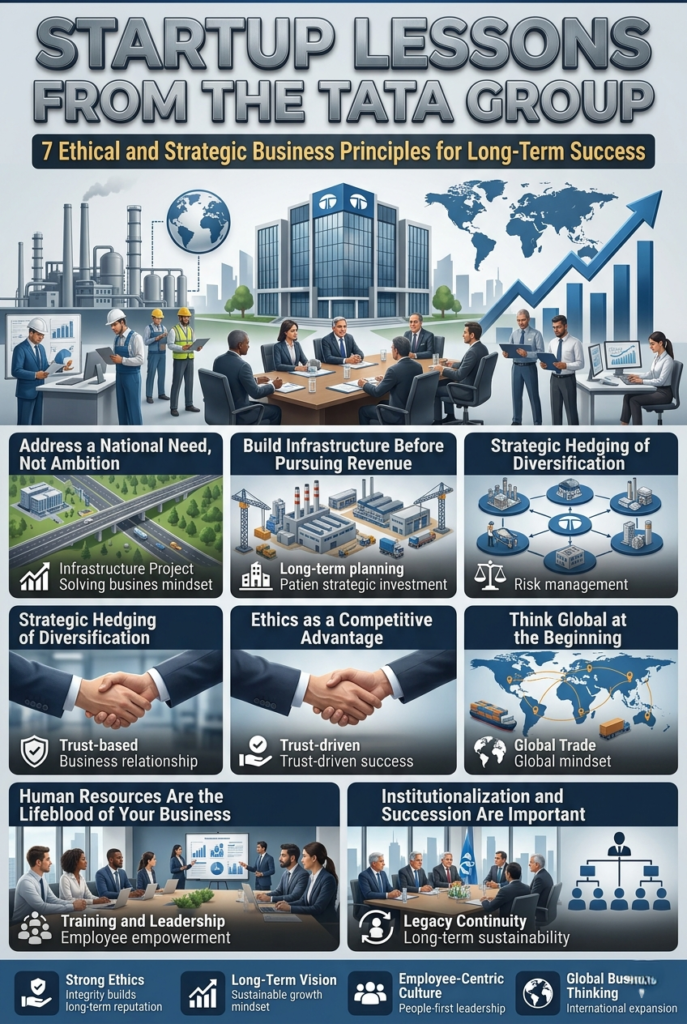
5. Think Global at the Beginning.
Jamsetji Tata did his research in international industry. Subsequently, takeovers such as Jaguar Land Rover and Corus reflected a global competition philosophy. TCS developed its model centering on international clients.
Implication on MSME and startups:
- Delayed export is one opportunity lost. The global customers present greater revenue, diversification of currencies and benchmarking of quality.
- Even small-scale exports are possible with the help of government assistance, including DGFT export incentives, duty drawback schemes, and trade promotion councils.
Going global early means you have a business that is scalable and able to compete in the future outside local markets.
6. Human Resources Are the Lifeblood of your Business.
The Tata Group has never been short of its employees, and it was among the first companies to introduce eight-hour working days, provident funds, and maternity benefits, where others followed suit.
Lessons for startups:
- The initial 10-20 employees determine operational success.
- Insure secure work settings, fair remunerations and esteem to encourage dedication and innovation.
- Use MSME skill development programs to efficiently train and retain talent.
Individuals are not a line item but they are the main pillars of sustainable business development.
Read More: Startup Selector
7. Institutionalization and Succession Are Important.
Most family businesses collapse during the second generation. The Tata Group was successful because the founders had established institutions rather than fiefdoms with governance systems that were long-term oriented.
For founders:
- Standard operational procedures (SOPs).
- Develop management systems that are not dependent on the founder.
- Transform feasibility reports into operations manuals to enhance continuity.
Scalability, investor confidence and long-term resilience are guaranteed by institutionalization.
The Reason Why These Lessons are Important Today
The policy environment in India is very favorable: PLI schemes, SATAT on biogas, PMFME on food processing, MSME credit guarantees, and export incentives through DGFT, give a good background to industrial projects.
Nevertheless, policy is not sufficient. Strategic thinking is the differentiator: making the right choice of product, investing in infrastructure, appreciating people, diversification planning, ethical operation, and global thinking.
Conclusion
The Tata Group demonstrates that businesses establish enduring success through their commitment to principle-based operational methods. First-time founders and MSMEs in India must learn that successful businesses require them to meet actual market demands while building essential infrastructure and expanding their business through planned strategic initiatives and maintaining their ethical standards and workforce value and their global business outlook while their operational activities progress through institutionalization.
The government incentives and strategic planning methods which we currently apply will enable our small startup to develop into a sustainable business that achieves success and gains respect in the industry.
FAQs
Q1: What do you believe is the most valuable lesson founders can learn about Tata?
Concentrate on actual market needs and not the individual taste. Find products according to the trends in import substitution and gaps in domestic supply.
Q2: What can MSMEs do to diversify in the Tata fashion?
Begin with a core product and strategize on neighboring products. Example: a plant of maize starch can subsequently create glucose syrup, sorbitol or modified starch.
Q3: Can first-time founders export?
Yes. Exports are feasible due to incentives created by the government, well established trade routes, and demand in other industries such as chemicals, food ingredients, and precision components in the world market.
Q4: What is the importance of a feasibility report?
It transforms strategic thinking into working figures capital requirements, operational costs and break even estimates and reduces risk and generates confidence.
Q5: What are the best opportunities sectors today?
Currently, high potential areas are specialty chemicals, compressed biogas, food processing (starch derivatives), pre-engineered steel structures, water-soluble fertilizers, and copper tubes used in HVAC.


